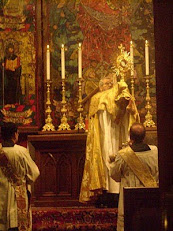
The first principle of the Ordinariate is then about Christian unity. St. Basil the Great, the Church’s greatest ecumenist, literally expended his life on the work of building bridges between orthodox brethren who shared a common faith, but who had become separated from one another in a Church badly fragmented by heresy and controversy. He taught that the work of Christian unity requires deliberate and ceaseless effort...St. Basil often talked with yearning about the archaia agape, the ancient love of the apostolic community, so rarely seen in the Church of his day. This love, he taught, is a visible sign that the Holy Spirit is indeed present and active, and it is absolutely essential for the health of the Church.

- Msgr. Jeffrey Steenson, Homily on the Occasion of his Formal Institution as Ordinary
Showing posts with label Evensong. Show all posts

Thursday, January 8, 2015

Choral Evensong to celebrate the 3rd Anniversary of the US Ordinariate

The congregation of St. Gregory the Great in Stoneham, Mass. will be celebrating the 3rd anniversary of the founding of the US Ordinariate on January 28th, with Boston Archbishop Sean Patrick Cardinal O'Malley as officiant.


Friday, June 6, 2014

The Daily Office; beginning with the Portal Magazine's essay on the Ordinariate Use liturgy

In the June 2014 issue of the Portal Magazine, Msgr. Andrew Burnham has a very comprehensive, yet concise, article on the Ordinariate Liturgy. He begins his essay with this story.

There is a story about Mgr Graham Leonard, formerly Anglican Bishop of London, being asked by Cardinal Hume what he valued in the worship of the Church of England and would miss as a Catholic. He replied that it would be the Prayer Book Offices of Matins and Evensong, and in particular the psalms in course, following the Coverdale Psalter, as set in the Book of Common Prayer.

There is no doubt that the daily services are the jewel in the crown and, when both Pope Paul VI and Pope Benedict XVI expressed their admiration for Anglican worship, it was the public celebration of the Offices that they had most clearly in mind. Small wonder then that the Ordinariate clergy in the United Kingdom particularly value the availability to them, as Catholics, of Morning and Evening Prayer in the Prayer Book tradition, as distilled in the Customary of Our Lady of Walsingham.

There is a wealth of material in the Customary, which I've been reading through again in recent weeks. And while Msgr. Burnham does not focus exclusively on the Daily Office in his essay (which you should go and read for all that it contains), I think that greater emphasis needs to be placed on the Daily Office as a truly daily experience of prayer in the life of Catholics, and particularly for those of the Anglican Use, for whom this is a particular heritage and tradition.

A recent post on the blog Gerry Lynch's Thoughts... asks "Why is Cathedral Evensong Growing and What Does It Mean?", and one of his answers is that he sees "weekday Evensong as ecumenical, interfaith and vital for a growing, healthy, Church." Evensong is ecumenical and interfaith, because anyone can participate, even those not yet baptized. While the Mass is undoubtedly important for evangelization, it also necessarily excludes some people from what, to many, will seem the central rite of the Eucharist, the Communion. But there is no part of Evensong (or Mattins) that I, as a confirmed, baptized Catholic, can do as a member of the congregation, that an unchurched seeker cannot do; whatever barriers there are to participation will be wholly interior, but that removes a modern complaint about erecting barriers; because in this service, we erect none.

And yet, as the author goes on to note: "Evensong is not necessarily undemanding. It gives tremendous space for daily study of Scripture, and disciplined prayer sustaining a life of Christian service."

For both reasons, evangelization and growth in Christian discipleship (and more), the Daily Office should be a key element of every parish, and particularly, every Ordinariate and Pastoral Provision's life.

Tuesday, December 10, 2013

Upcoming events for Advent at Mount Calvary Baltimore

1. Concert of Bach and Telemann Cantatas
Thursday, December 12, 7:30pm

Mount Calvary hosts a special concert: Students in Peabody Conservatory's "Bach and His Contemporaries" seminar taught by Dr. Andrew Talle will perform two cantata settings of "Gleichwie der Regen und Schnee vom Himmel fällt", by J.S. Bach and G.P. Telemann.

This concert's featured soloists:

Dr. Richard Giarusso, baritone (special guest)
Andrew Hann, tenor
Kerry Holahan, soprano

We also welcome special guest Patrick Merrill, harpsichord.

This concert is free and open to the public. 


2. Gaudete Sunday: Choral Evensong & Benediction
Sunday, December 15, 4:30pm

Please join Mount Calvary for a special Advent Choral Evensong and Benediction in the Anglican Use at 4:30pm this Sunday for one of Mount Calvary's best traditions. Music will feature Dyson, Hassler and Palestrina. "Rejoice in the Lord always; again I say, rejoice." Free and open to the public.


Friday, November 15, 2013

Celebrating the Feast of Christ the King

The Ordinariate church of Mount Calvary in Baltimore, Maryland invites everyone to join them for a special High Mass for the Solemnity of Christ the King at 10:00am on Sunday, Nov. 24. Featured music will include:


  • Mass Ordinary 'Collegium Regale' (Herbert Howells)
  • Hosanna to the Son of David (Orlando Gibbons)
  • Christus vincit (plainsong)
  • Dialogue sur les mixtures (Jean Langlais)


And for those a bit further north, the Congregation of St. Athanasius will celebrate the Solemnity with Choral Evensong & Benediction, with a reception to follow.

Monday, June 17, 2013

St. James celebrating first anniversary

The Rev. Nick Marziani with Jimmy Faulkner and Kathleen Sloan taken at a service
of Sacred Evensong Feb. 22, on the occasion of the Feast of the Chair of St. Peter,
the Ordinariate patronal feast day. Contributed photo.

Special to The Record
June 14, 2013

ST. AUGUSTINE, FLA---St. James Church, a Catholic community of the Personal Ordinariate of the Chair of St. Peter, will observe its first year anniversary June 22 as a Eucharistic community.

The church, which meets at the St. Augustine House of Prayer, 34 Ocean Ave., near the Mission Nombre de Dios, offers a weekly vigil Mass at 4:30 p.m. Saturdays.

June 22, Mass will be followed by a reception and no-cost dinner at the St. Augustine Shores Golf Clubhouse.

St. James is a constituent mission church of the Personal Ordinariate in the United States, a Roman Catholic trans-territorial jurisdiction headquartered in Houston that encompasses the entire United States and parts of Canada.

St. James exists to preserve the Anglican Patrimony within the context of the Catholic Church.

Established in canon law by Pope Benedict XVI in November 2009 by the Apostolic Constitution Anglicanorum Coetibus, and formally erected in the United States Jan. 2, 2012, churches of the Ordinariate offer a liturgical, spiritual and pastoral tradition deeply informed by the long history of the Church of England and its daughter churches throughout the English-speaking world. Two other global Ordinariates exist — one in England and the other in Australia, explains the pastor, the Rev. Nick Marziani.

While fully faithful to Roman Catholic sacramental and theological principles, a service of Holy Eucharist at St. James would be very familiar to anyone from an Episcopal or Anglican background.

In observing the first anniversary St. James invites members of the larger community to join with them in Divine Worship and Fellowship at this year’s event. There is no cost for the celebration dinner, but reservations are required. Inquiries are invited, and those wishing to attend should RVSP to Father Marziani at 904-460-0535 (home office) or 904-806-3037 (cell).

from St. Augustine.com, web home of the St. Augustine Record newspaper.

Hat tip to Mary Ann Mueller.

Thursday, November 15, 2012

Choral Evensong from AUS Conference

The first event of the Anglican Use Society's annual conference, just concluded, was a Choral Evensong & Benediction of the Blessed Sacrament. This was followed by a delicious dinner in the pavilion pitched outside the church in the parking lot, and the first talk, already posted here, by Fr. John Jay Hughes. The music provided for the Evensong is provided by the organist and musicians of the parish of St. Therese.

Tuesday, November 6, 2012

A More Thorough Review of The Customary

I received my copy of The Customary of Our Lady of Walsingham, purchased via the UK branch of Amazon.com, on All Souls' Day last week. I had intended to write a full review, but have discovered that a very full review has already been written.

On the blog Psallite Sapienter out of Australia, Joshua has written a series of posts that examine the new Customary.

In the post "The Number and Hardness of Rules Called Pie", Joshua goes through all the steps to set up his book for Evening Prayer on Sunday. Before beginning he reviews his set up:
Now, almost time to begin, but first to double-check: holy card for the Sentence, then red ribbon (moving it along as I go), then Psalms (as marked), then First Lesson (from Bible, as marked), then red ribbon for Mag., then Second Lesson (from Bible, as marked), then red ribbon for Nunc and so forth, then Collect of the Day (as marked), then back to the Second and Third Collects (red ribbon), then blue ribbon for post-Biblical reading (in place of sermon), then red ribbon again for Further Prayers down to "The grace"; and finally another holy card marks the Salve Regina.

Two items I noticed immediately when reviewing my copy of The Customary was that there are too few ribbons (only three when at least 6 are needed) and that the layout requires considerable back and forth, likely too many for most laypeople to warm to the use of this book (which I say having used many different office books over the years, including a 7-volume translation of the Liturgy of the Hours in Spanish).

In two posts "Customary Questions I" and "Customary Questions - II" Joshua asks several good questions. In his first post he asks:

1. Why on Sundays the Psalms are proper, rather than taken from the appropriate day of the month (the period over which their recitation is spread), since such an arrangement seems to unduly restrict the number and variety of Psalms heard by a Sunday congregation, in contradistinction to Anglican practice?
2. Why one of the two Scriptural Readings provided for both Mattins and Evensong is so short, when surely having two fairly long Lessons is a very hallmark of the Daily Office in the Anglican Patrimony?
3. Why the Prayer for All Conditions of Men, and other optional Prayers and Thanksgivings, is not included, when the reading at choice of various intercessions "After the Third Collect" is another venerable Anglican tradition?
4. Why the prefatory use of a Penitential Rite is allowed before Evensong only, rather than also before Mattins, and, similarly, why the opening versicles at both are not exactly the same, as has been traditional Anglican practice?

In the second "Questions" post, he notes:

Rather annoyingly, the new Customary of Our Lady of Walsingham restricts the use of the Te Deum to festal days only, so that on most weekdays one must plod through either the Benedicite or its little brother the Benedictus es (both from Daniel chapter 3.)...

I myself wonder if straining so to conform the Anglican Use to the Roman Rite is necessary or desirable; while the length of lessons of Scripture has declined over the past century and more (until 1871, a full chapter was almost invariably the norm, but first in the new lectionary of that year, and then in successive revisions, the length was generally lessened more and more), it was always the Anglican boast that they did read over a great deal of the Bible each year; it would be unhappy if that laudable aim were not still maintained. In particular, it seems that the Anglican pattern is to have two fairly substantial readings, one from each Testament, at both Mattins and Evensong, and to read through the Scriptures in course, maintaining the ancient principle of lectio continua – I wonder if this is adhered to so strictly in the new Customary.

Finally (although not the last post in chronological order), Joshua has compiled a helpful Index of the non-Biblical writings in his post "Customary Readings".

In addition to Joshua's questions on Psallite Sapienter, I also had two questions about the Proper of Saints in the book. There is a partial Proper of Saints for saints in the General Roman Calendar, and a second Proper of Saints for the Calendar of the Ordinariate. Why not merge these two sections? With the two sections, one must check both in setting up the book for the day's prayers. Second, why include some, but not all of the saints from the General Roman Calendar? For the month of January, for example, The Customary's General Sanctorale includes collects and other propers for 8 saints, with an additional 4 in the Proper Sanctorale for the Ordinariate. Among the feasts left out are those of Holy Name of Jesus (January 3), St. Elizabeth Ann Seton (January 5), and St. John Bosco (January 31). The first two absences are particularly surprising, as devotion to the Holy Name has a strong English history, and St. Elizabeth Ann Seton is certainly a significant figure for the Ordinariates as the first Anglican convert since the age of the British Martyrs under the Tudors and Stuarts to be canonized.

Following up on what Joshua writes about the Invitatory for Morning Prayer, I noticed that those psalms are not formatted in strophes, and it is unclear whether they should be read as responsorial psalms (as in the BDW and LotH) or with antiphons before and after only (as in the 1928 Proposed BCP in England). If the former, formatting in strophes would make this much easier for readers to use. It is also too bad that while adopting elements found in the BDW such as the Phos hilaron (admittedly also found in the CofE's Common Worship and Celebrating Common Prayer) at Evening Prayer that the alternative Venite that substitutes verses 9 & 13 of Psalm 96 for verses 8-11 of Psalm 95 (the final verses of which are optional in The Customary).

This absence is an example of what I see as a missed opportunity with the current version of The Customary. There are glances toward the US Ordinariate, noting differences in the rank of certain feasts in the calendar, for example, and drawing on some of the material in the Daily Offices of the BDW such as noting acceptable changes in the Preces in areas with "a Republican Administration"; but other elements that would have made this book more suitable for use in the US as well as England (such as drawing on Canon Douglas' chant work in the Saint Dunstan Plainsong Psalter for the music and the prayers for mission at the end of the office in the BDW) are missing, regrettably.

There are additional instances that made me think that The Customary was rushed out the door a bit too soon. On page 47 and 112 there is a prayer for the Pope, and while I certainly wish the Holy Father many more years, the prayer shouldn't have had the reigning Pope's name printed in the same typeface as the rest of the prayer. Normally a reader would expect to see the placeholder "N." as in the Common collects, such as the one for a Pope on page 662, or at least that the name would be in italics as is the Queen's on page 113 in the prayer for the Monarch. At the end of the Ordinary for Evening Prayer on page 115 we find the usual prayer for the dead, but it reads, "May all the faithful, through the mercy of God, rest in peace." Should this not read "May all the faithful departed, through the mercy of God..."?

There are certainly things to love in The Customary, but given that it requires so many supplemental books to be used (at the least, a Bible, an Ordo, a copy of the Liturgy of the Hours) as a regular daily prayer book, I fear it may be only a resource to supplement the Daily Offices of The Book of Divine Worship or the Liturgy of the Hours. But it is an expensive supplement; hopefully, there will be a second edition, produced in consultation with the US, Canadian and Australian ordinariate communities, that will help complete it as a fully usable resource for the Daily Office for both clergy and laity.


Thursday, November 1, 2012

Music for the Anglican Use Conference Nov 8 & 9

Fr. Ernie Davis has forwarded the music programs for Evensong on Thursday, November 8th and the Solemn Mass on Friday, November 9th during the Annual Conference of the Anglican Use Society.


Another Review of the Customary of Our Lady of Walsingham

This review is from the just published November issue of The Portal magazine:
As an Anglican I, along with many others, rarely used Anglican devotional material. The Church I attended was a “Roman Rite” Parish. We spurned Anglican material for fear of liberal or Calvinist contamination. However, now we are members of the Ordinariate the position is totally different.

As Anglicans we obeyed the rules from choice, because the rules we obeyed were Catholic rules. We chose to obey them. Now we are in full communion with the Catholic Church, we obey the rules because good Catholics obey the teaching of the Church. Rebels no longer, we are Catholics, and we obey the rules of the Catholic Church.

It was with great interest then, that I opened my copy of the new Customary of Our Lady of Walsingham, with the sub-title Daily Prayer for the Ordinariate. It arrived last month. It is the Prayer Book of the Ordinariate.

Published under the Imprimatur of the Ordinary, Mgr Keith Newton, the book contains the Calendar, the Divine Office with traditional Office hymns, Litany, together with material for times and seasons including saints and holy days, with an Introduction by Mgr Andrew Burnham and Dr Aidan Nichols OP. The language is traditional (thee and thou) the feel is in accordance with our Anglican patrimony and the psalms are in the beloved Coverdale translation. But the gem of the book is the series of hagiographical readings for the saints and holy days.

There will be those who prefer the Roman Divine Office, but as members of the Ordinariate, we have a loyalty to uphold. This is our book. It is true that most of us would never have thought of using it when we were Anglicans. However, now we are Catholics and the Holy Father has made this wonderful offer to us. The offer is to join the Ordinariate - united yet not absorbed. If we spurn the Holy Father’s generosity and, in effect, become Diocesan Catholics, we shall have failed Benedict XVI and his prophetic vision.

The Customary bridges that most difficult of gulfs between the Anglican and the Catholic. It unites these two traditions, yet makes important distinctions. The Divine Office is the Prayer Book one of Morning and Evening Prayer shape, augmented by Prayer through the Day and a beautifully traditional Compline. The Litany will be familiar to users of the 1662 Prayer Book, and the Calendar is specific to the Ordinariate, with many particularly British Saints.

In the future there will be a Eucharistic Rite for the Ordinariate, also in traditional language. For the time being we have this book. It is good, although there are one or two glaring mistakes. Nevertheless, the compilers are to be congratulated on its production. The mistakes may be corrected if it is re-printed or if there is a second edition. I have used it every day since its publication and see no reason why this should not continue. It fulfils the Holy Father’s wish - truly Catholic and also distinctively Anglican. After all this project of the Ordinariate is an Ecumenical one. We must never forget that.

Finally you may purchase the Customary on-line through Amazon for £39.93 - click on BOOKS on The Portal website - www.portalmag.co.uk/books.html.

Saturday, October 20, 2012

O Gracious Light

One of the new elements from the 1979 US Book of Common Prayer that found its way into the Book of Divine Worship is the Phos Hilaron, which is an optional hymn for the beginning of Evening Prayer.

The version given in the BDW is below.

O Gracious Light   Phos hilaron
O gracious Light,
pure brightness of the everliving Father in heaven,
O Jesus Christ, holy and blessed!

Now as we come to the setting of the sun,
and our eyes behold the vesper light,
we sing thy praises, O God: Father, Son, and Holy Spirit.

Thou art worthy at all times to be praised by happy voices,
O Son of God, O Giver of life,
and to be glorified through all the worlds.

Unfortunately, of course, there is no music in the BDW, nor a reference to where the music for this translation of the hymn can be found. In chanting the office, I usually fell back on using the version found in the Liturgy of the Hours, sung to the tune "Jesu, dulcis memoria" (LM). But a few years ago I stumbled upon the web site of the Metropolitan Cantor's Institute of the Byzantine Catholic Eparchy of Pittsburgh (and doesn't it say something that there is a Cantor's Institute in an Eastern eparchy, i.e., diocese; you'd be hardpressed to find the equivalent in a Latin diocese). And there I found the archive of sheet music. The version of the Phos Hilaron below is from that archive.

This version pairs well with the chants from St. Dunstan's Plainsong Psalter for chanted Evensong, I find. Here's hoping that the Ordinariate will also find its way to establish some equivalent to a Cantors (a Schola) Institute, for the preservation, teaching and handing on of the Anglican musical patrimony: its hymnody, the chant work of learned clergy such as Canon Douglas, and Anglican Chant.

Tuesday, October 16, 2012

Liturgy as provider of an ordered and bordered encounter with Scripture


From the blog Haligweorc comes an interesting post on the Daily Office:
...When people think of Anglo-Catholics or Anglo-Catholicism or even Catholic Anglicans, they tend to think of vestments and smoke and sacraments, clusters of candles, and racks of rosaries; the daily office – not so much. And yet, the daily office is a central liturgical discipline that grounds so much of what we do. The Mass and the Office are not alternatives, they are complements. To cleave to the Catholic faith East and West is to give the daily office the honor and the attention – and the attentiveness – that it is due.

The two public rites of the church – the holy Eucharist and the daily office – have the same primary purpose: the worship and glorification of God. And that always has to be kept central. But the secondary purposes are different. The Eucharist is mystigogical and leads us into the heart of the mystery of Christ. The office is catechetical and instructs and forms us in the foundations of the faith. Now, you might be wondering… The dominant theme of our time together is the Anglo-Catholic social tradition. So why am I taking up time talking about the office? (Or, as I’ve heard some Episcopal clergy say, why are you spending your time talking about prayer when you should be talking about justice issues!) It’s because the Anglo-Catholic social conscience must be formed, it must be crafted, and the distinctive characteristic that differentiates a secular drive for a just society from one formed in the Catholic Anglican tradition is the process and method of its formation. The greatest tool that we have for molding a Christian social conscience is Scripture itself, and more particularly, the attentive practice of the daily office.

The wellspring of the Western liturgical tradition and particularly the monastic practices that have nourished it is the concept that the liturgy provides an ordered and bordered encounter with Scripture. Again, the liturgy provides an ordered and bordered encounter with Scripture.This is true of the Eucharist, it’s even more true of the office. It was true of the Sarum offices that the reformers received, and the Anglican offices received an additional infusion from Cranmer’s own Protestant love of the Scriptures.

Alright, so what do I mean by ordered and bordered? ...

Read the whole presentation. It is a great essay on the importance of the Daily Office.

Sunday, September 16, 2012

St. Luke's Bladensburg and the Anglican Use in the nation's capital

Father Scott Hurd wrote on Facebook last Sunday (September 9th):

Great meeting last night at which the future of Saint Luke's (in Bladensburg, for now) was unveiled. It was great to be with my friends and colleagues Fr. Mark Lewis and Fr. Rick Kramer, the communications directors for both the North American and UK ordinariates; Susan Gibbs and Fr. James Bradley.


The shape of that future was not mentioned in Fr. Hurd's post, and the web sites of the Ordinariate and St. Luke's are not updated yet with info. However, I have heard from a friend that the future that is contemplated is that there will be a unified parish at St. Luke's in Bladensburg for all Anglican Use Catholics in the area. While St. Luke's will sponsor regular Anglican Use masses at Our Lady of Hope Parish in Potomac Falls, VA, there is no provision for services to continue at the Benedictine Abbey of St. Anselm's, which has been hosting the Anglican Use Society of St. Thomas of Canterbury for nearly two years now.

The current plan includes moving St. Luke's from its current site in two years after the lease period is up. A search for a new site has yet to be found, possibly in the northeast quadrant of DC. At the same time, the Archdiocese apparently would like St. Luke's to consider moving to a place where Catholics are underserved by parishes now, which, for all practical purposes, could amount to the same thing. There is also talk of a capital campaign to purchase and build the new place, wherever it is to be located. However, that plan has not yet been put into place.

My correspondent assures me that some of the members of St. Luke's, of the St. Thomas Society and the St. Gregory Society (the branch in Northern Virginia) were consulted ahead of this announcement, but the correspondent was uncertain as to whether they had any real input into the actual formation of the plan. It will be the case, as announced earlier, that there will be regular Masses in Northern Virginia at Our Lady of Hope church in Potomac Falls.

Two concerns are raised by the announcements at this meeting.

First, one of the great things about the group that had been meeting at St. Anselm's was that they were regularly meeting for Evensong. It cannot be stressed enough that Evensong is one of the true jewels of the Anglican Patrimony. It should be a goal of every parish to offer it regularly. It is a service that is at once rooted in the earliest liturgies of the Church, that shows forth the beauty of holiness in liturgical worship and yet is a fully evangelical service: the perfect vehicle, as it were, to reach out to other Christians and the unchurched. Of course, as we have all been taught, the Mass is the summit of Christian prayer; but St. Paul didn't enter a town, celebrate the Divine Liturgy and invite folks in: he went to the synagogue for its regular servcie of psalms and lessons and preached the Gospel there, where anyone, Jew or Gentile, might hear (as the daily lesson from Acts in the Daily Office earlier this week reminded us).

John Wesley, in his The Sunday Service of the Methodists in North America declared:
There is no LITURGY in the World, either in ancient or modern language, which breathes more of a solid, scriptural, rational Piety, than the COMMON PRAYER of the CHURCH of ENGLAND.
As quoted on page 5 in American Methodist Worship by Karen B. Westerfield Tucker.

This endorsement of the value of the Prayer Book liturgy, and especially the daily offices, are echoed by scholars and liturgists down to our day. Fr. Louis Bouyer, of the Oratory wrote in his great book Liturgical Piety:

We must admit frankly that the Offices of Morning Prayer and of Evensong, as they are performed even today in St. Paul's, Westminster Abbey, York Minster, or Canterbury Cathedral, are not only one of the most impressive, but also one of the purest forms of Christian common prayer to be found anywhere in the world.

and more recently, in an article by Ed Franklin in The Walsingham Way, (published by the principal church of the US Ordinariate, Our Lady of Walsingham in Houston), Eamon Duffy is quoted as writing:
Anglican Choral Evensong is to my mind the greatest liturgical achievement of the Reformation, a perfect blend of noble prayer in memorable language, interspersed with the reading of two extended passages of scripture, all set to glorious music.

Secondly, one of the issues that many of the Anglican Use parishes face, whether Ordinariate or Pastoral Provision, and which they share with many parishes of Eastern Catholic Churches, is the great distance that parishioners must travel in order to attend worship at the parish church. In Boston, we are well acquainted with this: I travel almost 45 minutes from the south to the church, while my fellow schola member Allen travels almost 45 minuters from the north. It means that, except for Sunday and occasional Holy Days, there is no contact with the church. Many of the parishioners cannot reasonably come even every week because of the distance. But what if there were a way to have regular worship closer to home? It would certainly be feasible to have one or two additional sites (preferably a church or oratory, but even a home or other setting) for midweek worship and fellowship.

My DC correspondent wrote that a suggestion was made during the meeting by one of the clergymen that there might be faith formation offered during the week for people in DC, i.e., the people from the St. Thomas of Canterbury Society, since St. Luke's will be offering similar catechesis on Wednesdays in Bladensburg. In theory, there could be an informal evening prayer or compline service during these sessions, but the prayer component was not discussed at that time. I hope it will be.

In the D.C. area up until this time, there was an opportunity for worship close to home at St. Anselm's, where I was fortunate enough to visit back in January of this year. And as that community grew, it recognized this need for worship opportunity close to home, and started the associated Society of St. Gregory the Great for Northern Virginia residents. It would be a shame if this attempt to meet the needs of parishioners was discontinuted, particularly for a parish as richly blessed with clergy as St. Luke's is, which counts among its clergy Fr. Lewis, Fr. Kramer, and Fr. Sly.

CUA is blessed with a number of chapels (the one in Caldwell Hall is particularly beautiful) and is surrounded by religious houses like St. Anselm's (including the wonderful Dominican Study House. located right across Michigan Ave from the center of CUA's campus). Why not regular services on campus and introduce the Ordinariate and the Anglican Use liturgy to a cadre of students who would then bring the memory and hopefully the practice of those treasures of Anglican patrimony out to the world as they graduate?

Friday, June 1, 2012

Mgr Andrew Burnham: The Customary of Our Lady of Walsingham

Friday, June 01, 2012


Mgr Andrew Burnham, Assistant to the Ordinary, writes in this month's Portal:
The Customary of Our Lady of Walsingham is to be published very soon now by Canterbury Press. In a month or two we shall have access to this very handsome publication. It will contain the Ordinariate’s own form of Morning and Evening Prayer, drawn from the Book of Common Prayer, together with the Litany, minor offices for use during the day, and a traditional order for Compline.
The Coverdale Psalter will be included, as will lectionary tables which closely follow the not as yet well-known, but superb, two-year sequence of Scripture readings devised for the daily Office of the Roman Breviary. There will also be the Ordinariate Calendar and, most notably, a rich anthology of post-biblical readings drawn from the riches of the British spiritual tradition. This anthology complements the Roman Divine Office as well as the Ordinariate Office, for it will be possible to use many of the post-biblical readings for the Office of Readings.

Evensong and Benediction
Some will find themselves using the different Office books for different purposes – one for individual prayer and devotion, the other for public worship. Those who want to use the Roman Office books in the morning and the Customary in the evening – or the other way round – will be able to do so without too much difficulty. The particular value of the Customary is that it makes available one of the acknowledged treasures of the Anglican tradition – the public celebration of the Office, and in particular of Evensong. The reform of the Roman Office following the Second Vatican Council sought the development of the public celebration of the Office and, truth to tell, that is a reform yet to be realised. In these early days of the Ordinariates, there have been already many celebrations of Evensong and Benediction and it is intriguing to know not only that this has been in accordance with the Holy Father, Pope Benedict’s wish, but also that it has been his great pleasure, that this should have been so.

Traditional language
It is hoped that the Customary will be ecumenically helpful too. There has been a deliberate decision by the Holy See that the Ordinariate’s distinct Use should be predominantly in traditional language. This is not to criticise in any way the modern language translations and compositions of recent Anglican revisions. Rather it is a recognition of the value of the sacral language of the Prayer Book. Members of the Ordinariates in North America and Australia are great devotees of Prayer Book English. Moreover, the 400th anniversary of the 1611 Authorised Version of the Bible (AV) – and the immense popularity still of cathedral Evensong – shows that the British public too are aware of the beauty and importance of a traditional sacred dialect. It is that dialect which the Customary and the Revised Standard Version (RSV) of the Bible preserve and make available.

‘Common Bible’
Why the RSV and not the King James Bible? The answer lies in the subtle development of the English Bible tradition. For accuracy’s sake, twentieth century students began to rely on the Revised Version of 1881-1894. Meanwhile the Revised Standard Version of 1946-1957 was becoming established and, in 1966, was accepted by Catholics and Protestants as a ‘Common Bible’. It was the first truly ecumenical Bible and brought together the two traditions – the Catholic Douay-Rheims Bible and the Protestant Authorised Version. Thus, whenever the Customary quotes extensively from the Bible, it is the RSV that it uses. The Catholic Church in the 1970s in Britain opted (mistakenly as it now seems) for the ‘dynamic equivalent’ Jerusalem Bible translation. That version greatly helped public understanding of the Scriptures, but, like the Mass translation of the same period, was based on a theory of translation that is of great value in paraphrasing and communicating the meaning of, for example, modern literature written in other languages, but no longer thought appropriate for representing sacred texts written in ancient languages.
Our prayer is that the Customary will be a treasury not only for the Ordinariates but for the whole English-speaking world.
__
The Customary of Our Lady of Walsingham is available to 'pre-order' from Amazon.co.uk here.

Ordo for the Personal Ordinariate of Our Lady of Walsingham, part III

The latest edition of the Ordo for the Personal Ordinariate of Our Lady of Walsingham (part III, Time after Trinity) has been published online. You may download the PDF at this link.

Friday, May 11, 2012

How the Ordinariate is healing England’s cultural wounds

Four hundred years after the bitter conflicts of religion, the Church is posthumously reCatholicising Archbishop Cranmer and reclaiming him for our tradition
By FR ALEXANDER LUCIE-SMITH on Friday, 11 May 2012


Yesterday I was in a cathedral city in the south of England, and having time to spare, and because it was raining, I decided to visit the cathedral and stay for Evensong. I am, like so many in this country, familiar with Evensong; I find it both beautiful and alien at the same time. I both love it and hate it. I only go to Evensong to listen to it, never to take part.
...

Thus the experience of Cranmerian English leaves me feeling conflicted. I love it and I hate it, and I feel I ought to love it, as it is so beautiful, and because it has inspired so many of our great poets, not least among whom is T.S. Eliot.

That’s why I am profoundly pleased by something that happened earlier that day in London. I attended a meeting about the Ordinariate of Our Lady of Walsingham, at which Mgr Burnham, the assistant to the Ordinary, told the assembled guests that a Customary is in preparation.  This is essentially what we might call an office book, with various readings drawn from the English spiritual tradition, such as Newman’s writings from his Anglican days; but it also draws on those fine psalms and prayers used by Cranmer, with some doctrinal alterations. Mgr Burnham also spoke of the growing popularity of Evensong and Benediction amidst Ordinariate congregations.

What this Customary will do, it seems to me, is posthumously reCatholicise Cranmer and reclaim him for our tradition; it will make the Cranmerian liturgy, which I find a cause of division and conflict, into something that will bring about unity. It will mean that from now on, I need not find Evensong alien. Perhaps Dr Cranmer himself would approve. I hope so! It certainly promotes the healing of a cultural and religious wound.
The Ordinariate, which I greatly welcome, is already enriching us in many ways. Long may it continue to grow and flourish.

Read the whole article in the Catholic Herald.