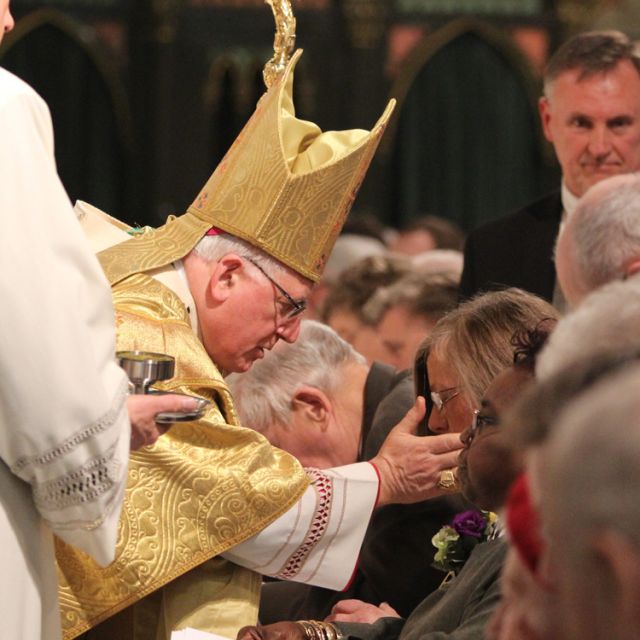
The first principle of the Ordinariate is then about Christian unity. St. Basil the Great, the Church’s greatest ecumenist, literally expended his life on the work of building bridges between orthodox brethren who shared a common faith, but who had become separated from one another in a Church badly fragmented by heresy and controversy. He taught that the work of Christian unity requires deliberate and ceaseless effort...St. Basil often talked with yearning about the archaia agape, the ancient love of the apostolic community, so rarely seen in the Church of his day. This love, he taught, is a visible sign that the Holy Spirit is indeed present and active, and it is absolutely essential for the health of the Church.

- Msgr. Jeffrey Steenson, Homily on the Occasion of his Formal Institution as Ordinary
Showing posts with label Book of Divine Worship. Show all posts

Tuesday, October 29, 2013

Outline of the new Ordinariate Eucharistic rite posted

On the web site of the Church of St. Michael the Archangel, Philadelphia, Fr. Ousley has posted a presentation that compares the new Ordinariate rite with the rite in the Book of Divine Worship. The presentation helpfully notes, not only the changes, but also the reason for the changes. In most cases, the changes represent a restoration of more traditional Anglican practices and formularies. The first page is shown below, but you can download the entire PDF of the presentation at the church's web site.

With the new Eucharistic rite's inauguration, the material in the Book of Divine Worship which remains normative has been further reduced. The funeral and marriage rites had been previously supplanted, as had Rite II of the Eucharist. All that remains as normative are the Daily Office, the Litany and Baptism. Doubtless, the Baptismal rite will be the next to be revised and published. I doubt we will see much change in the Litany, and so it remains to be seen what changes will come to the Daily Office. Currently the personal ordinariate of Our Lady of Walsingham uses the texts from the BDW, but uses the psalter from the Customary of Our Lady of Walsingham, owing to differences in the US and English versions of the Coverdale Psalter. There are other differences between the US and English Books of Common Prayer, which are reflected in differences found in the BDW and the Customary, and those differences will have to be addressed by the Anglicanae Traditiones commission.

Monday, May 6, 2013

Rogationtide

The calendar for the Personal Ordinariate restores to a modern Catholic Calendar the Rogation Days which were left on the cutting room floor following the calendar change in 1969. The Minor Rogation Days are the three days following Rogation Sunday (or, the 3 days preceding Ascension Thursday, when it's actually celebrated on Thursday as it is, fortunately, here in the Archdiocese of Boston).

There are 3 prayers for Rogationtide in the Book of Divine Worship:
I. For fruitful seasons
Almighty God, Lord of heaven and earth: We humbly pray
that thy gracious providence may give and preserve to our
use the harvests of the land and of the seas, and may prosper
all who labor to gather them, that we, who constantly receive
good things from thy hand, may always give thee thanks;
through Jesus Christ our Lord, who liveth and reigneth with
thee and the Holy Spirit, one God, for ever and ever. Amen.

II. For commerce and industry
Almighty God, whose Son Jesus Christ in his earthly life
shared our toil and hallowed our labor: Be present with thy
people where they work; make those who carry on the
industries and commerce of this land responsive to thy will;
and give to us all a pride in what we do, and a just return for
our labor; through Jesus Christ our Lord, who liveth and
reigneth with thee, in the unity of the Holy Spirit, one God,
now and for ever. Amen.

III. For stewardship of creation
O merciful Creator, whose hand is open wide to satisfy the
needs of every living creature: Make us, we beseech thee,
ever thankful for thy loving providence; and grant that we,
remembering the account that we must one day give, may be
faithful stewards of thy bounty; through Jesus Christ our
Lord, who with thee and the Holy Spirit liveth and reigneth,
one God, for ever and ever. Amen.

More information about the Rogation days is from the web site of Holy Trinity German Church here in Boston.

The Rogation Days Are...
Universally Christian,

  • The use of litanies goes back to the Old Testament, when the cantor would recite something and the congregation would reply with a set line, such as "His mercy endureth forever" (Ps. 135) or "Praise and exalt Him above all forever" (Dan. 3.57-87). Litanies are the most sensible form of song for pedestrians, as they enable both cantor and congregation to catch their breath in between verses.
  • The Jews also prayed for blessings on their crops and homes at certain key points of the year. In fact, two of the three great Hebrew feasts of the year -- the Feast of Weeks (Pentecost) and the Feast of Tabernacles -- were related to the harvest.
  • Christianity retained the spirit of both of these practices, and rightfully so, as everything that happened in the Old Testament happened so that it might instruct us on a deeper figurative level. Litanies such as the Kyrie eleison, for example, were treasured by both Eastern and Western Christians, as were blessings over the fruits of the earth. 
Uniquely Roman,
  • While the Rogation Days tie into a universally Christian tradition, they are nevertheless quintessentially Roman. The Major litanies on April 25, for example, are a Roman Catholic "baptism" of the Robigalia, a pagan procession to gain favor from the Robigo, the Roman god of grain. Since the Church had no objection to praying for the harvest, it threw out Robigo while keeping the procession.
  • Interestingly enough, the Lesser litanies are not, strictly speaking, Roman at all. They were begun in 470 by Bishop Mamertus of Vienne, whose diocese (along with the rest of France) practiced not the Roman rite, but the Gallican. Mamertus instituted these petitions in response to a terrifying series of natural calamities (storm, floods, earthquakes, etc.). The practice spread through France and Germany, and was eventually incorporated into the Roman rite. Despite this fact, however, they are still a good example of a uniquely Roman phenomenon, which is the engrafting of Gallican or Frankish practices onto the Roman rite. Not only were the other historic apostolic rites far more self-sufficient, but there is no other instance in Christendom of an area under a patriarch’s authority practicing a rite different than his own. 
Usefully Natural,
  • Rogationtide not only crystallizes the prayers of those whose livelihood depends on the harvest, but it reminds all of us of our dependence on the fruits of the earth. The Rogation Days are in fact the only days in the church calendar which are explicitly agricultural.
  • Rogationtide also makes us aware of our reliance on nature’s clemency. Natural disasters such as those experienced in fifth-century Gaul ever threaten to disrupt civilization. The Lesser Rogation Days are the only days in the church calendar which explicitly remind us of this fact.
  • Thus, whereas the Ember Days commemorate nature from the perspective of its seasons, Rogationtide commemorates it vis-a-vis its relation to man and the city, both as a source of bounty and as a source of potential harm.
  • Put differently, there is a communal dimension to Rogationtide’s portrayal of nature. This can be adapted to modern parish life in ingenious ways. The Catholics of Cold Springs, Minnesota, for example, erected "Grasshopper Chapel" in thanksgiving for the end to an 1877 grasshopper plague that was miraculously stopped by their prayers. To commemorate their deliverance, parish Rogation Days thereafter were marked by processions to this chapel. 
Communally Reconciling,
  • The Rogation Days (especially the Lesser) were also used as occasions of reconciliation among parishioners who had grown angry at each other. This custom, popular in the Middle Ages, also stems from the communal dimension of Rogationtide and could apparently be quite successful.  
And Personally Prayerful
  • The Litanies used for both the Greater and Lesser Rogation Days are exquisite. God and the saints are invoked in a perfect theological hierarchy, followed by a touching plea for deliverance from various evils. The psalms that are used -- the seven penitential psalms of David -- also beatify the ceremony immensely. The litanies are therefore not only an excellent mode of prayer, but an objection of great reflection.
  • Finally, the Lesser Litanies are a good preparation for Ascension Thursday. Psychologically, it is difficult to keep up the jubilance of Pashaltide for forty days. The penitential character of the Lesser Litanies allows for an emotional denoument so that we may rejoice all the more for the "novena" from Ascension Thursday to Whitsunday.

Sunday, March 31, 2013

Pascha Nostrum

One of the jewels of the Anglican Use that is preserved in the Book of Divine Worship is the Pascha Nostrum, or Easter Anthem, appointed for use in place of the Venite throughout the Octave of Easter, and permitted as the invitatory throughout the Easter season. It is one of the premier examples of the way in which the Prayer Book tradition has preserved ancient Catholic practice, the practice of an Easter procession with anthem and alleluia being attested to in medieval English practice.
In his "Notes on the Canticles", the Rev. John Henry Blunt (his essay reprinted in the Saint Dunstan's Plainsong Psalter) writes:
The Anthems instead of "Venite exultemus" on Easter Day represent the primitive custom of Easter morning, when the versicle "The Lord is risen," and the response "He is risen indeed," were the formal salutation between Christians.  In the ancient rite of the English Church one of these anthems was said in procession before Mattins; and the service was retained in 1549.

In the Commentary on the American Prayer Book, the Rev. Marion J. Hatchett adds to this by writing:
The 1549 Prayer Book provided for the use of two "anthems" (Romans 6:9-11, two Alleluias, and 1 Corinthians 15:20-22 with one Alleluia) prior to Morning Prayer on Easter. A versicle and response and a collect followed. The structure of this preface, the first two verses of the first anthem, and a large part of the collect, derived from the order for the procession to the Easter sepulcher which had preceded the Sarum Mass for Easter Day. 
A choral version of Pascha Nostrum from 
the National Cathedral in Washington, D.C.

Thursday, December 6, 2012

Another new rite at Blackfen

Quietly, with just two members of the faithful and myself, we had a little piece of history at Blackfen last night with Mass celebrated here for the first time according to the Book of Divine Worship (BDW). This is the book produced for the Anglican Use parishes in the United States (they are in full communion with the Church). It is legitimate for priests of the Ordinariate of Our Lady of Walsingham to use this rite.

Fr Simon Heans is a great help to me at Blackfen, usually saying either Saturday or Sunday evening Mass and often assisting at other functions. He often says a quiet Mass on a Wednesday evening when his prison Chaplaincy duties allow, and I suggested that he might like to offer this Mass according to the BDW. With a small and friendly congregation it is a good opportunity for him to become accustomed to the rite. It is also a chance for diocesan Catholics in the parish to hear and pray some of the beautiful prayers of the English tradition...

Read Fr. Finigan's full post about the "new rite" at Blackfen at his blog The hermeneutic of continuity

HT to Brian McCord.

Thursday, November 15, 2012

Choral Evensong from AUS Conference

The first event of the Anglican Use Society's annual conference, just concluded, was a Choral Evensong & Benediction of the Blessed Sacrament. This was followed by a delicious dinner in the pavilion pitched outside the church in the parking lot, and the first talk, already posted here, by Fr. John Jay Hughes. The music provided for the Evensong is provided by the organist and musicians of the parish of St. Therese.

Saturday, November 10, 2012

Revised Book of Divine Worship Soon to Arrive


In remarks at the annual Conference of the Anglican Use Society on Friday, November 9th, Msgr. Jeffrey Steenson, Ordinary of the Personal Ordinariate of the Chair of St. Peter said that work was nearing completion on a revision of the Book of Divine Worship. Following guidance from the Congregation of Divine Worship in Rome, this revision will include only the Rite I services; congregations wishing to use contemporary language are directed to use the Roman Missal, third edition, in the translation released in 2011.

Commenting on the new version of the BDW, Msgr. Steenson said that this was not the final version of the liturgy being prepared by the Anglicane Traditiones interdicasterial commission, but an update with three purposes:

1) The correction of errors in the first printed edition of the BDW.

2) The updating of texts that taken from the Roman Missal, such as the Prayer over the gifts at the Offertory.

3) The restoration of certain prayers, such as the Prayer of Humble Access, to their original versions.

The new text is expected to be in the hands of parishes of the Ordinariate and the Pastoral Provision in time for Advent. Once made available, this version will be mandatory for use in all the parishes using the Anglican Use liturgy.

===========

November 12, 2012 UPDATE: In the comments, you'll see I've clarified that this revision to the BDW is only to the liturgy of the Mass, and it is by way of corrections and bringing certain texts into conformity with the new translation of the Roman Missal. It will not at this time include the Daily Office or other services.

I've been informed by a member of the ad hoc committee that has worked on this that it will not, at this time, include the older text of the Prayer of Humble Access or other prayers; that is apparently being considered for the definitive liturgy that will be promulgated by the interdicasterial commission.

Friday, October 26, 2012

Anglican Use Liturgy in the Ordinariate of Our Lady of Walsingham

The Personal Ordinariate in the United Kingdom has posted updated information and regulations about the use of the Anglican Use Liturgies for use in the Personal Ordinariate. As it relates to the use of the Book of Divine Worship, the following is found:
The Book of Divine Worship
The Book of Divine Worship (PDF) adapts the 1979 Book of Common Prayer of the Protestant Episcopal Church in the United States of America. It was approved for the use of clergy and faithful of the Pastoral Provision in 1983, by the Congregation for Divine Worship and the Committee for the Liturgy of the United States Conference of Catholic Bishops (USCCB). Elements of The Book of Divine Worship are permitted for use in the Personal Ordinariate of Our Lady of Walsingham under the provision of the Apostolic Constitution Anglicanorum coetibus (cf. AC III), subject to the following alterations:


The Daily Office: The provision for the Daily Office as found in the Book of Divine Worship is replaced by the Liturgy of the Hours as found in the Customary of Our Lady of Walsingham within the Personal Ordinariate of Our Lady of Walsingham. This applies to all public and private celebrations of the Liturgy of the Hours. Furthermore, the contemporary language psalter of the Book of Divine Worship is not permitted for use in the Personal Ordinariate of Our Lady of Walsingham.

The Litany: Within the Personal Ordinariate of Our Lady of Walsingham, the Litany as found in the Book of Divine Worship is replaced by the version found in the Customary of Our Lady of Walsingham. This applies to all public and private celebrations.

The Holy Eucharist: Rite One for the celebration of the Holy Eucharist is permitted for celebration in the Personal Ordinariate of Our Lady of Walsingham. Following the publication of the English translation of Missale Romanum 2002, the text for the celebration of the Holy Eucharist according to the Book of Divine Worship is to be updated. Rite Two (in contemporary language) is not permitted for use in the Personal Ordinariate of Our Lady of Walsingham.

Holy Baptism: Rite One for the celebration of Holy Baptism as found in the Book of Divine Worship is permitted for celebration in the Personal Ordinariate of Our Lady of Walsingham. Rite Two (in contemporary language) is not permitted for use in the Personal Ordinariate of Our Lady of Walsingham.

Holy Matrimony: The provision for the celebration of Holy Matrimony as found in the Book of Divine Worship is not permitted for use in the Personal Ordinariate of Our Lady of Walsingham. See details of The Order for the Celebration of Holy Matrimony, below.

The Burial of the Dead: The provision for The Burial of the Dead as found in the Book of Divine Worship is not permitted for use in the Personal Ordinariate of Our Lady of Walsingham. It is replaced by The Order for Funerals (see below).

The Order for the Celebration of Holy Matrimony
The Order for the Celebration of Holy Matrimony is awaiting final approval for use in England and Wales and in Scotland. It is not, therefore, permitted for use in the Personal Ordinariate of Our Lady of Walsingham at this time. The Order for the Celebration of Holy Matrimony can be viewed here (PDF). An explanation of The Order for the Celebration of Holy Matrimony by Mgr Andrew Burnham can be viewed here (Video).

The Order for Funerals
The Order for Funerals is the proper liturgical provision for funeral rites in the Personal Ordinariate of Our Lady of Walsingham. It replaces the provision of The Burial of the Dead in the The Book of Divine Worship. The Order for Funerals can viewed here (PDF). An explanation of The Order for Funerals by Mgr Andrew Burnham can be viewed here (Video).

Lectionary
The sole Lectionary authorised for use in the Personal Ordinariate of Our Lady of Walsingham is the Revised Standard Version, Catholic 2nd Edition.

Wednesday, October 24, 2012

Comparing Collects

Msgr Edwin Barnes, on his blog Ancient Richborough, recently reported on a meeting with his Ordinary Msgr. Newton. In the comments that followed the post, I found the following:
Independent
21 October 2012 18:20

As for being in touch with Anglican roots and English traditional culture - are a hymn book and former Anglican personnel enough? Have not the Americans of the Pastoral Provision set a good example by adapting the Book of Common Prayer and the King James' Bible for Catholic Use with the Book of Divine Worship?
Edwin21
October 2012 19:36

A good example for America, maybe; but not for former Anglo-Catholics in England. The rich treasury of Tudorbethan English has largely passed us by. No doubt we shall learn (or in the case of the very elderly, like me, relearn) to value BCP's cadences - but only when we have a version of the Mass authorised for our use. To try to use the Book of Divine Worship will not do - its bowdlerised BCP collects, for instance, grate on the ears of those who have used the Book of Common Prayer in times past. Meanwhile, the Customary of Our Lady of Walsingham (approved by our Ordinary)is a good place for us to begin.
I was surprised by the phrase "bowdlerised BCP collects". Is that really the case? There are, of course, numerous differences between the 1662 English Book of Common Prayer and the US BCP-derived Book of Divine Worship, some of which is because the latter book follows the revised Roman calendar of 1969, while the English book is based on the Sarum version of the older Roman calendar. But I did take a quick look at some collects from the two books to see if those prayers which are based on the same Latin originals are really so different. I'm not sure that "bowdlerised" is a just characterization.

A Comparison of some Collects from the Book of Common Prayer, 1662, and the Book of Divine Worship (Rite 1)
Book of Common Prayer 1662 Book of Divine Worship
First Sunday of Advent
Almighty God, give us grace that we may cast away the works of darkness, and put upon us the armor of light, now in the time of this mortal life in which thy Son Jesus Christ came to visit us in great humility; that in the last day, when he shall come again in his glorious majesty to judge both the quick and the dead, we may rise to the life immortal; through him who liveth and reigneth with thee and the Holy Ghost, one God, now and for ever. Amen.

Second Sunday of Advent
Blessed Lord, who hast caused all holy Scriptures to be written for our learning: Grant that we may in such wise hear them, read, mark, learn, and inwardly digest them; that, by patience and comfort of thy holy Word, we may embrace and ever hold fast the blessed hope of everlasting life, which thou hast given us in our Saviour Jesus Christ; who liveth and reigneth with thee and the Holy Spirit, one God, for ever and ever. Amen.
Proper 28
The Sunday closest to November 16
Blessed Lord, who hast caused all holy Scriptures to be written for our learning: Grant that we may in such wise hear them, read, mark, learn, and inwardly digest them; that, by patience and comfort of thy holy Word, we may embrace and ever hold fast the blessed hope of everlasting life, which thou hast given us in our Savior Jesus Christ; who liveth and reigneth with thee and the Holy Spirit, one God, for ever and ever. Amen.

Second Sunday of Advent
Merciful God, who didst send thy messengers the prophets to preach repentance and prepare the way for our salvation: Give us grace to heed their warnings and forsake our sins, that we may greet with joy the coming of Jesus Christ our Redeemer; who liveth and reigneth with thee and the Holy Spirit, one God, now and for ever. Amen.

Good Friday
First of the three collects
Almighty God, we beseech thee graciously to behold this thy family, for which our Lord Jesus Christ was contented to be betrayed, and given up into the hands of wicked
men, and to suffer death upon the cross; who now liveth and reigneth with thee and the Holy Ghost, ever one God, world without end. Amen.
Good Friday

Almighty God, we beseech thee graciously to behold this thy family, for which our Lord Jesus Christ was willing to be betrayed, and given up into the hands of sinners, and to suffer death upon the cross; who now liveth and reigneth with thee and the Holy Spirit ever, one God, for ever and ever. Amen.

Sunday after Ascension Day
God, the King of glory, who hast exalted thine only Son Jesus Christ with great triumph unto thy kingdom in heaven: We beseech thee leave us not comfortless; but send to us thine Holy Ghost to comfort us; and exalt us unto the same place whither our Saviour Christ is gone before; who liveth and reigneth with thee and the Holy Ghost, one God, world without end. Amen.
Seventh Sunday of Easter
O God, the King of glory, who hast exalted thine only Son Jesus Christ with great triumph unto thy kingdom in heaven: We beseech thee, leave us not comfortless, but send to us thine Holy Ghost to comfort us, and exalt us unto the same place whither our Savior Christ is gone before; who liveth and reigneth with thee and the same Holy Ghost, one God, world without end. Amen.

Fourth Sunday after Trinity

O God, the protector of all that trust in thee, without whom nothing is strong, nothing is holy: Increase and multiply upon us thy mercy; that thou being our ruler and guide, we may so pass through things temporal, that we finally lose not the things eternal: Grant this, O heavenly Father, for Jesus Christ's sake our Lord. Amen.
Proper 12
The Sunday closest to July 27
O God, the protector of all that trust in thee, without whom nothing is strong, nothing is holy: Increase and multiply upon us thy mercy, that, thou being our ruler and guide, we may so pass through things temporal, that we finally lose not the things eternal; through Jesus Christ our Lord, who liveth and reigneth with thee and the Holy Spirit, one God, for ever and ever. Amen.

And, per Msgr. Barnes' suggestion, here is the collect for Trinity Sunday from both books.

Trinity Sunday
ALMIGHTY and everlasting God, who hast given unto us thy servants grace, by the confession of a true faith, to acknowledge the glory of the eternal Trinity, and in the power of the Divine Majesty to worship the Unity; We beseech thee, that thou wouldest keep us stedfast in this faith, and evermore defend us from all adversities; who livest and reignest, one God, world without end. Amen.
Trinity Sunday
Almighty and everlasting God, who hast given unto us thy servants grace, by the confession of a true faith, to acknowledge the glory of the eternal Trinity, and in the power of the Divine Majesty to worship the Unity: We beseech thee that thou wouldest keep us steadfast in this faith and worship, and bring us at last to see thee in thy one and eternal glory, O Father; who with the Son and the Holy Spirit livest and reignest, one God, for ever and ever. Amen.

Saturday, October 20, 2012

Finding balance within the Ordinariate

Thanks to Don Henri for pointing out the post below in a comment on St. Joseph of Arimathea in Indiana. This comes from Fr. Ed Tomlinson's blog:
Whenever something new comes along it takes time time for things to settle and find their equilibrium. The new car is returned to the garage for a tweak to the engine. New software requires a patch before it works smoothly. The same is true for Ordinariates!

We who have formed the first groups of former Anglicans reconciled to full communion with the Holy See are in our infancy. We are therefore still working out the delicate balance- seeking that equilibrium between maintaining our unique patrimony/ distinctive character whilst settling into the wider family we have joined as equal members.

Focus too heavily on Anglican patrimony, that which makes us distinct, and we could so easily create a ghetto. An inward looking backwater away from mainstream life. This would be a disaster for we would not then witness to the unity at the heart of the Ordinariate vision. Thank God that there is no evidence of this happening at this time!

But forget that patrimony altogether and the reason for our existence dies. The purpose of our entering as groups not individuals is negated. It may be tempting to go native – after all the Catholic church is a comfortable place for us - but we must resist. Slipping away into the wider body, either as individuals or as groups, does not help the cause!

And that is the point. We have been called as groups to fulfil a visionary purpose. The Pope is asking us to witness to something which he passionately believes is important for the future. So out of fidelity to him we must not vanish into long grass. A one off experiment ushering in but one generation of Anglicans. No - the door which this Pope has built must be kept open for future generations. A witness to Catholic hope for the conversion of England and end to reformation divide...

There's a good bit more to read, so do head over to take a look.

Fr. Tomlinson may find that there is in fact a growing attachment for the Book of Divine Worship liturgy among his congregants and other visitors. At my parish in Boston, visitors are uniformly awed at the beauty of the service, even with our small choir and congregation to lead the singing. We all know that there are some sections in the BDW liturgy that need improvement (especially the offertory, which, lacking a good Anglican antecedent relies on the Novus Ordo rite, whereas the Tridentine rite would have been a better fit), but overall, the language and rhythm of the BDW liturgy is beautiful and provides worshippers with fitting language and ritual to give praise to the Lord and to offer up the great mystery of the Lord's sacrifice.

Thursday, October 18, 2012

Regular Sunday Mass time for Indiana Ordinariate group

Holy Rosary Church, Indianapolis, Indiana

Beginning Sunday, December 2nd, 2012 – the First Sunday in Advent – St. Joseph of Arimathea Society will be having Mass according to the Book of Divine Worship (also know as the “Anglican Use”) both this Sunday and all subsequent Sundays at 8 AM in Holy Rosary Parish. Our Chaplain and the parish’s administrator, Fr. Peter Marshall, will be officiating.

This addition to the Sunday schedule at Holy Rosary is being made along with time changes for the other Masses. The Ordinary Form, currently at noon, will move to the 9:30 slot and the Extraordinary Form will move to 11:30.

We are also making arrangements to provide music at our first Mass as well as all subsequent ones. Please, plan to join us on this joyous occasion.

from the web site of the St. Joseph of Arimathea Society.

From the parish web site of Holy Rosary Church:
Our Administrator, Father Michael W. Magiera, was, at one time, a priest of the Priestly Fraternity of St. Peter, which has as its apostolate the spreading of the Extraordinary Form of Mass. (You can reach Father Magiera at 317-636-4478).

The Priestly Fraternity of St. Peter no longer has an apostolate at Holy Rosary. Likewise, there is no separate “Latin Mass Community.” To be sure, the Extraordinary Form is celebrated six days a week at Holy Rosary, but, because of Holy Rosary’s uniqueness, its openness to the Extraordinary Form and because parishioners are parishioners, no matter what liturgical form they prefer, there is no community “distinction” with regard to liturgical expression.

Monday, October 8, 2012

Contemporary Language Liturgies for the Ordinariates

On the blog Ordinariate Expats, a post entitled "Ordinariates need a decision on Eucharistic Liturgy sooner rather than later" was published on Michaelmas. I call your attention to the comments, including my own (posting as "cav513") below.

Rev22:17 says:
October 2, 2012 at 2:11 am
David,

You wrote: As the Ordinariates are beginning to establish themselves and find their footing in large areas of the English-speaking world, it is becoming ever clearer that some kind of agreement needs to be found as soon as possible on what constitutes Anglican (or Anglo-Catholic) liturgical patrimony and which forms of Eucharistic liturgy should be offered by Ordinariate communities and parishes.

The unfortunate reality is that the ordinariates in North America and Australia are still in relatively early stages of formation, with many of their initial members still awaiting reception into the Catholic Church and many of their original clergy still awaiting reception. Realistically, they do not have the resources to participate in the process as yet. Thus, a good portion of the work of the pontifical commission organized to develop the ordinariate liturgy thus must await their ability to contribute to the process. The commission probably will not be able to move forward on that portion of its work for another year or more.

Of course, the other side of this issue is that there apparently are some liturgical issues that are unique to the Personal Ordinariate of Our Lady of Walsingham. It’s very reasonable for work to proceed on those issues — and this undoubtedly is what the commission is now doing.

You wrote: Apart from the Ordinary and Extraordinary forms of the Roman Rite…

There’s a significant linguestic nit here. It is unfortunate that some Traditionalists wrongly refer to the Tridentine form of the liturgy as the extraordinary form, as though there were no other. Rather, any use other than the current “ordinary form” (also correctly called the “Pauline” form) of the Roman liturgy within the Roman Catholic Church is an extraordinary form — and today there are several, including the “Anglican Use” here in the United States, for which Pope John Paul II gave permission by approving the Book of Divine Worship in 1983, the use of the Mozarabic Rite preserved by a small community in Toledo, Spain, and the continued use of the Ambrosian Rite within the Archdiocese of Milan, Italy. Thus, when Pope Benedict XVI promulgated a statement to clarify his intention with regard to the future direction of the liturgy, he was very careful to say that the Tridentine form of the liturgy will remain an extraordinary form of the Roman Rite.

You wrote: there are basically two traditionally Anglican or Anglo-Catholic liturgical forms which clearly offer themselves:
1. A “Romanised” version of the Prayer Book Communion Service, with texts by Cranmer and Coverdale
2. The more traditional Sarum Use and its English-language manifestations, as in the English, Anglican or American Missals (i.e. the Tridentine Mass with Sarum variations, translated into Cranmeresque English and with generous inclusion of Prayer Book elements)


My understanding is that the Sarum Use had substantially fallen into disuse throughout Anglican Christendom centuries ago, and that its use is not within the experience of any of those coming to the ordinariates, but that many of the so-called “Anglo-Catholic” parishes within the Church of England had adopted newer missals created during the Oxford Movement even though proper authorities of the Church of England never officially authorized them. As such, it makes sense for the Book of Common Prayer to form the heart of the liturgy for the ordinariates. Of course, this does not preclude inclusion of a mass adapted from the missal tradition, as currently or recently in use, as an alternate form of mass in the new prayer book (which presumably will be called the Book of Divine Worship). Note that the present Book of Divine Worship actually provides two forms for mass, designated “Form I” and “Form II,” and there’s absolutely no reason why the revision could not also provide a “Form III.” On the other hand, reversion to an older form of Anglican worship that is not within the experience of those coming to the ordinariates does not make much sense from a pastoral perspective: it will not be familiar those coming to the ordinariates, either now or in the future, and thus will not make them feel at home within the Catholic Church — which is the very purpose of authorizing an Anglican form of the liturgy for the ordinariates in the first place.

You wrote: As Monsignor Andrew Burnham has pointed out there is no need for a modern English rival to the Novus Ordo, especially after the, admittedly limited, sacralisation achieved in the new translation.

There’s another linguistic nit here. Many traditionalists also refer to the current ordinary form of the Roman Rite as “Novus Ordo,” but this also is not an official designation. Rather, the term novus ordo is simply the Latin phrase meaning “new order” (of mass, etc.) — a term used when the revision was in process to distinguish from the Tridentine form, which was then the ordinary form. Official Catholic documents instead refer either to the “Pauline form” or to the “ordinary form” when they wish to distinguish between the current ordinary form and any other.

Having said that, I’m not sure whether to agree or disagree with Msgr. Burnham’s statement. There are prayers in the Anglican form of the liturgy such as the “Prayer for Humble Access” and other elements such as a second penitential rite that are not present in either the Tridentine form or the current ordinary form of the Roman Rite. It clearly does not make sense to force ordinariate parishes to use Shakespearian English, which few would understand correctly, in order to use a form of the liturgy that includes those elements. On the other hand, I think that it does make sense to adopt the translations in the present ordinary form of the Roman Rite for elements that are common to both or that, for whatever reason, require conformity.

Norm.


Ordinariate Support Group for Expats in Europe says:
October 6, 2012 at 1:03 pm
Norm,

Thank you for your comment, which is, as ever, very detailed, displaying a profound knowledge of the subject matter.

Regarding the 1962 Roman Missal, generally referred to as “the” Extraordinary Form, I have taken the trouble to consult the original Motu Proprio “Summorum Pontificum” as well as the Instruction “Universae Ecclesiae” on the implementation of the Motu Proprio. As you rightly state, the English translation of Summorum Pontificum speaks of “an” extraordinary expression of the Roman Rite. However, the Vatican website gives only the Latin original as the authoritative text, and because of the absence of “a” and “the” in Latin, the exact meaning is inconclusive. The Instruction refers in the approved English and German texts repeatedly to “the/die” Extraordinary Form, as does the accompanying “Note” also. All three texts refer to “TWO” forms of the Roman Rite liturgy. So, I feel I must beg to differ from you in this matter.

As Mgr. Burnham has informed me personally, it is more correct to speak of the Ambrosian Use, the Dominican Use, the Sarum Use, the Anglican Use of the Roman Rite, and not call these “forms” or, as often occurs, “rites”.

You refer to the particular issues of the Personal Ordinariate of Our Lady of Walsingham (these being in particular the widespread use of the Ordinary Form and not of an Anglican Use liturgy). This is one of the main reasons why I believe a decision on the normative liturgy (for ALL Ordinariates) should be made as soon as possible, so that the UK Ordinariate communities can begin to use one of the new forms of the Anglican Use as their standard liturgical expression. Using the Ordinary Form of the Roman Rite as a “statement of catholicity” while still in the Anglican Church might make sense, but the role of the Ordinariates is another, namely to bring typically Anglican liturgical elements into the Catholic Church, thus enriching the diversity of the Church.

I accept your comments on the Sarum Use and admit that its revival would be a matter of nostalgia.

However, I very much disagree with your statement that making new Catholics feel at home in the Catholic Church is “the very purpose of authorizing an Anglican form of the liturgy for the ordinariates in the first place”.

As I see it, and the Holy Father too, I dare to add, bringing elements of Anglican liturgical patrimony into the Church has the primary purpose of “enriching” the Catholic Church, opening it to a church of the Reformation, broadening its diversity. The Anglican liturgy is seen as a “gift” to the Church.

David Murphy

cav513 says:
October 6, 2012 at 2:10 pm
Norm,

I'm not sure that it does make sense to adopt the new translation of the Pauline Missal instead of the contemporary language translation of the BCP found in Rite 2 of the Book of Divine Worship. In addition to the loss of elements such as the the prayer of Humble Access which you mentioned, I don't think the new English version of the Roman Missal (certainly an improvement over the 1973 version, if only because it is a translation and not a paraphrase) is superior to the Rite 2 prayers, being based on the Prayer Book versions, are superior in the main.

For example, here is the collect from this past Sunday, which is based on the same Latin original (not always the case between the BDW and the Roman Missal).

Book of Common Prayer, 1928
11th Sunday after Trinity
O GOD, who declarest thy almighty power chiefly in showing mercy and pity; Mercifully grant unto us such a measure of thy grace, that we, running the way of thy commandments, may obtain thy gracious promises, and be made partakers of thy heavenly treasure; through Jesus Christ our Lord. Amen.

Book of Divine Worship
Proper 21 (Sunday closest to September 28)
Rite 1
O God, who declarest thy almighty power chiefly in showing mercy and pity: Mercifully grant unto us such a measure of thy grace, that we, running to obtain thy promises, may be made partakers of thy heavenly treasure; through Jesus Christ our Lord, who liveth and reigneth with thee and the Holy Spirit, one God, for ever and ever. Amen.

Rite 2
O God, you declare your almighty power chiefly in showing mercy and pity: Grant us the fullness of your grace, that we, running to obtain your promises, may become partakers of your heavenly treasure; through Jesus Christ our Lord, who lives and reigns with you and the Holy Spirit, one God, for ever and ever. Amen.

Roman Missal (2002, new translation)
26th Week in Ordinary Time

O God, who manifest your almighty power above all by pardoning and showing mercy, bestow, we pray, your grace abundantly upon us and make those hastening to attain your promises heirs to the treasures of heaven. Through our Lord Jesus Christ, your Son, who lives and reigns with you in the unity of the Holy Spirit, one God, for ever and ever. Amen.

Clearly, the Rite 2 version in the BDW retains the cadences and structure of the Rite 1 prayer, which is close to the original Prayer Book version. The Prayer Book version is based directly on the original prayer appointed for the 10th Sunday after Pentecost (11th after Trinity in Anglican and Northern European reckoning) in both ancient sources and the 1962 Roman Missal (as discussed on Fr. Z's What Does the Prayer Really Say? site). It strikes me that the Anglican Patrimony has to be a bit more focused than just the general principal of vernacular language, accurately translated and reverently prayed. It should also draw from the actual prayers of the tradition, which prayers drew down God's grace and impelled the brethren toward communion.

In the prayers for an upcoming feast,* there's a greater contrast.

Book of Divine Worship
St. Luke, October 18

Rite 1
Almighty God, who didst inspire thy servant Luke the physician to set forth in the Gospel the love and healing power of thy Son: Graciously continue in thy Church the like love and power to heal, to the praise and glory of thy Name; through the same thy Son Jesus Christ our Lord, who liveth and reigneth with thee, in the unity of the Holy Spirit, one God, now and for ever. Amen.

Rite 2
Almighty God, who inspired your servant Luke the physician to set forth in the Gospel the love and healing power of your Son: Graciously continue in your Church this love and power to heal, to the praise and glory of your Name; through Jesus Christ our Lord, who lives and reigns with you, in the unity of the Holy Spirit, one God, now and for ever. Amen.

Roman Missal (2002, new translation)
St. Luke, October 18

Lord God, who chose Saint Luke to reveal by his preaching and writings the mystery of your love for the poor, grant that those who already glory in your name may persevere as one heart and one soul and that all nations may merit to see your salvation. Through our Lord Jesus Christ, your Son, who lives and reigns with your in the unity of the Holy Spirit, one God, for ever and ever. Amen.

Here, we have two very different prayers. The BDW version recalls the tradition of St. Luke as being St. Paul's "beloved physician" (Col. 4:14), both directly and in recalling the "healing power" of Jesus; these two elements are absent the Roman Missal version. (And both of these are quite different from the 1962 Missal version, which is, in good Roman fashion, quite terse.*) There is nothing wrong, of course, with either version of the prayer.

If the various ordinariate communities are using prayers in traditional language and others are using contemporary language, but essentially the same prayers, there will be a unity fostered among them. But if the traditional and contemporary language groups are using entirely different prayers, we now have a split in the very language of prayer. I think this would be unfortunate, and akin to the problem faced in contemporary times with different Bible translations; there are so many translations, each with their own strengths and weakness, that there is no longer a common Bible. This has led to people being unfamiliar with the Scriptures, as it makes memorization, or even just strong acquaintance, all that much harder. The same could occur with the liturgy, which would be a real loss. We should hope that the words of the liturgy will permeate our thinking and speech.

Of course, the Committee that is hashing out what form the Ordinariate Liturgy will take its cue from the Roman Authorities but I do hope the Committee will fight for the patrimonial prayers, just as Fr. Phillips did when the BDW was being assembled.

------

*(for comparison, here is the 1962 version of the collect for St. Luke, Latin and my rough English translation:

Interveniat pro nobis, quaesumus, Domine, sanctus tuus Lucas Evangelista: qui crucis mortificationem iugiter in suo corpore, pro tui nominis honore, portavit.

O Lord, we beseech thee that your holy evangelist Luke, who bore the sufferings of the cross in his body for the honor of thy Name, may intercede for us.
)

Friday, October 5, 2012

The Ordinariate and the Extraordinary Form of the Roman Rite

On September 23, Dr. Daniel Page, the music director & organist at Mount Calvary Church in Baltimore informed friends that:

It's official: the Extraordinary Form of the Roman Rite (aka Traditional Latin Mass, Tridentine Mass, etc.) has been formally banned from the Ordinariate of the Chair of Saint Peter (North American Anglican Use).1

This notice garnered many comments and related posts on other blogs such as Rorate Caeli2 and Eccentric Bliss3 and Foolishness to the World4 about the topic of the use of the Extraordinary Form of the Roman Rite in the Ordinariate that had become a topic of interest in August with the posting of a pair of articles on the topic at the Anglo-Catholic blog back in July of this year,5 which prompted an official reply from the Ordinariate The Liturgy of the Ordinariate and the Latin Mass.6

People who have been involved in blogs and other discussion fora know that the subject of liturgy can be a contentious one. In some ways, the issue of the Ordinariate and the TLM is an extension of "the Liturgy wars." But it is not simply a discussion about liturgy. The issue involves a range of important issues from the relationship between an ordinary and clergy to parish resources to the nature of the Anglican Patrimony within the Catholic Church.

Relationship of the TLM and the Ordinariate Liturgy

The TLM is a codification of the liturgy of the Roman Court, as preserved in Franciscan Missals of the Middle Ages. St. Francis had urged his brothers to follow the example of the Roman Church in its liturgy, and when Pope St. Pius V codified the liturgy which has come to be known as the "Tridentine" Mass, he based it on one of the three extant Franciscan missals then in existence. This version of the Liturgy shows great similarities to other Western rites and uses, although there are differences between it and the other rites such as the Ambrosian, Sarum, Lyonaisse, Braga and Dominican. While there were several changes made to the liturgy of the Roman Church in the late 1940s and 1950s, the 1962 Missal is substantially the same as its predecessors in most respects.

The liturgy of the Ordinariate, on the other hand, has many influences. The Book of Common Prayer was based on the Sarum rite, but was also vastly simplified. The theological arguments of the Reformation played their part in shaping many of the prayers and the arrangement thereof of the Book of Common Prayer. Archbishop Laud and the "Caroline Divines" tried to renew Catholic elements of the liturgy, particularly by way of rubrics, which had been squeezed out by the Puritans. After the English Civil War, the restored Anglican Church retained much of the Caroline restoration of ritual and order.

Following the "Glorious Revolution" and the ouster of King James II of England in 1688, the first "continuing" Anglican church came into being with the Nonjurors,7 who continued in existence until the late 18th century. No longer part of the Established Church, these Nonjurors no longer felt bound to the Prayer Book of that church, and in conjunction with the Scottish Episcopal Church, which had likewise been disestablished, they modified the rites, based on their own studies and the example of the Eastern Church liturgies.

When Samuel Seabury, the first US Episcopalian bishop, sought ordination from the Scottish Episcopalians, it was their liturgy, which had been originally devised by Archbishop Laud and modified through contact with the Nonjurors, that he brought back to Connecticut, and which formed the basis for the US Book of Common Prayer of 1789.

In the 19th century, the Oxford Movement in the Church of England spawned the related ritualist movement which sought to restore even more of Catholic ritual, and later, Catholic texts to the Prayer Book services, resulting ultimately in the Anglican Missal and related missals. The motivation for these changes was in part the growing conviction among the new High Church Anglicans that the Church of England (and by extension, other Anglican churches) was essentially Catholic, and that this Catholicity could be best asserted by a restoration of liturgical worship based on the Latin liturgical tradition. (At the same time that this was happening in the Anglican Communion, there was a growing liturgical renewal movement in the Catholic Church, spearheaded by Dom Propser Gueranger, who restored the priory of Solesmes in France.)

The Anglican Missal and its cousins can only be understood in relationship to the Tridentine Mass which was the most common form of Mass amongst 19th and early 20th century Catholics. The ritual and liturgical framework of the Tridentine Mass became the ritual and liturgical framework of the Missal tradition. In a September 28th post on Foolishness to the World8 that reposts part of article by Zack Candy we have an illustration of this relationship.

The Trolleys note the similarities between their traditional Anglican Use liturgy and the older form of the Roman rite...
"The differences aren't so much the text of the liturgy," said Michael. "In the way that they're celebrated, our Mass has a great deal in common with the Extraordinary Form (the traditional Latin Mass). They're both celebrated facing east, it's usually chanted, with incense. It's quieter in some ways, it's more formal, a greater spirit of reverence."

Mr. Trolley's impression as quoted above simply illustrates the fact that there would be no Anglo-Catholic ritual as currently practiced without the TLM, and without priests from John Mason Neale to Dom Gregory Dix to Fr. Hunwicke in our own day, who, through their knowledge of traditional Western liturgy, brought its influences to bear on the Prayer Book ritual to create the Anglo-Catholic ritual that we think of as typical.

The direct predecessor of the current Ordinariate liturgy, The Book of Divine Worship (BDW) is, of course, the 1979 US Book of Common Prayer. But in many ways that book represented the triumph of Catholic-minded Episcopalian liturgists, in its establishment of the Eucharist as the most important of the church's liturgies, the promotion of weekly, and even more frequent, celebration, and the inclusion of ritual elements that had not been present in the 1928 Book of Common Prayer, such as the 9-fold Kyrie, the Benedictus as the conclusion of the Sanctus, and the Agnus Dei, all elements that were familiar to many Episcopalians via the Missal tradition. The way the BDW liturgy, particulary Rite 1, has been celebrated in the Pastoral Provision Anglican Use communities up to this day use the ritual of the TLM in large part, as mediated through the American and English Missals. Thus, via the Anglican Missal, the TLM had its influence even on the modern Ordinariate Liturgy.

Current Status of the TLM in the Ordinariate

Fr. Scott Hurd, the Vicar General of the US Ordinariate, confirmed to me that the TLM was not to be celebrated at Ordinariate parishes, and that this was an implementation of Msgr. Steenson's letter in August6, particularly the following:
But as the Extrordinary Form is not integral to the Anglican patrimony, it is not properly used in our communities.

That Anglican Patrimony, as regards liturgy, is identified by Msgr. Steenson in the same letter as:
This liturgical identity seeks to balance two historic principles -- that Christian prayer and proclamation should be offered in the vernacular and that the language of worship should be sacral. This is what Anglicans understand when they speak of the prayer book tradition.

This understanding is valid, although I would point out that the traditional phrase about "vernacular" worship is more typically referred to as language "understanded of the people", which derives from Article XXIV of the 39 Articles9:
It is a thing plainly repugnant to the Word of God, and the custom of the Primitive Church, to have public Prayer in the Church, or to minister the Sacraments, in a tongue not understanded of the people.
Even with that article, and similar provisions in the Prefaces of the various Prayer Books, liturgy in other languages was not historically prohibited amongst Anglicans, as is witnessed by a translation of the 1559 Prayer Book into Latin made in 1560. Latin was regularly used as the language in Prayer Book services at Oxford and Cambridge Universities in England, fluency in Latin being taken for granted (after all, the grammar studied at "grammar schools" until the 20th century was Latin grammar). To this day, the University of Oxford's Church of St. Mary the Virgin begins each term with a Latin Communion service.

As far as I know, only one of the US Ordinariate communities regularly celebrated a TLM; until now that parish has offered a weekday Low Mass according to either the Anglican Use or the Ordinary Form of the Roman Rite at 12:10, but on Fridays also offered a TLM at 8:00 am.

Knowing this schedule, and that Mount Calvary, which I was fortuante enough to visit in January when the congregation was received into full communion (see video here), certainly upholds the Anglican Patrimony in its worship, which includes regular Sunday Evensong, I was perplexed as to why this directive was issued. There seemed to be no danger of Mount Calvary failing to promote the Anglican Liturgical patrimony. But since it is rarely beneficial to leap to conclusions, I have been investigating this.

First, it is clear from His Holiness Pope Benedict XVI's motu proprio Summorum Pontificum10 that all priests of the Latin Rite (which includes Ordinariate clergy) have a right to celebrate Extraordinary form of the Roman Rite in private (article 2). Additionally, pastors may provide for public celebrations when requested by a stable group of the faithful (article 5). It is also clear from the same Pope's Apostolic Constitution Anglicanorum coetibus11 that the Ordinariate may celebate liturgy according to the Roman Rite.

These being the facts concerning the rights of Ordinariate priests as to which form of the Roman Rite they may celebrate, how can they be prohibited from celebrating according to the Extraordinary Form? Well, according to Msgr. Steenson's August letter, they are not prohibited from celebrating Mass using the 1962 Missal. In that letter he writes:

Some of our clergy want to learn also how to celebrate according to the Extraordinary Form of the Roman Rite. They are certainly encouraged to do so, under the provisions of Summorum Pontificum and under the supervision of the local bishop, to assist in those stable communities that use the Extraordinary Form.

What has been prohibited, then, is the use of the Extraordinary Form, not by Ordinariate clergy, but in Ordinariate property. The former would be a violation of Summorum Pontificum's clear directives, and would be an assumption of authority that is not inherent in the Ordinary's office; if a diocesan bishop may not prohibit his priests from celebrating the TLM, neither may the Ordinary of the Ordinariate, his jurisdiction being "juridically comparable to a diocese." Were such a personal prohibition enacted, it would certainly be something that could be appealed. But there has been no public prohibition of an Ordinariate priest celebrating according the 1962 Missal.

Which then raises the question why prohibit the use of Ordinariate property?

Conjectures and Conclusions

Here I have to pose some additional questions and possible answers, as I don't have the answers to the question above.

I begin by pointing out the obvious: no ritual happens without people! If there is a TLM being offered publicly, then there are people in the congregation. Are these people members of the parish or visitors? If visitors, are the willing to contribute to the upkeep of the parish which is providing them a service?

I have been involved with a couple of Latin scholas as a singer and director. In one parish where we sang several times, I noted that most of the congregation for the TLM were from outside the parish. This Sunday TLM was an addition to the schedule; the young priest who celebrated this weekly was happy to do so as he found it a source of grace and strength. But it is not clear to me that these non-parishioners were contributing to the good of the parish. There was no strife between the TLM worshippers and the parishioners that I was aware of, but there was also little integration.

Other parishes which have celebrated the TLM have noted that at times there has arisen a divide between "traditionalists" and the other worshippers. This has at times caused strife in the parish. Fr. Christopher Phillips, on the occasion of the publication of Summorum Pontificum wrote about his parish's unhappy experience with implementing a regular celebration according to the 1962 Missal years before.12 He concluded by saying:

I hope our experience might be cautionary for those parishes which will be implementing the provisions of the motu proprio. There will be a temptation for some people to erect an "us and them" attitude. There may be a creeping sense of exclusivity ("We attend the real Mass."). There may be the danger that some will see their life in the parish as consisting only of taking part in the traditional Latin Mass with little or no need to be integrated into the totality of the parish.

Of course, Our Lady of the Atonement went on to establish regular Latin-language celebrations of the Ordinary Form of the Roman Rite, on Fridays and Sunday evening. It's people are well-prepared to sing the chants of the ordinary of the Mass whereever they may travel. It is a regular part of the parish life.

Perhaps the motivation for Msgr. Steenson in prohibiting the celebration of the TLM at Ordinariate parishes is to prevent such a devisive "us and them" situation from arising, especially as the Ordinariate parishes are adjusting to life within the Catholic Church and getting themselves firmly established? While safeguarding the right of his priests to celebrate other legitimate uses of the Roman Rite, he can also safeguard the fledgling steps of these new communities.

By allowing his priests to say the TLM if requested, but not in Ordinariate parishes, the new Ordinary may well have acted within his canonical rights. However, should a group of parishioners from an ordinariate parish request that the TLM be celebrated, it is hard to see how they could legitimately be impeded from having that celebration in their own parish. In such a case, an appeal of the situation to the Ecclesia Dei Commision, now part of the Congregation for the Doctrine of the Faith, might well reverse this decree.

There have been accusations by some on the internet of other motivations for this prohibition. These accusations have been made on the basis of supposition, deduction from private conversations, and observation at a distance of particular events, such as the cancellation of the lease of St. Thomas More, Scranton's school building, which was the event that triggered the past two month's series of blog posts and accusations.

It is a commonplace of moral theology that we should interpret other's actions in the best possible way; this is especially true when we don't have all the information on a given situation. As such, I am not going to repeat any accusations about motives.

Final Thoughts

Of course, even if this best of interpretations is true, there have been missteps by the Ordinariate as a whole in this matter, I think. First and foremost is the failure to get out ahead of the news by better communication. I know that the Ordinariate's Media Contact has many years' experience working as a publicist with the Church; is she not being listened to in her counsel to get more information and news out there?

For example, the story about the school in Scranton should have been made public by the Ordinariate. Yes, Fr. Bergman's congregation in Scranton should have heard it from him, but it involved the Ordinariate as well, and this kind of news, which begged for clarification, should have had it provided immediately.

Secondly, I think there has been a failure to cultivate the still tremendous reserve of good will toward the Ordinariate among the many hundreds (thousands?) who have for years followed the Anglican Use. This good will needs to be cultivated and harnessed, and communication is the key to this. There are bloggers and other journalists who have been kept at arm's length so far. But despite the many other pressing tasks that the Ordinariate's small and part-time staff have before them, reaching out to those who can help foster good will should also be considered important.

Finally, I hope that, should my interpretation of the reasons for the TLM policy be true, that this will be handled going forward in a pastorally sensitive way. Many of the new members of the Oridnariate have emerged from Anglican jurisdictions after years of controversy and contention with bishops. Episcopal persecution of priests and congregations has been a too familiar element of Anglican life, from the jailings and prosecution of "ritualist" priests in 19th century England under the Public Worship Regulation Act to the well-publicized court cases against various priests and parishes by the Presiding Bishop of the Episcopal Church. This is not an aspect of the Anglican Patrimony anyone wants to see preserved.


References and Links

1. Facebook: It's Official

2. Rorate Caeli: You Report: American Anglican Ordinariate, anti-Tradition zone

3. Eccentric Bliss: The Failure of the Ordinariate

4. Foolishness to the World: The Traditional Latin Mass and the Ordinariate

5. The Anglo-Catholic: Monsignor Steenson Continues to Express Enmity toward the Extraordinary Form (July 29, 2012) and More Ordinariate Disappointment

6. The Personal Ordinariate of the Chair of St. Peter: The Liturgy of the Ordinariate and the Latin Mass

7. Anglican Embers: "Catholicity in the Church of England: The Nonjurors: The Repudiation of Erastianism and the Recovery of Sacrifice"

8. Foolishness to the World: Our Thurifer posts his Inaugural Piece in the Catholic Register

9. 1928 US Book of Common Prayer: Articles of Religion

10. EWTN Library: Summorum Pontificum

11. Vatican web site: Anglicanorum coetibus

12. AtonementOnline: Summorum Pontificum

Friday, September 28, 2012

Msgr. Steenson meets 3 Toronto-area Anglican Use Sodalities to Establish Ordinariate in Canada

On the Peregrinations blog there is a very full account of Msgr. Steenson's meeting with Toronto area Catholics. Several questions were raised and answered by the Ordinary, and it is well-worth the time of Ordinariate-interested readers to take a look.

An excellent meeting with Msgr Steenson was held this past Saturday in Toronto. He spent the morning answering many questions for people from the three local sodalities seeking membership in the soon-to-be established Canadian Deanery of the Ordinariate of the Chair of St. Peter (OCSP)...

1. Membership

Individuals in each small sodality (associations of Oridinariate-bound Catholics in the Archdiocese of Toronto and the Diocese of Hamilton) will be received into the Ordinariate of the Chair of St Peter once each person has completed and sent a form to Msgr Steenson stating their desire for membership and the facts relating to former Anglican status or family relationship to an Anglican Catholic i.e. anyone raised as an Anglican or married to or the child of such former-Anglican Catholics.

All Latin Rite and all other Catholics are welcome to worship with Ordinariate Catholics and are indeed invited to. However, those not from an Anglican background or related to a former Anglican may not officially be listed as member for purposes of holding an official position in an Ordinariate...

. Authority ?

Is there still a place for the voice of the laity in the Ordinariate?

There is to be a kind of synodical structure to the Ordinariates as provided for in Anglicanorum Coetibus (AC) and its attendant norms. Msgr Steenson indicated that lay participation is one of the distinctive patrimonial features of the Ordinariates. The Governing Council is now in formation.

There will be deanery and parish level structures to which lay people will contribute and participate in...

4. Liturgy...

In answer to questions about the forms of liturgy for the Mass, Msgr. Steenson clarified a number of issues relating to rites, practice and faculties for priests to celebrate the Anglican Use Mass in Canada.

First of all, there is a new form of the Anglican Use Mass which has been adapted for use in Canada and is now approved by Rome. The Book of Divine Worship (BDW) Mass is no longer authorized as printed due to changes in the Novus Ordo (3rd edition) and other practical issues.

All sodalities and parishes are to use the Canadian form of the Mass modified under the direction of Msgr Steenson and edited by the soon-to-be-ordained former Bishop Wilkinson. This is now the only authorized form for Anglican Use Mass in Canada...

Read the full report at Peregrinations.

Sunday, September 9, 2012

Regular Anglican Use Mass to be celebrated in Potomac Falls, Virginia

Beginning September 16th, Fr. Randolph Sly will offer an Anglican Use Mass at Our Lady of Hope Church in Potomac Falls, Virginia at 5:00 pm each Sunday. All Catholics are invited to attend (and yes, this Mass will fulfill your Sunday obligation!).
Mark your calendars now! More details about this Mass and about the Personal Ordinariate of the Chair of St. Peter will be available soon. The web site for Our Lady of Hope is http://ourladyofhope.net.

Tuesday, April 17, 2012

Another (in-depth) post on the reception of ACCC groups this past weekend

Canadian Anglican groups welcomed into Catholic Church


Tuesday, 17 April 2012 09:01
Ottawa Archbishop Terrence Prendergast at the Rite of Reception of Anglican Catholic Church of Canada members.Ottawa Archbishop Terrence Prendergast at the Rite of Reception of Anglican Catholic Church of Canada members.- Photo by Robert Du Broy, courtesy of the Archdiocese of Ottawa

OTTAWA - Bishops in Ottawa and Victoria received two groups from the Anglican Catholic Church of Canada (ACCC) into the Roman Catholic Church April 15, including two former ACCC bishops and about a half dozen clergy.

"Today, the Body of Christ is a little more healed, a little more unified," Ottawa Archbishop Terrence Prendergast told more than 700 people who packed St. Patrick's Basilica. "Today, after half a millennium, separated brethren are separated no more. We are brethren, rejoicing at the same banquet table. Hallelujah."

In Victoria, an estimated 600 people packed St. Andrew's Cathedral, where Bishop Richard Gagnon welcomed the former metropolitan bishop of the ACCC, Peter Wilkinson.

The two groups received on Divine Mercy Sunday will soon become part of the Canadian Deanery of St. John the Baptist of the Personal Ordinariate of the Chair of St. Peter under Msgr. Jeffrey Steenson, who was named the Ordinary when the American Ordinariate was erected Jan. 1. Steenson, a former Episcopal (Anglican) bishop, is a married Catholic priest who teaches theology at the University of St. Thomas and St. Mary's Seminary in Houston...


Read the rest at The Catholic Register.

Thursday, February 23, 2012

Anglican Use Mass in Toronto, Ontario

The Toronto Anglican Use Association

is preparing to offer weekly

Anglican Use Sunday Mass

beginning during the Easter Season


in St. John's Chapel

at

St. Michael's Cathedral

30 Bond Street Toronto, ON M5B 1W8

(Queen Street TTC Subway Station)


Father Eric Rodrigues, chaplain to the Toronto Anglican Use Sodality will offer High Mass on Sunday afternoons using the approved Anglican Use rite from the Book of Divine Worship adapted for Canada with Anglican patrimonial music. Mass will be offered for those who were received into full communion in December of 2011 as well as for other Catholics, former Anglicans, and all those who are exploring the ordinariate as a way of entering into full communion with the Holy See.


Read the rest at the Peregrinations blog.