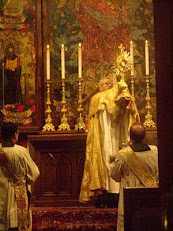
The first principle of the Ordinariate is then about Christian unity. St. Basil the Great, the Church’s greatest ecumenist, literally expended his life on the work of building bridges between orthodox brethren who shared a common faith, but who had become separated from one another in a Church badly fragmented by heresy and controversy. He taught that the work of Christian unity requires deliberate and ceaseless effort...St. Basil often talked with yearning about the archaia agape, the ancient love of the apostolic community, so rarely seen in the Church of his day. This love, he taught, is a visible sign that the Holy Spirit is indeed present and active, and it is absolutely essential for the health of the Church.

- Msgr. Jeffrey Steenson, Homily on the Occasion of his Formal Institution as Ordinary
Showing posts with label Daily Office. Show all posts

Thursday, November 20, 2014

Voices from the Patrimony on the Psalms


One of the positive achievements of the reformers in the Church of England was the renewal of the daily office in parish life. The combination of Matins and Lauds into Morning Prayer and of Vespers and Compline into Evening Prayer (a situation that was commonly done de facto in many English parishes and cathedrals at the time) in the Book of Common Prayer, and the canonical requirement for pastors to recite the offices in the parish church daily brought this important liturgical element once more into the daily lives of Christians. Far from being only an Anglican concern, the renewal of daily liturgical prayer was also frequently urged by Popes and Councils.
On the Anglican Embers page at the Anglican Use Society site (http://www.anglicanuse.org/AngEmb.htm) we have made available two articles in our "From the Anglican Patrimony" series. The first is from the writings of William Law, who was a nonjuror and mystic in 18th century England. His classic book A Serious Call to a Devout and Holy Life influenced many readers, including John and Charles Wesley, William Wilberforce and John Henry Newman. This selection from Law's work "On the Singing of Psalms" (http://www.anglicanuse.org/AE_3_05_AngPatr-Law-Psalms.pdf) gets to the heart of the importance of the psalms in Christian worship, and the psalms are, of course, the heart of the Divine Office. This except from Law's work was published in our Lent 2010 issue.

The second article is by Canon Charles Winfrid Douglas, an erudite and key Anglican clergyman of 20th century America, who was chief editor of the Episcopal Church's new hymnal in 1918 and one of the editors of The Hymnal 1940. Canon Douglas' article "The Importance of the Psalter in Worship" (http://www.anglicanuse.org/AE_3_10_AngPatr-Douglas-Psalms.p…) is from his The Hale Lectures. Church Music in History and Practice: Studies in the Praise of God. Here again, we are instructed in a short but wise essay on the value of the psalter to our daily prayer. Canon Douglas' article was published in our Pentecost 2012 issue.


(Cross-posted on the Facebook page of the Anglican Use Society.)

Friday, June 6, 2014

The Daily Office; beginning with the Portal Magazine's essay on the Ordinariate Use liturgy

In the June 2014 issue of the Portal Magazine, Msgr. Andrew Burnham has a very comprehensive, yet concise, article on the Ordinariate Liturgy. He begins his essay with this story.

There is a story about Mgr Graham Leonard, formerly Anglican Bishop of London, being asked by Cardinal Hume what he valued in the worship of the Church of England and would miss as a Catholic. He replied that it would be the Prayer Book Offices of Matins and Evensong, and in particular the psalms in course, following the Coverdale Psalter, as set in the Book of Common Prayer.

There is no doubt that the daily services are the jewel in the crown and, when both Pope Paul VI and Pope Benedict XVI expressed their admiration for Anglican worship, it was the public celebration of the Offices that they had most clearly in mind. Small wonder then that the Ordinariate clergy in the United Kingdom particularly value the availability to them, as Catholics, of Morning and Evening Prayer in the Prayer Book tradition, as distilled in the Customary of Our Lady of Walsingham.

There is a wealth of material in the Customary, which I've been reading through again in recent weeks. And while Msgr. Burnham does not focus exclusively on the Daily Office in his essay (which you should go and read for all that it contains), I think that greater emphasis needs to be placed on the Daily Office as a truly daily experience of prayer in the life of Catholics, and particularly for those of the Anglican Use, for whom this is a particular heritage and tradition.

A recent post on the blog Gerry Lynch's Thoughts... asks "Why is Cathedral Evensong Growing and What Does It Mean?", and one of his answers is that he sees "weekday Evensong as ecumenical, interfaith and vital for a growing, healthy, Church." Evensong is ecumenical and interfaith, because anyone can participate, even those not yet baptized. While the Mass is undoubtedly important for evangelization, it also necessarily excludes some people from what, to many, will seem the central rite of the Eucharist, the Communion. But there is no part of Evensong (or Mattins) that I, as a confirmed, baptized Catholic, can do as a member of the congregation, that an unchurched seeker cannot do; whatever barriers there are to participation will be wholly interior, but that removes a modern complaint about erecting barriers; because in this service, we erect none.

And yet, as the author goes on to note: "Evensong is not necessarily undemanding. It gives tremendous space for daily study of Scripture, and disciplined prayer sustaining a life of Christian service."

For both reasons, evangelization and growth in Christian discipleship (and more), the Daily Office should be a key element of every parish, and particularly, every Ordinariate and Pastoral Provision's life.

Tuesday, October 29, 2013

Outline of the new Ordinariate Eucharistic rite posted

On the web site of the Church of St. Michael the Archangel, Philadelphia, Fr. Ousley has posted a presentation that compares the new Ordinariate rite with the rite in the Book of Divine Worship. The presentation helpfully notes, not only the changes, but also the reason for the changes. In most cases, the changes represent a restoration of more traditional Anglican practices and formularies. The first page is shown below, but you can download the entire PDF of the presentation at the church's web site.

With the new Eucharistic rite's inauguration, the material in the Book of Divine Worship which remains normative has been further reduced. The funeral and marriage rites had been previously supplanted, as had Rite II of the Eucharist. All that remains as normative are the Daily Office, the Litany and Baptism. Doubtless, the Baptismal rite will be the next to be revised and published. I doubt we will see much change in the Litany, and so it remains to be seen what changes will come to the Daily Office. Currently the personal ordinariate of Our Lady of Walsingham uses the texts from the BDW, but uses the psalter from the Customary of Our Lady of Walsingham, owing to differences in the US and English versions of the Coverdale Psalter. There are other differences between the US and English Books of Common Prayer, which are reflected in differences found in the BDW and the Customary, and those differences will have to be addressed by the Anglicanae Traditiones commission.

Thursday, April 18, 2013

Liturgical Guidelines from the Ordinariate of Our Lady of Walsingham

Released today on Facebook (and no doubt soon on the web site), the UK's Personal Ordinariate of Our Lady of Walsingham has released a set of guidelines for liturgical use.* Among the highlights:

1. Use of the Rite I Eucharistic liturgy of the Book of Divine Worship is permitted.

2. Slight modifications of the Rite I BDW liturgy are to be made: the words of consecration, the anamnesis and the offertory prayers are to conform with the 3rd edition of the Roman Missal.

3. The psalter from the Book of Divine Worship is not permitted; the psalter from the Customary of Our Lady of Walsingham is preferred.

4. The Anglican Use Gradual (editor: C. David Burt) is commended for use for singing the propers.

*Note: The linked file is a PDF, but does not have the ".pdf" extension, and may not open with a double-click (particularly on Windows-based PCs). It will open from within Adobe Acrobat.

Sunday, March 31, 2013

Pascha Nostrum

One of the jewels of the Anglican Use that is preserved in the Book of Divine Worship is the Pascha Nostrum, or Easter Anthem, appointed for use in place of the Venite throughout the Octave of Easter, and permitted as the invitatory throughout the Easter season. It is one of the premier examples of the way in which the Prayer Book tradition has preserved ancient Catholic practice, the practice of an Easter procession with anthem and alleluia being attested to in medieval English practice.
In his "Notes on the Canticles", the Rev. John Henry Blunt (his essay reprinted in the Saint Dunstan's Plainsong Psalter) writes:
The Anthems instead of "Venite exultemus" on Easter Day represent the primitive custom of Easter morning, when the versicle "The Lord is risen," and the response "He is risen indeed," were the formal salutation between Christians.  In the ancient rite of the English Church one of these anthems was said in procession before Mattins; and the service was retained in 1549.

In the Commentary on the American Prayer Book, the Rev. Marion J. Hatchett adds to this by writing:
The 1549 Prayer Book provided for the use of two "anthems" (Romans 6:9-11, two Alleluias, and 1 Corinthians 15:20-22 with one Alleluia) prior to Morning Prayer on Easter. A versicle and response and a collect followed. The structure of this preface, the first two verses of the first anthem, and a large part of the collect, derived from the order for the procession to the Easter sepulcher which had preceded the Sarum Mass for Easter Day. 
A choral version of Pascha Nostrum from 
the National Cathedral in Washington, D.C.

Monday, November 26, 2012

The Daily Offices as a Healing Balm

David Clayton is the Artist-in-Residence at Thomas More College in Merrimack, NH. An Oxford graduate, David has spoken about the way that even in contemporary Oxford, the Daily Office is the framework around which the life of the College is built. In a new post on the New Liturgical Movement blog he writes about a novel way of praying the office that his students and colleagues have taken up:
Recently when I went home to England we had a reunion of old college friends of mine. Most were not believers of any sort - I had known them since I was eighteen and so the friendships pre-date, by a long way, my conversion (I was 31 when was received into the Church and have just turned 50 FYI). It was great to catch up with everyone and see how they were getting on. I was interested by a recent decision of one. She had given up teaching genetics at Imperial College, London and was now working for a company that would go into investment banks in the City and teach executives how to meditate to help them deal with the stress of the job. She been introduced to meditation when she took up yoga for the physical benefits and then was attracted to the 'spirituality' that is attached to it.

In order to convince the executives that there is something to this Eastern meditation, they would be armed with statistics from scientific research. She said that there had been observable improvements in the condition of heart patients in hospitals when people meditated. The research shows, she said, that even if the patients did not meditate with the visitors or even if they were unaware it was happening, just have meditation going on in the building seemed to have a positive effect.

I was happy to believe that she was right and that the research backed her up. However, my reaction was that if anything good was coming out of this, then it was because it was participating in some way in Christian prayer, whether they knew it or not. I would contest that the fullness of what they are doing is in the traditional prayer of the Church and there is every chance that this would be even more powerful if done.

When I got back to the USA, I contacted local hospitals and asked if they would like a small group of people to come and sing Vespers on a regular basis. What is surprising and some ways dismaying, is that I couldn't find anyone who had ever heard of this being done before. There are Christian prayer groups who visit hospitals, but I don't hear of people making regular commitment (beyond the occasional concert) to pray the liturgy. Shouldn't the liturgy of the hours be one of our most powerful weapons as part of the New Evangelisation?

...

I was delighted when the Catholic chaplain at the VA Hospital, the American armed services veterans hospital in Manchester, New Hampshire invited us to come in every other Monday evening. Fr Boucher is an old friend of mine and the college. Since September, myself and Dr Tom Larson from Thomas More College have been leading a group of male students in Vespers and Compline on Monday evenings. Because we were singing the psalms, we have presented it as ecumenical and administratively this enabled us to fill an available slot in the chapel and it has attracted a few non-Catholics

The veterans at the hospital know that we are there but very few have been able to come each time. Most are too ill or injured even to be able to get up one floor from the ward without someone dressing them and bringing them up and those helpers aren't always available. Even then, I am not fooling myself that large numbers want to come but can't make it. This is an unusual thing. But we are undaunted. A regular group of up to a dozen guys has been going in and singing the psalms. We keep the door open and sing loud enough so that it floats down the corridor for the wards to hear. They are always surprised at the effort we make to sing well on their behalf and in order to praise God. It has been gratifying to hear how readily those who come, many who have never been to any Office before, can sing with us, and want to. We are singing in the vernacular so that any visitor can understand and join in. Nevertheless the tones are modal and have the feel of the plainchant tradition and this I think draws them in. (They were developed for the liturgy at the college)...

Read his full reflection at the NLM post "Send Out the L-Team - Making a Sacrifice of Praise for American Veterans"

Sunday, November 11, 2012

More on the Customary of Our Lady of Walsingham

During the recent Anglican Use Society Conference I had the chance to speak with some other people who have also purchased a copy of The Customary, and like me they are pleased with much of the material in the customary, although the layout and usability are a concern. A a member of the interdicasterial commission Anglicanae Traditiones wrote to me during the conference to point out that while the CDF did give give its permission for publication as an interim text, to supplement (per Msgr. Burnham's comment in the thread below) the Liturgy of the Hours or the Book of Divine Worship, it is not a mandatory text, certainly for the Ordinariate clergy in the USA, Australia and Canada.

The official Ordinariate daily office book, at least here in the USA, remains the office in the Book of Divine Worship. It is to be hoped that an official version of this will be re-published (as the BDW is currently out of print), in an easily handled volume that contains only the Daily Office. This would be a great boon for both the clergy, who are bound by canon law to daily recitation, and to the laity, many of whom recite the office regularly out of devotion.

The commission Anglicanae Traditiones will eventually prepare an official proposal, which will then need to be approved and confirmed by the CDF and CDW.

---

edited on 11/26/2012 to clarify the status of both the Customary and the Daily Office.

Tuesday, November 6, 2012

A More Thorough Review of The Customary

I received my copy of The Customary of Our Lady of Walsingham, purchased via the UK branch of Amazon.com, on All Souls' Day last week. I had intended to write a full review, but have discovered that a very full review has already been written.

On the blog Psallite Sapienter out of Australia, Joshua has written a series of posts that examine the new Customary.

In the post "The Number and Hardness of Rules Called Pie", Joshua goes through all the steps to set up his book for Evening Prayer on Sunday. Before beginning he reviews his set up:
Now, almost time to begin, but first to double-check: holy card for the Sentence, then red ribbon (moving it along as I go), then Psalms (as marked), then First Lesson (from Bible, as marked), then red ribbon for Mag., then Second Lesson (from Bible, as marked), then red ribbon for Nunc and so forth, then Collect of the Day (as marked), then back to the Second and Third Collects (red ribbon), then blue ribbon for post-Biblical reading (in place of sermon), then red ribbon again for Further Prayers down to "The grace"; and finally another holy card marks the Salve Regina.

Two items I noticed immediately when reviewing my copy of The Customary was that there are too few ribbons (only three when at least 6 are needed) and that the layout requires considerable back and forth, likely too many for most laypeople to warm to the use of this book (which I say having used many different office books over the years, including a 7-volume translation of the Liturgy of the Hours in Spanish).

In two posts "Customary Questions I" and "Customary Questions - II" Joshua asks several good questions. In his first post he asks:

1. Why on Sundays the Psalms are proper, rather than taken from the appropriate day of the month (the period over which their recitation is spread), since such an arrangement seems to unduly restrict the number and variety of Psalms heard by a Sunday congregation, in contradistinction to Anglican practice?
2. Why one of the two Scriptural Readings provided for both Mattins and Evensong is so short, when surely having two fairly long Lessons is a very hallmark of the Daily Office in the Anglican Patrimony?
3. Why the Prayer for All Conditions of Men, and other optional Prayers and Thanksgivings, is not included, when the reading at choice of various intercessions "After the Third Collect" is another venerable Anglican tradition?
4. Why the prefatory use of a Penitential Rite is allowed before Evensong only, rather than also before Mattins, and, similarly, why the opening versicles at both are not exactly the same, as has been traditional Anglican practice?

In the second "Questions" post, he notes:

Rather annoyingly, the new Customary of Our Lady of Walsingham restricts the use of the Te Deum to festal days only, so that on most weekdays one must plod through either the Benedicite or its little brother the Benedictus es (both from Daniel chapter 3.)...

I myself wonder if straining so to conform the Anglican Use to the Roman Rite is necessary or desirable; while the length of lessons of Scripture has declined over the past century and more (until 1871, a full chapter was almost invariably the norm, but first in the new lectionary of that year, and then in successive revisions, the length was generally lessened more and more), it was always the Anglican boast that they did read over a great deal of the Bible each year; it would be unhappy if that laudable aim were not still maintained. In particular, it seems that the Anglican pattern is to have two fairly substantial readings, one from each Testament, at both Mattins and Evensong, and to read through the Scriptures in course, maintaining the ancient principle of lectio continua – I wonder if this is adhered to so strictly in the new Customary.

Finally (although not the last post in chronological order), Joshua has compiled a helpful Index of the non-Biblical writings in his post "Customary Readings".

In addition to Joshua's questions on Psallite Sapienter, I also had two questions about the Proper of Saints in the book. There is a partial Proper of Saints for saints in the General Roman Calendar, and a second Proper of Saints for the Calendar of the Ordinariate. Why not merge these two sections? With the two sections, one must check both in setting up the book for the day's prayers. Second, why include some, but not all of the saints from the General Roman Calendar? For the month of January, for example, The Customary's General Sanctorale includes collects and other propers for 8 saints, with an additional 4 in the Proper Sanctorale for the Ordinariate. Among the feasts left out are those of Holy Name of Jesus (January 3), St. Elizabeth Ann Seton (January 5), and St. John Bosco (January 31). The first two absences are particularly surprising, as devotion to the Holy Name has a strong English history, and St. Elizabeth Ann Seton is certainly a significant figure for the Ordinariates as the first Anglican convert since the age of the British Martyrs under the Tudors and Stuarts to be canonized.

Following up on what Joshua writes about the Invitatory for Morning Prayer, I noticed that those psalms are not formatted in strophes, and it is unclear whether they should be read as responsorial psalms (as in the BDW and LotH) or with antiphons before and after only (as in the 1928 Proposed BCP in England). If the former, formatting in strophes would make this much easier for readers to use. It is also too bad that while adopting elements found in the BDW such as the Phos hilaron (admittedly also found in the CofE's Common Worship and Celebrating Common Prayer) at Evening Prayer that the alternative Venite that substitutes verses 9 & 13 of Psalm 96 for verses 8-11 of Psalm 95 (the final verses of which are optional in The Customary).

This absence is an example of what I see as a missed opportunity with the current version of The Customary. There are glances toward the US Ordinariate, noting differences in the rank of certain feasts in the calendar, for example, and drawing on some of the material in the Daily Offices of the BDW such as noting acceptable changes in the Preces in areas with "a Republican Administration"; but other elements that would have made this book more suitable for use in the US as well as England (such as drawing on Canon Douglas' chant work in the Saint Dunstan Plainsong Psalter for the music and the prayers for mission at the end of the office in the BDW) are missing, regrettably.

There are additional instances that made me think that The Customary was rushed out the door a bit too soon. On page 47 and 112 there is a prayer for the Pope, and while I certainly wish the Holy Father many more years, the prayer shouldn't have had the reigning Pope's name printed in the same typeface as the rest of the prayer. Normally a reader would expect to see the placeholder "N." as in the Common collects, such as the one for a Pope on page 662, or at least that the name would be in italics as is the Queen's on page 113 in the prayer for the Monarch. At the end of the Ordinary for Evening Prayer on page 115 we find the usual prayer for the dead, but it reads, "May all the faithful, through the mercy of God, rest in peace." Should this not read "May all the faithful departed, through the mercy of God..."?

There are certainly things to love in The Customary, but given that it requires so many supplemental books to be used (at the least, a Bible, an Ordo, a copy of the Liturgy of the Hours) as a regular daily prayer book, I fear it may be only a resource to supplement the Daily Offices of The Book of Divine Worship or the Liturgy of the Hours. But it is an expensive supplement; hopefully, there will be a second edition, produced in consultation with the US, Canadian and Australian ordinariate communities, that will help complete it as a fully usable resource for the Daily Office for both clergy and laity.


Thursday, November 1, 2012

Another Review of the Customary of Our Lady of Walsingham

This review is from the just published November issue of The Portal magazine:
As an Anglican I, along with many others, rarely used Anglican devotional material. The Church I attended was a “Roman Rite” Parish. We spurned Anglican material for fear of liberal or Calvinist contamination. However, now we are members of the Ordinariate the position is totally different.

As Anglicans we obeyed the rules from choice, because the rules we obeyed were Catholic rules. We chose to obey them. Now we are in full communion with the Catholic Church, we obey the rules because good Catholics obey the teaching of the Church. Rebels no longer, we are Catholics, and we obey the rules of the Catholic Church.

It was with great interest then, that I opened my copy of the new Customary of Our Lady of Walsingham, with the sub-title Daily Prayer for the Ordinariate. It arrived last month. It is the Prayer Book of the Ordinariate.

Published under the Imprimatur of the Ordinary, Mgr Keith Newton, the book contains the Calendar, the Divine Office with traditional Office hymns, Litany, together with material for times and seasons including saints and holy days, with an Introduction by Mgr Andrew Burnham and Dr Aidan Nichols OP. The language is traditional (thee and thou) the feel is in accordance with our Anglican patrimony and the psalms are in the beloved Coverdale translation. But the gem of the book is the series of hagiographical readings for the saints and holy days.

There will be those who prefer the Roman Divine Office, but as members of the Ordinariate, we have a loyalty to uphold. This is our book. It is true that most of us would never have thought of using it when we were Anglicans. However, now we are Catholics and the Holy Father has made this wonderful offer to us. The offer is to join the Ordinariate - united yet not absorbed. If we spurn the Holy Father’s generosity and, in effect, become Diocesan Catholics, we shall have failed Benedict XVI and his prophetic vision.

The Customary bridges that most difficult of gulfs between the Anglican and the Catholic. It unites these two traditions, yet makes important distinctions. The Divine Office is the Prayer Book one of Morning and Evening Prayer shape, augmented by Prayer through the Day and a beautifully traditional Compline. The Litany will be familiar to users of the 1662 Prayer Book, and the Calendar is specific to the Ordinariate, with many particularly British Saints.

In the future there will be a Eucharistic Rite for the Ordinariate, also in traditional language. For the time being we have this book. It is good, although there are one or two glaring mistakes. Nevertheless, the compilers are to be congratulated on its production. The mistakes may be corrected if it is re-printed or if there is a second edition. I have used it every day since its publication and see no reason why this should not continue. It fulfils the Holy Father’s wish - truly Catholic and also distinctively Anglican. After all this project of the Ordinariate is an Ecumenical one. We must never forget that.

Finally you may purchase the Customary on-line through Amazon for £39.93 - click on BOOKS on The Portal website - www.portalmag.co.uk/books.html.

Wednesday, October 31, 2012

An Early Review of the Customary of Our Lady of Walsingham

Writing on his blog, Fr. David Allen offers a first look at the new Customary.
I have just received my copy of The Customary of Our Lady of Walsingham. Forms of the Divine Office are intended for the long haul and can only really be evaluated after long use. So it is probably much too early to review this new book from the Ordinariate in the UK. Obviously the Customary has a very particular and rather small (at least so far) audience in view. However, Msgr. Andrew Burnham has said, "Our prayer is that the Customary will be a treasury not only for the Ordinariates but for the whole English-speaking world." It is hard to imagine any Anglicans who would not be delighted by some aspect or other of this new book of daily prayer. Actually I can imagine Anglicans who will not like any of it, because a particularly virulent strain of Romanophobia has infected many of us and made strange bedfellows of liberals, evangelicals, and hyphenated and qualified catholics.

For those Anglicans who realize that the future of the best in the Anglican Way may well be found outside the Anglican Communion there is much to love and respect in The Customary of Our Lady of Walsingham. First, there is the use of traditional language and especially the Coverdale Psalter. We are told by evangelicals that the old Prayer Book language is not 'missional.' By liberals that it is not 'relevant.' By some Anglo-Catholics that it is not 'catholic enough.' All of which is a high recommendation of Cranmer's prose. Unlike in the American Anglican Usage Book of Divine Worship, which is a strange bit of homage to the 1979 BCP, there is one vernacular for the Ordinariate in the UK. That is a uniformity which would benefit all Anglicans who do not have it. It is one of the deep sources of Anglican unity in the past.

Secondly, this new book is simply the best (that I know of) compilation of readings from ancient English sources, the Caroline Divines, the Oxford Movement and more modern Catholic-minded Anglicans...
The full review can be read at his blog Parish Priest: St. Francis, Dallas.

Hat tip to Fr. Bartus on Facebook.

Monday, October 29, 2012

The Chanted Office

In speaking to and reading accounts by Anglican Christians who have been inclined toward reconciliation with the Roman Church, but who hesitate on the threshold, there are various stumbling blocks that come up. I don't think any of these are trivial, although some are obviously of greater importance than others.

For one person it may be questions about Catholic dogmas: Papal Infallibility, the Assumption of the Blessed Virgin, or some other defined doctrine. For others it could be scandalous behavior in the Catholic Church that renders her less attractive.

Still others are hesitant to abandon the very things that nourished their faith in Christ: a parish that is focused on Christ and living out the Gospel, a church that has been the scene not only for their own faith life, but that of generations of their family, or the beautiful liturgy for which modern Anglican churches are rightly praised. "How," a person might ask themselves, "will I continue if I am deprived of the worship that has been the vehicle for the grace that has brought me to this point?"

Of course, the promise of the Pastoral Provision and the Personal Ordinariates is that such an Anglican Christian needn't give up anything from their past that is true and beautiful, that such practices will be welcome in the Catholic Church. Nevertheless, the fact that something is welcome doesn't mean it will in fact happen! If a small number of people are received into the full communion of the Catholic Church and do establish an Ordinariate Community, that doesn't mean that they'll have a choir, or organist, or books. "We'll never have evensong like we used to," they might think.

Well, it's true, things will be different. But not necessarily worse!

For many, the part of the Daily Office that is most familiar, and most cherished, is Choral Evensong. Pope Benedict himself was so entranced with the service at Westminster Abbey during his visit to England that he invited the choir there to join him at St. Peter's in Rome for the feast of Ss. Peter & Paul. But Evensong as it is today is not how it originally was celebrated. Imagine the same words, but there is no Anglican Chant and no hymns. Seem impossible? And yet, that was how Evensong was celebrated for nearly 100 years after the first Book of Common Prayer was issued in 1549.

When Cranmer and the royal authority issued the Daily Offices as part of the Prayerbook, they were not a new creation; rather the Daily Officers were an adaptation and a simplification of the Divine Office of the the Medieval Church. What was also adapted and simplified was the music for the Office. We have one example from that time in the Book of Common Prayer Noted by John Merbecke, but his was not the only adaptation. In addition to this adaptation of plainsong, there were simple harmonies, often in the form of fauxbourdons that were employed. And of course, there were more complex pieces written by some of the great musicians of the age, such as Thomas Tallis and William Byrd. Nearly all of this was a capella, because the use of organs in churches was fairly rare; organs were more typically found in private homes.

The parishes, as opposed to the cathedrals, tended to have the simpler music, which also made it possible for the lay people in the congregation to join in. And this example from the early days of specifically Anglican services may well be a help for new Ordinariate congregations today. While services of chanted Evensong may not be hosted soon on the BBC's Choral Evensong broadcast, it will provide for the most important aspect of any liturgy: the worship of God and the building up of His people.

First, many people may not have even heard an a capella service. As an example, I would point you to the web site of the Compline Choir. This choir began in 1954, and since 1956 has been singing the office of Compline at St. Mark's Episcopal Cathedral in Seattle every Sunday. The service has been broadcast continually since 1960, and now is available as Podcasts as well. The most recent podcast I listened to, from October 14th, was entirely a capella and is a wonderful example of the most important instrument we can employ in the praise of God: the human voice.

Of course, any group starting out will not sound like the Compline Choir the first time out; but that hardly matters. The key resource, I think, that people need is to have the chants available. That resource, fortunately, is readily to hand: The Saint Dunstan Plainsong Psalter. This book, which is actually more than just a psalter, contains the American version of the Coverdale Psalter along with the usual canticles from Morning and Evening Prayer. Each of the psalms is set to one chant melody, while the canticles are set to multiple chant melodies. There is also a set of Old Testament canticles to supplement the appointed ones for Morning Prayer, with both festal and ferial settings.

I use St. Dunstan's Psalter daily to pray the office, but also used it as a source for compiling the Compline service we used at St. Athanasius on Maundy Thursday, at the end of adoration following the Mass of the Lord's supper.


Tuesday, October 16, 2012

Liturgy as provider of an ordered and bordered encounter with Scripture


From the blog Haligweorc comes an interesting post on the Daily Office:
...When people think of Anglo-Catholics or Anglo-Catholicism or even Catholic Anglicans, they tend to think of vestments and smoke and sacraments, clusters of candles, and racks of rosaries; the daily office – not so much. And yet, the daily office is a central liturgical discipline that grounds so much of what we do. The Mass and the Office are not alternatives, they are complements. To cleave to the Catholic faith East and West is to give the daily office the honor and the attention – and the attentiveness – that it is due.

The two public rites of the church – the holy Eucharist and the daily office – have the same primary purpose: the worship and glorification of God. And that always has to be kept central. But the secondary purposes are different. The Eucharist is mystigogical and leads us into the heart of the mystery of Christ. The office is catechetical and instructs and forms us in the foundations of the faith. Now, you might be wondering… The dominant theme of our time together is the Anglo-Catholic social tradition. So why am I taking up time talking about the office? (Or, as I’ve heard some Episcopal clergy say, why are you spending your time talking about prayer when you should be talking about justice issues!) It’s because the Anglo-Catholic social conscience must be formed, it must be crafted, and the distinctive characteristic that differentiates a secular drive for a just society from one formed in the Catholic Anglican tradition is the process and method of its formation. The greatest tool that we have for molding a Christian social conscience is Scripture itself, and more particularly, the attentive practice of the daily office.

The wellspring of the Western liturgical tradition and particularly the monastic practices that have nourished it is the concept that the liturgy provides an ordered and bordered encounter with Scripture. Again, the liturgy provides an ordered and bordered encounter with Scripture.This is true of the Eucharist, it’s even more true of the office. It was true of the Sarum offices that the reformers received, and the Anglican offices received an additional infusion from Cranmer’s own Protestant love of the Scriptures.

Alright, so what do I mean by ordered and bordered? ...

Read the whole presentation. It is a great essay on the importance of the Daily Office.

Sunday, June 17, 2012

Oh, the Coverdale Psalter...

Another entry from Mr. Uher, and my commentary.
Everyone says they love the Coverdale Psalter, the grace of its language, its majestic tone. Most people have never used Coverdale's Psalter exactly as he wrote it, but rather we have worshipped with it via various recensions and twigglings over the years.

The American recension of 1928 is to my mind one of the very best. It does have single problems with the elimination of the word "Satan". A closer reading of the Vulgate and Septuaginta also has suggested worthy corrections.

Currently, the best version I have encountered is in The St. Dunstan's Plainsong Psalter published by Lancelot Andrewes Press -- a press of the Western Rite Orthodox who are also of the Anglican Patrimony, my friends. Frankly, I recommend the adoption of this Plainsong Psalter as it is. It is a wise revised edition of Canon Douglas' great Plainsong Psalter. It includes Sarum tones and other ancient British tones. Its version of the Coverdale Psalter restores some things got wrong in the American 1928 recension, and it makes other slight alterations that make the text sing doubly in the mouth of a worshipper.

This press, Lancelot Andrewes Press, is one of the reasons to cheer among the Anglican diaspora. They have brought Dr. Neale's commentary on the psalter back into print. Deo gratias! They have published a gorgeous Western Orthodox edition of The Book of Common Prayer. They have made Lancelot Andrewes great prayers available in a beautiful edition. And the version of the Rule of St. Benedict in Latin and English sold by them is the one I use...

Read the rest of Mr. Uher's post at Tonus Peregrinus

I want to second Mr. Uher's recommendation of the St. Dunstan Plainsong Psalter. I have been using this for my personal singing of the office for about 2 years now, and included it for illustration in my lectures on Gregorian and Anglican chant at the summer sessions at Thomas More College in 2010 and 2011. I have a hard cover version, but there is also a soft cover version (not a paperback) now available as well. The notes are also quite valuable.

In a future Office Book for the Ordinariates, it would be good if this noted psalter could be included.

In addition to the Coverdale Psalter, the SDPP also has several settings of the Benedictus, Te Deum, Magnificat, Nunc Dimmittis and other canticles appointed in the Prayer Book that can be used to good effect in a sung Office. See below for an example.


Friday, June 1, 2012

Mgr Andrew Burnham: The Customary of Our Lady of Walsingham

Friday, June 01, 2012


Mgr Andrew Burnham, Assistant to the Ordinary, writes in this month's Portal:
The Customary of Our Lady of Walsingham is to be published very soon now by Canterbury Press. In a month or two we shall have access to this very handsome publication. It will contain the Ordinariate’s own form of Morning and Evening Prayer, drawn from the Book of Common Prayer, together with the Litany, minor offices for use during the day, and a traditional order for Compline.
The Coverdale Psalter will be included, as will lectionary tables which closely follow the not as yet well-known, but superb, two-year sequence of Scripture readings devised for the daily Office of the Roman Breviary. There will also be the Ordinariate Calendar and, most notably, a rich anthology of post-biblical readings drawn from the riches of the British spiritual tradition. This anthology complements the Roman Divine Office as well as the Ordinariate Office, for it will be possible to use many of the post-biblical readings for the Office of Readings.

Evensong and Benediction
Some will find themselves using the different Office books for different purposes – one for individual prayer and devotion, the other for public worship. Those who want to use the Roman Office books in the morning and the Customary in the evening – or the other way round – will be able to do so without too much difficulty. The particular value of the Customary is that it makes available one of the acknowledged treasures of the Anglican tradition – the public celebration of the Office, and in particular of Evensong. The reform of the Roman Office following the Second Vatican Council sought the development of the public celebration of the Office and, truth to tell, that is a reform yet to be realised. In these early days of the Ordinariates, there have been already many celebrations of Evensong and Benediction and it is intriguing to know not only that this has been in accordance with the Holy Father, Pope Benedict’s wish, but also that it has been his great pleasure, that this should have been so.

Traditional language
It is hoped that the Customary will be ecumenically helpful too. There has been a deliberate decision by the Holy See that the Ordinariate’s distinct Use should be predominantly in traditional language. This is not to criticise in any way the modern language translations and compositions of recent Anglican revisions. Rather it is a recognition of the value of the sacral language of the Prayer Book. Members of the Ordinariates in North America and Australia are great devotees of Prayer Book English. Moreover, the 400th anniversary of the 1611 Authorised Version of the Bible (AV) – and the immense popularity still of cathedral Evensong – shows that the British public too are aware of the beauty and importance of a traditional sacred dialect. It is that dialect which the Customary and the Revised Standard Version (RSV) of the Bible preserve and make available.

‘Common Bible’
Why the RSV and not the King James Bible? The answer lies in the subtle development of the English Bible tradition. For accuracy’s sake, twentieth century students began to rely on the Revised Version of 1881-1894. Meanwhile the Revised Standard Version of 1946-1957 was becoming established and, in 1966, was accepted by Catholics and Protestants as a ‘Common Bible’. It was the first truly ecumenical Bible and brought together the two traditions – the Catholic Douay-Rheims Bible and the Protestant Authorised Version. Thus, whenever the Customary quotes extensively from the Bible, it is the RSV that it uses. The Catholic Church in the 1970s in Britain opted (mistakenly as it now seems) for the ‘dynamic equivalent’ Jerusalem Bible translation. That version greatly helped public understanding of the Scriptures, but, like the Mass translation of the same period, was based on a theory of translation that is of great value in paraphrasing and communicating the meaning of, for example, modern literature written in other languages, but no longer thought appropriate for representing sacred texts written in ancient languages.
Our prayer is that the Customary will be a treasury not only for the Ordinariates but for the whole English-speaking world.
__
The Customary of Our Lady of Walsingham is available to 'pre-order' from Amazon.co.uk here.

Ordo for the Personal Ordinariate of Our Lady of Walsingham, part III

The latest edition of the Ordo for the Personal Ordinariate of Our Lady of Walsingham (part III, Time after Trinity) has been published online. You may download the PDF at this link.

Friday, May 11, 2012

Customary of Our Lady of Walsingham to be published

The Customary of Our Lady of Walsingham will be be released on 30th June.


Per the description:

This is a daily prayer book for the Ordinariate – those former Anglicans who have recently become a distinct part of the Roman Church. In creating the Ordinariate, Pope Benedict recognised the treasures that Anglicans brought with them from their own tradition and this book is replete with the riches of Anglican patrimony. It contains material from the Anglican tradition, adapted according to the Roman rite including:

* an order for morning, evening and night prayer throughout the year
* an interim order of the Mass
* spiritual readings for the Christian year
* the minor offices
* calendar and lectionary tables

For use throughout the English speaking world, this unique volume will fill an immediate need. Eventually, an authorised version of the Mass for the Ordinariate will emerge from Rome, but that is many years away.

from the blog of Fr. Stephen Smuts.