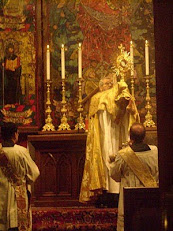
The first principle of the Ordinariate is then about Christian unity. St. Basil the Great, the Church’s greatest ecumenist, literally expended his life on the work of building bridges between orthodox brethren who shared a common faith, but who had become separated from one another in a Church badly fragmented by heresy and controversy. He taught that the work of Christian unity requires deliberate and ceaseless effort...St. Basil often talked with yearning about the archaia agape, the ancient love of the apostolic community, so rarely seen in the Church of his day. This love, he taught, is a visible sign that the Holy Spirit is indeed present and active, and it is absolutely essential for the health of the Church.

- Msgr. Jeffrey Steenson, Homily on the Occasion of his Formal Institution as Ordinary
Showing posts with label Easter. Show all posts

Sunday, March 31, 2013

Msgr. Steenson's Easter Letter

The newest Ordinariate community, St. Timothy of Catonsville, Maryland, shown with Msgr. Steenson, who celebrated the Easter VIgil and received members into full communion.

Easter 2013

Dear People of the Personal Ordinariate of the Chair of St. Peter, 

A blessed and joyous Easter to you all!

We have just passed through a Lent in so many ways like none other.  We began this Lent trying to absorb the unsettling announcement of the retirement of Pope Benedict XVI, who more than anyone else has made our journey to full communion possible.  And we concluded Lent by welcoming Pope Francis, whose beginning days have been so full of surprises.  In many ways, we are in a different place than when we started.

But in a more important sense, we have come full circle.  Ours is a living tradition, and the Pope has the ministry of interpreting that tradition authoritatively so that it might continue to be heard throughout the world today.  The two Popes of Lent 2013 are a study in contrasts, gifted in different ways, but they serve the same Gospel.  It is a wonderful illustration of how the Petrine office is exercised; it is an instrument of the Holy Spirit: to renew the Church’s mission and to configure her in the image of Christ.

I love the way St. Irenaeus of Lyon wrote of how the Tradition is perpetually revivified in the Church.  The Faith that is received and handed will, by the Spirit of God, renew the Church and make it young, “as if some precious deposit in an excellent vessel causes the vessel itself containing it to renew its youth also” (3.28.1).

There is a resurrection theme to be discerned in this.  Earthly communities and societies get old and tired and are replaced by something new and different.  But the Church is renewed and recovers her youthfulness, because she participates in the life of the blessed Trinity.
The people of the Ordinariate should understand this principle because we have experienced it in the renewal of our communities and in our personal faith, as we have journeyed deeper to the source of the Church’s life, to the streams of living water.  In the words of Jeremiah 2:13, we have learned of the futility of digging “broken cisterns that cannot hold water.”

May our Risen Lord bless our life together and keep us always faithful to Him and to His Church!

- Msgr. Jeffrey Steenson

Pascha Nostrum

One of the jewels of the Anglican Use that is preserved in the Book of Divine Worship is the Pascha Nostrum, or Easter Anthem, appointed for use in place of the Venite throughout the Octave of Easter, and permitted as the invitatory throughout the Easter season. It is one of the premier examples of the way in which the Prayer Book tradition has preserved ancient Catholic practice, the practice of an Easter procession with anthem and alleluia being attested to in medieval English practice.
In his "Notes on the Canticles", the Rev. John Henry Blunt (his essay reprinted in the Saint Dunstan's Plainsong Psalter) writes:
The Anthems instead of "Venite exultemus" on Easter Day represent the primitive custom of Easter morning, when the versicle "The Lord is risen," and the response "He is risen indeed," were the formal salutation between Christians.  In the ancient rite of the English Church one of these anthems was said in procession before Mattins; and the service was retained in 1549.

In the Commentary on the American Prayer Book, the Rev. Marion J. Hatchett adds to this by writing:
The 1549 Prayer Book provided for the use of two "anthems" (Romans 6:9-11, two Alleluias, and 1 Corinthians 15:20-22 with one Alleluia) prior to Morning Prayer on Easter. A versicle and response and a collect followed. The structure of this preface, the first two verses of the first anthem, and a large part of the collect, derived from the order for the procession to the Easter sepulcher which had preceded the Sarum Mass for Easter Day. 
A choral version of Pascha Nostrum from 
the National Cathedral in Washington, D.C.