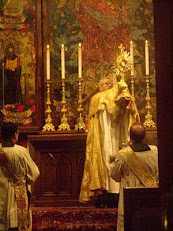
The first principle of the Ordinariate is then about Christian unity. St. Basil the Great, the Church’s greatest ecumenist, literally expended his life on the work of building bridges between orthodox brethren who shared a common faith, but who had become separated from one another in a Church badly fragmented by heresy and controversy. He taught that the work of Christian unity requires deliberate and ceaseless effort...St. Basil often talked with yearning about the archaia agape, the ancient love of the apostolic community, so rarely seen in the Church of his day. This love, he taught, is a visible sign that the Holy Spirit is indeed present and active, and it is absolutely essential for the health of the Church.

- Msgr. Jeffrey Steenson, Homily on the Occasion of his Formal Institution as Ordinary
Showing posts with label Gregorian Chant. Show all posts

Tuesday, November 25, 2014

Melismatic Propers for Midnight Mass at Christmas

Many people who attend Anglican Use liturgies are aware of The Anglican Use Gradual, edited by C. David Burt, a fellow congregant of mine at St. Athanasius Parish in Boston. The AUG sets the minor propers of the liturgy (introit, gradual, alleluia, tract, offertory and communion) to simple psalm tones so that even a small schola or choir can chant them. I have heard the chants of the AUG sung not only in Pastoral Provision and Ordinariate parishes, but even in regular Roman Rite parishes.

Mr. Burt's gradual was the first English language gradual to appear for Catholic use, although there are now many others available, thanks to the work of folks like the hard working people at Corpus Christi Watershed.

But The Anglican Use Gradual remains the best suited for the Divine Worship liturgy, as it has congruent language, the texts being taken from the Coverdale psalter and the King James and Revised Standard translations of the Scriptures.

Over the years, we have published additions to the gradual in Anglican Embers, adapting the melismatic tones found in the Solemnes books and chants from the Sarum tradition. These are available on the Anglican Embers page at the Anglican Use Society web site, but here's a link to an appropriate one, the Midnight Mass propers for Christmas, published in our Advent 2010 issue: http://www.anglicanuse.org/Christmas-Midnight-Propers.pdf

Tuesday, August 26, 2014

New Ordinariate Chant Schola in DC

As the Saint Luke ordinariate community moves to downtown Washington DC next month, a new initiative is beginning, to build on an existing tradition of Sacred Music. Named in honour of Saint Benedict and the Benedictine tradition of Gregorian chant, and with a nod of gratitude to Pope Emeritus Benedict XVI (who founded the ordinariates), the women of The Saint Benet Schola will provide the chant at the 8.30am Sunday Mass at Immaculate Conception, 8th Street NW. The group will draw on the Anglican plainsong tradition, whilst at the same time emphasizing the universal, Catholic nature of our worship, by singing the ancient chants and texts of the Sacred Liturgy.

More details here: www.stlukesordinariate.com

Hat tip to Charles Cole at The New Liturgical Movement.

Sunday, June 17, 2012

Oh, the Coverdale Psalter...

Another entry from Mr. Uher, and my commentary.
Everyone says they love the Coverdale Psalter, the grace of its language, its majestic tone. Most people have never used Coverdale's Psalter exactly as he wrote it, but rather we have worshipped with it via various recensions and twigglings over the years.

The American recension of 1928 is to my mind one of the very best. It does have single problems with the elimination of the word "Satan". A closer reading of the Vulgate and Septuaginta also has suggested worthy corrections.

Currently, the best version I have encountered is in The St. Dunstan's Plainsong Psalter published by Lancelot Andrewes Press -- a press of the Western Rite Orthodox who are also of the Anglican Patrimony, my friends. Frankly, I recommend the adoption of this Plainsong Psalter as it is. It is a wise revised edition of Canon Douglas' great Plainsong Psalter. It includes Sarum tones and other ancient British tones. Its version of the Coverdale Psalter restores some things got wrong in the American 1928 recension, and it makes other slight alterations that make the text sing doubly in the mouth of a worshipper.

This press, Lancelot Andrewes Press, is one of the reasons to cheer among the Anglican diaspora. They have brought Dr. Neale's commentary on the psalter back into print. Deo gratias! They have published a gorgeous Western Orthodox edition of The Book of Common Prayer. They have made Lancelot Andrewes great prayers available in a beautiful edition. And the version of the Rule of St. Benedict in Latin and English sold by them is the one I use...

Read the rest of Mr. Uher's post at Tonus Peregrinus

I want to second Mr. Uher's recommendation of the St. Dunstan Plainsong Psalter. I have been using this for my personal singing of the office for about 2 years now, and included it for illustration in my lectures on Gregorian and Anglican chant at the summer sessions at Thomas More College in 2010 and 2011. I have a hard cover version, but there is also a soft cover version (not a paperback) now available as well. The notes are also quite valuable.

In a future Office Book for the Ordinariates, it would be good if this noted psalter could be included.

In addition to the Coverdale Psalter, the SDPP also has several settings of the Benedictus, Te Deum, Magnificat, Nunc Dimmittis and other canticles appointed in the Prayer Book that can be used to good effect in a sung Office. See below for an example.


Thursday, October 14, 2010

New set of Communion Propers for Anglican Use Mass

Since the Congregation of St. Athanasius in Boston moved to large quarters last December at St. Lawrence Church, we've found it advisable to make use of the option provided in both the Graduale Romanum and the Anglican Use Gradual to sing additional verses with the communion chant that we've employed for years. It has fallen to your blog host to compile these verses each week, and recently I decided to try to get ahead of the process and compile the chants for several weeks in advance; my goal is to eventually have all of the chants set with the appropriate verses and then publish them via Lulu.

Here you have the fruits of my labor so far: Communion chants with verses for the Sundays and principal feast days from the 29th Sunday in Ordinary Time (i.e., October 17th) through Ash Wednesday. The chants are mostly taken from the Anglican Use Gradual compiled by C. David Burt; with a few additions such as St. John and Holy Innocents which I made using the Graduale Romanum as a guide and the Douay-Reims version for the text of the chant. Please feel free to contact me with any corrections. I will hopefully have the project finished by the time we reach the beginning of Lent.

Sunday, March 7, 2010

World-renowned organist seeks to preserve classic Gregorian chant in Catholic liturgy

By Kevin Kelly

KANSAS CITY — Call him nutty. At age 85, Bruce Prince-Joseph is used to it.

His own father thought Prince-Joseph was thinking rather oddly when the then-teenager, with a fresh diploma from Kansas City’s Westport High School, quit a budding career at Mercantile Bank and Trust to pursue his dream of music in New York City...

Read the rest about the organist at the Anglica Use Mass at St. Therese of the Little Flower in Kansas City at the web site of The Catholic Key.