The first principle of the Ordinariate is then about Christian unity. St. Basil the Great, the Church’s greatest ecumenist, literally expended his life on the work of building bridges between orthodox brethren who shared a common faith, but who had become separated from one another in a Church badly fragmented by heresy and controversy. He taught that the work of Christian unity requires deliberate and ceaseless effort...St. Basil often talked with yearning about the archaia agape, the ancient love of the apostolic community, so rarely seen in the Church of his day. This love, he taught, is a visible sign that the Holy Spirit is indeed present and active, and it is absolutely essential for the health of the Church.

- Msgr. Jeffrey Steenson, Homily on the Occasion of his Formal Institution as Ordinary
Showing posts with label Bible. Show all posts

Monday, April 14, 2014

St. Edmund's Update: In praise of Benedict

The excellent Update from the Sodality of St. Edmund has just been published. While I commend all the content to you, I call your attention to this wonderful paen to Pope emeritus Benedict XVI by Monsginor Mercer:

ROBERT'S RAMBLINGS
 IN PRAISE OF BENEDICT
 There are many Benedicts. The name means "blest" or "blessed" (by God of course). There is St Benedict of Nursia (480 - 550), the patrician Italian who is considered to be the patriarch of Western monasticism. He wrote his famous Rule for men and women who wished to withdraw from secular society and live communal lives of prayer, study and manual labour. In the Dark Ages of Europe which followed upon the collapse of the Roman empire, monasteries became a civilizing influence, centres of peace in a violent world, places of agriculture, education, hospitality and medical care.
There is St Benedict Biscop (628 - 689), a patrician Brit who became a Benedictine monk in France and then founded monasteries back home in county Durham. He was famous for his learning and patronage of music and art. There is St Benedict Aniane of France (750 - 821) about whom similar things could be said.
There is St Benedict Labre (1748 - 1783), a holy tramp of no fixed abode who wandered about the famous shrines of Europe. It takes all sorts to build the communion of saints. There was a not dissimilar man in modern times, John Bradburne, who finally ended up in Zimbabwe living among lepers where he was martyred by Mugabe's freedom fighters. He too will be canonized one day ("Strange Vagabond of God" by John Dove SJ published by Gracewing).
Sixteen popes have been called Benedict. Number XV tried hard to be a peacemaker (Matthew 6,9). He attempted to stop the First World War before it began, he tried to end it sooner than it did, and afterwards he attempted to ensure there'd be no future wars. He might now be thought of as a "son of God" (Beatitude no. 6) but what can a mere clergyman do against bellicose politicians? So far as I know, Joseph Ratzinger has not told us why he adopted the name Benedict when he was elected pope. Perhaps he was thinking both of the civilizing and pacifying effect of St Benedict the Great, and of the eirenic attempts of Benedict XV? However, because he is orthodox and Biblical he came to be nicknamed the panzer cardinal or the rottweiler. Nothing could be further from the truth. He is courteous, gentle, modest, an excellent listener who can explain your own point of view better than you can yourself. If you are looking for somebody to tell your sins to, he's just the chap. He has written, "The Pope is not an absolute monarch whose thoughts and desires are law. On the contrary, the Pope's ministry is a guarantee of obedience to Christ and His Word. He must not proclaim his own ideas, but rather constantly bind himself and the church to obedience to Christ and to His Word".
He has had a powerful effect upon evangelical Protestants, Lutherans and Anglicans. He is responsible for an agreement with the Lutheran World Federation which says that whatever else might separate the two churches, the doctrine of justification by faith does not. He is responsible for an agreement with the Coptic Church of Egypt and its sister churches like the Armenian, which says that whatever else might separate their churches, the doctrines of Christ's divinity and humanity do not. He has tried hard for rapprochement with the Eastern Orthodox churches.
There is a lot of Thomist philosophy knocking about the RC church and the Vatican and many of us from the Anglican tradition are all at sea with it. Benedict once told a theologian at the Congregation for the Doctrine of the Faith "I am not a Thomist". But he is a Biblical scholar, and this is why so many Anglicans feel at home with him. Benedict knows and often quotes St Jerome who translated the Bible from Hebrew and Greek into Latin, "Ignorance of Scripture is ignorance of Christ". Benedict has written, "The normative theologians are the authors of Holy Scripture. This statement is valid not only with regard to the objective written statements which they left behind but also with regard to their manner of speaking in which it is God Himself Who speaks". Benedict has written, "Leading men and women to God, to the God Who speaks in the Bible, is the supreme and fundamental priority of the church". There are three introductions to Benedict's thought:
The Thought of Benedict XVI  by Aidan Nichols OP published in 1988 by Burns Oates. (I have written about this author in a previous "Update").
Ratzinger's Faith by Tracy Rowland published in 2008 by Oxford University Press. (She mentions the TAC and our desire for unity.)
Covenant and Communion: the Biblical Theology of Pope Benedict XVI  by Scott Hahn published in 2009 by Brazos Press. (This author is a former Presbyterian minister whose rapprochement with the Catholic church was presumably by way of Benedict's writings.)
There is a special place in the heart of the Ordinariate for Benedict. He welcomed us to communion while at the same time allowing us to be ourselves. When we hang up his photographs we do so with personal affection and deep gratitude. Benedict himself would say that Catholicism is not about Popes but about Christ. He might therefore prefer us to read his three slim volumes about his dear Lord and ours, "Jesus of Nazareth".
To Whom with His Father in the unity of Their Spirit be thanks for evermore.
Monsignor Robert Mercer CR

Tuesday, October 23, 2012

The Knox Bible Now Available on Bible Gateway


From the Bible Gateway Blog:
We’re pleased to announce the addition of a new Bible to our online library: the Knox Bible, published by Baronius Press!

The Knox Bible is a noteworthy translation for a number of reasons. It was first translated from the Latin Vulgate by the English theologian and priest Ronald Knox. Knox’s aim was to produce a translation that was clear and accurate, yet which also captured the readability and flair of English literary tradition...

Hat tip to Brian McCord via Facebook.

Friday, June 1, 2012

Mgr Andrew Burnham: The Customary of Our Lady of Walsingham

Friday, June 01, 2012


Mgr Andrew Burnham, Assistant to the Ordinary, writes in this month's Portal:
The Customary of Our Lady of Walsingham is to be published very soon now by Canterbury Press. In a month or two we shall have access to this very handsome publication. It will contain the Ordinariate’s own form of Morning and Evening Prayer, drawn from the Book of Common Prayer, together with the Litany, minor offices for use during the day, and a traditional order for Compline.
The Coverdale Psalter will be included, as will lectionary tables which closely follow the not as yet well-known, but superb, two-year sequence of Scripture readings devised for the daily Office of the Roman Breviary. There will also be the Ordinariate Calendar and, most notably, a rich anthology of post-biblical readings drawn from the riches of the British spiritual tradition. This anthology complements the Roman Divine Office as well as the Ordinariate Office, for it will be possible to use many of the post-biblical readings for the Office of Readings.

Evensong and Benediction
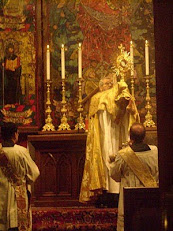
Some will find themselves using the different Office books for different purposes – one for individual prayer and devotion, the other for public worship. Those who want to use the Roman Office books in the morning and the Customary in the evening – or the other way round – will be able to do so without too much difficulty. The particular value of the Customary is that it makes available one of the acknowledged treasures of the Anglican tradition – the public celebration of the Office, and in particular of Evensong. The reform of the Roman Office following the Second Vatican Council sought the development of the public celebration of the Office and, truth to tell, that is a reform yet to be realised. In these early days of the Ordinariates, there have been already many celebrations of Evensong and Benediction and it is intriguing to know not only that this has been in accordance with the Holy Father, Pope Benedict’s wish, but also that it has been his great pleasure, that this should have been so.

Traditional language
It is hoped that the Customary will be ecumenically helpful too. There has been a deliberate decision by the Holy See that the Ordinariate’s distinct Use should be predominantly in traditional language. This is not to criticise in any way the modern language translations and compositions of recent Anglican revisions. Rather it is a recognition of the value of the sacral language of the Prayer Book. Members of the Ordinariates in North America and Australia are great devotees of Prayer Book English. Moreover, the 400th anniversary of the 1611 Authorised Version of the Bible (AV) – and the immense popularity still of cathedral Evensong – shows that the British public too are aware of the beauty and importance of a traditional sacred dialect. It is that dialect which the Customary and the Revised Standard Version (RSV) of the Bible preserve and make available.

‘Common Bible’
Why the RSV and not the King James Bible? The answer lies in the subtle development of the English Bible tradition. For accuracy’s sake, twentieth century students began to rely on the Revised Version of 1881-1894. Meanwhile the Revised Standard Version of 1946-1957 was becoming established and, in 1966, was accepted by Catholics and Protestants as a ‘Common Bible’. It was the first truly ecumenical Bible and brought together the two traditions – the Catholic Douay-Rheims Bible and the Protestant Authorised Version. Thus, whenever the Customary quotes extensively from the Bible, it is the RSV that it uses. The Catholic Church in the 1970s in Britain opted (mistakenly as it now seems) for the ‘dynamic equivalent’ Jerusalem Bible translation. That version greatly helped public understanding of the Scriptures, but, like the Mass translation of the same period, was based on a theory of translation that is of great value in paraphrasing and communicating the meaning of, for example, modern literature written in other languages, but no longer thought appropriate for representing sacred texts written in ancient languages.
Our prayer is that the Customary will be a treasury not only for the Ordinariates but for the whole English-speaking world.
__
The Customary of Our Lady of Walsingham is available to 'pre-order' from Amazon.co.uk here.