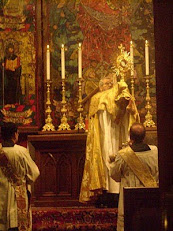
The first principle of the Ordinariate is then about Christian unity. St. Basil the Great, the Church’s greatest ecumenist, literally expended his life on the work of building bridges between orthodox brethren who shared a common faith, but who had become separated from one another in a Church badly fragmented by heresy and controversy. He taught that the work of Christian unity requires deliberate and ceaseless effort...St. Basil often talked with yearning about the archaia agape, the ancient love of the apostolic community, so rarely seen in the Church of his day. This love, he taught, is a visible sign that the Holy Spirit is indeed present and active, and it is absolutely essential for the health of the Church.

- Msgr. Jeffrey Steenson, Homily on the Occasion of his Formal Institution as Ordinary
Showing posts with label Vatican II. Show all posts

Thursday, September 25, 2014

Prayer Book Society of Canada on the words of Divine Worship

In the Lent 2014 newsletter of the Prayer Book Society of Canada, there is a long article on the restoration of the traditional wording of the Prayer of Humble Access in the Divine Worship liturgy used by Ordinariate parishes. Here is a short excerpt from the article:

 One of the bugbears of the revisers was the “overly penitential” nature of the Book of Common Prayer, and one of their favourite targets was the Prayer of Humble Access, held up for mockery as the Prayer of Humble Excess.
The authors of the Canadian Book of Alternative Services (BAS) followed the lead of those who produced the 1979 U.S. Prayer Book, and removed the same words. During the wave of propaganda that accompanied its introduction, the removal of these words became something of a touchstone, a cause célèbre, for the liturgical changes it embodied. It was proudly pointed out at so many “implementation sessions” for the BAS how the revised wording was so superior to that of the BCP. Cranmer’s phrase was derided for being “simplistic”, “literal minded”, even “fundamentalist” in implying that the bread was for our bodies, and the chalice for our souls, even though the Words of Administration which immediately follow the Prayer of Humble Access make it clear that both bread and wine are for the preservation and cleansing of both body and soul.
 BAS for the Cranmer’s wording was based on a footnote from Dom Gregory Dix’s book The Shape of the Liturgy (p. 611-12), where Cranmer’s memorable and sublime phrase is dismissed as a “mediaeval speculation”. (Dix’s book was treated with something approaching reverence by the liturgical revisers, almost as if it were Holy Scripture itself.) In fact, Dix had it quite wrong: the parallel imagery “bread/Body/body” on the one hand and “wine/Blood/soul” on the other (that is, the bread of the sacrament / the Body of Christ given for us / our bodies, and the wine of the sacrament / the Blood of Christ shed for us / our souls), is neither mediaeval nor speculative. Thomas Aquinas derives it from Ambrosiaster, the patristic writer of the fourth century, and Ambrosiaster in turn derives it directly from Leviticus 17:11: “It is the blood that makes atonement for the soul.” Thus the imagery belongs to the early Church’s meditation on the Scriptures, and to the Scriptures themselves. It needs to be remembered that it is this mind of the early church as it meditated upon the Scriptures which was the ideal for the Anglican reformers, in contrast to the Continental reformers, who tended to work on the basis of sola Scriptura , “Scripture alone”. So Cranmer’s memorable language encapsulates Aquinas, Ambrosiaster, and Leviticus - Mediaeval Church, Patristic Church, and the Old Testament, all in reference to the supreme act of Our Lord’s sacrifice for us as set out in the New Testament.
Hat tip to Jim Hilborn.

Monday, November 25, 2013

Msgr. Wadsworth of ICEL to speak at Mount Calvary, Baltimore - Friday, December 6th

Mount Calvary Welcomes Msgr. Andrew Wadsworth for a Special First Friday Lecture on Vatican II and the Liturgy

Mount Calvary Catholic Church, Baltimore's Ordinariate parish, continues its new monthly First Friday Series on Friday, Dec. 6. Adoration and Confessions will begin at 5:30 pm, followed by Devotions and Benediction in the Anglican Use at 6:30 pm. The First Friday supper and lecture will follow immediately after Benediction at 7:00 pm. Msgr Wadsworth will be giving a talk on Vatican II and the sacred liturgy, entitled “Sacrosanctum Concilium: What We Have Done, and What We Have Failed To Do.” 

Msgr. Wadsworth is Moderator of The Community of St. Philip Neri, a community-in-formation for the Oratory at the Church of St. Thomas the Apostle in Washington, D.C., and is the Executive Director of the International Commission on English in the Liturgy (ICEL). Mount Calvary, long known for its Anglo-Catholic traditions and liturgy, entered the Catholic Church in January, 2012 as the first parish of the Personal Ordinariate of the Chair of St. Peter. For more information, see our website at www.mountcalvary.com.


Sunday, December 27, 2009

The Legitimate Patrimony of Ethnic and Ritual Churches

The question of respecting the legitimate patrimony of distinct ritual churches has dogged the Catholic Church for many centuries; but this problem has usually been the result of local misunderstanding and not the teaching of the Church's magisterium. In the U.S. this problem's worst manifestations led to the creation of two separate schisms: the Polish National Catholic Church and the Carpatho-Russian Orthodox diocese. While the problems with ethnic diversity and between Eastern and Latin spirituality caused tension, this could have been resolved by the proper exercise of humility and patience. And while the situation of Anglicans is not exactly the same as that of either the Polish nor of the Eastern Churches, it is analagous.
The specific question of the Eastern Churches legitimate patrimony was taken up by the Second Vatican Council, in its decree Orientalium Ecclesiarum. But even before that, Pope Pius XII wrote, in his encyclical Orientalis Ecclesiae:
25. As it was in those times long past, Venerable Brethren, so will it be also today. More effective than anything else for promoting that reunion of all our separated sons with the one Church of Christ for which all good men are striving, will be a sincere and practical goodwill, with the help and inspiration of God. The fruit of such goodwill is mutual understanding, an understanding which Our Predecessors have sought so earnestly to foster and increase by various means, in particular by founding in Rome the Pontifical Institute of Higher Oriental Studies.
26. This goodwill implies also a proper respect for those traditions which are the special heritage of the peoples of the East, whether these be concerned with the sacred liturgy and the hierarchical Orders or with other observances of the Christian life, so long as they are in keeping with the true faith and with the moral law[emphasis mine-ed]. Each and every nation of Oriental rite must have its rightful freedom in all that is bound up with its own history and its own genius and character, saving always the truth and integrity of the doctrine of Jesus Christ.
27. We would have this to be known and appreciated by all, both by those who were born within the bosom of the Catholic Church, and by those who are wafted towards her, as it were, on the wings of yearning and desire. The latter especially should have full assurance that they will never be forced to abandon their legitimate rites or to exchange their own venerable and traditional customs for Latin rites and customs. All these are to be held in equal esteem and equal honor, for they adorn the common Mother Church with a royal garment of many colors. Indeed this variety of rites and customs, preserving inviolate what is most ancient and most valuable in each, presents no obstacle to a true and genuine unity. It is especially in these times of ours, when the strife and discord of war have estranged men's hearts from one another nearly all the world over, that all must be impelled by the stimulus of Christian charity to promote union in Christ and through Christ by every means in their power.
28. But the work of faith and charity would remain incomplete and powerless to establish unity firmly in Christ Jesus, unless it rested upon that unshaken rock upon which the Church is divinely founded, that is, upon the supreme authority of Peter and his Successors.

In Anglicanorum Coetibus, Pope Benedict has applied these principles to the patrimony of Anglican Christians, recognizing that there is great value in many of the liturgical and spiritual customs found in Anglicanism. That even the Complementary Norms are not specific about this patrimony allows freedom for this distinct Anglican patrimony to be defined by the ordinariates that will be erected.

Tuesday, December 1, 2009

ANGLICANS/Personal Ordinariates as an Expression of Vatican II Ecumenism

lunedì 30 novembre 2009
by Fred Kaffenberger, ilsussidiario.net (http://tinyurl.com/ygfvs3u)


The recent apostolic constitution on Anglicans seeking full communion with the Catholic Church, Anglicanorum Coetibus, has stirred up a wide range of reactions among Catholics, Anglicans, Protestants, and the Orthodox churches. As the Bishop of Rome, the Pope has an apostolic responsibility to all baptized Christians, even if their ecclesial communion does not accept Roman primacy. And so, when groups of Anglicans approached the Vatican seeking union, Pope Benedict XVI responded with a pastoral gesture to enable groups to be admitted corporately — even retaining as much as possible their historical character and pastoral structures. This corporate provision is thus a practical expression of Vatican II documents: Lumen Gentium (the dogmatic constitution on the Church) and Unitatis Redintegratio (the decree on Christian ecumenism)...

Read the rest on Virtue Online

Hat tip to Mary Ann Mueller