The first principle of the Ordinariate is then about Christian unity. St. Basil the Great, the Church’s greatest ecumenist, literally expended his life on the work of building bridges between orthodox brethren who shared a common faith, but who had become separated from one another in a Church badly fragmented by heresy and controversy. He taught that the work of Christian unity requires deliberate and ceaseless effort...St. Basil often talked with yearning about the archaia agape, the ancient love of the apostolic community, so rarely seen in the Church of his day. This love, he taught, is a visible sign that the Holy Spirit is indeed present and active, and it is absolutely essential for the health of the Church.

- Msgr. Jeffrey Steenson, Homily on the Occasion of his Formal Institution as Ordinary
Showing posts with label Philadelphia. Show all posts

Tuesday, November 4, 2014

NEWMAN FELLOWSHIP BECOMES ORDINARIATE PARISH


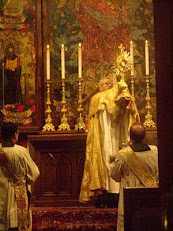
Yesterday evening (Sunday, 02 November 2014) The Fellowship of the Blessed John Henry Newman (http://blessedjohnhenrynewmanfellowship.org/) was received as a group into the Anglican Ordinariate of the Chair of St. Peter (http://www.usordinariate.org/) established by the Constitution “Anglicanorum Coetibus,” issued by Pope Benedict xvi, and became an official parish of the Ordinariate, at Our Lady of the Assumption Catholic Church in Wayne, PA (http://www.olastrafford.org/).

David L. Moyer, formerly the rector of the Episcopalian parish, The Church of The Good Shepherd, and pastor to the Fellowship during its period of discernment, presented the parishioners to the Rev. David Ousley, who received the group on behalf of Msgr. Jeffrey Steenson, the Ordinary. The formal reception into communion took place during a Solemn High Mass celebrated by Fr. Ousley using the Anglican form of worship approved by the Holy See for use in the Ordinariate. The service was followed by a reception hosted in the Assumption Parish Building by the congregation of the Church of St. Michael the Archangel (http://www.anglicanphiladelphia.org/), for which Fr. Ousley is Pastor.

Approximately forty families left The Church of The Good Shepherd to follow Moyer when the Episcopal Church deposed him as Rector. Thirty of these have now entered communion with the See of St. Peter through the Ordinariate. Some families were already Catholic, and others have entered communion with the See of St. Peter through their local Roman Catholic parishes.

The Ordinariate was established by Pope Benedict xvi to allow groups of Anglicans to enter communion with the Holy See as corporate bodies, while retaining their married clergy and Anglican forms of worship. The Newman Fellowship joins the 35 other parishes of the Ordinariate, for which the Church of Our Lady of Walsingham in Houston (http://walsingham-church.org/) is the mother church and the seat of the Ordinary. Father Ousley, Pastor of the Church of St. Michael the Archangel in Philadelphia, is interim Pastor for the Newman Fellowship, as well as for the Church of St. Michael the Archangel, the two parishes of the Ordinariate in the Philadelphia area. The Newman Fellowship has its temporary home at the Church of Our Lady of the Assumption.

Hat tip to Mary Ann Mueller.

Wednesday, October 17, 2012

Friends of the Ordinariate in Philadelphia

From the monthly newsletter of St. Michael's in Philadelphia:
We are this month launching the Friends of the Ordinariate in Philadelphia. Its purpose is:
  • to support the mission of Ordinariate congregations in the region of southern and central New Jersey, southeastern Pennsylvania and northern Delaware (currently St Michael's is the only one).
  • to help develop new Ordinariate congregations in the region.
  • to connect Anglicans, whether already in communion with the See of Peter or not, with the Ordinariate.
  • to articulate the purpose and mission of the Ordinariate to Catholics and others interested in it.
The aim is to involve people in the mission of the Ordinariate in the region even though they may not be members of St Michael's. The Ordinariate is a new thing after all; we need help getting the word out that we are up and running. We also need help explaining what it is we are about, especially to those in the Latin Rite. And we need help identifying those who might benefit from being a part of an Ordinariate congregation. We will be inviting those who have visited St Michael's to join, as well as those who have been a part of our larger family over the years. If you know of people who might be interested, please let me know and I will see that they receive an invitation to join. As I have mentioned in the past, Msgr Steenson has asked us to serve as the portal for the region. So we need to find those who are part of the Anglican patrimony and are ready to establish Ordinariate congregations, and then help them to do so. My hope is that the Friends will help with this, as well as supporting St Michael's with our various needs as we get more permanently settled. It is important for us to think of our mission not just in terms of building up St Michael's, important as that is. We are part of this great experiment, which the Holy Father has launched, of preserving and developing the Anglican patrimony within the fold of the Catholic Church. This is an exciting task. Daunting as well. If we give ourselves to it generously, God can and will do some great things.

Saturday, June 16, 2012

Renegade Episcopal rector to be ordained Roman Catholic church

By David O'Reilly
Inquirer Staff Writer


Rev David Ousley at Holy Cross Church where
he was ordained on June 16, 2012


The Rev. David Ousley was baptized a Methodist in 1951, was ordained a priest of the Episcopal Church in 1979, and left it in 1999 for the Anglican Church in America.

And on Saturday, this 61-year-old married father of three will make one more ecclesiastical leap: he will be ordained a priest of the Roman Catholic Church in a 11 a.m. Mass at Holy Cross Church in Mount Airy.

He is "swimming the Tiber," as Anglicans call conversion to Catholicism — a reference to the river that runs through Rome — but the white-bearded Ousley will not emerge from his swim on some strange and foreign shore.

Even after he becomes a Catholic priest, he can continue to wear his Anglican collar, lead his flock at Vesper services, warble old hymns like "A Mighty Fortress," and read some of the prayers found in the lectionary that the Church of England has been using since King Henry VIII broke with Rome in the 16th century .

After decades of petitioning and negotiating by conservative Anglicans and Episcopalians, Pope Benedict XVI in 2009 approved a constitution, called Anglicanorum Coetibus, establishing the equivalent of national dioceses for disaffected Anglicans such as Ousley. These ordinariates, as they are called, allow laity and clergy from the Anglican tradition to join the Roman Catholic Church while retaining much of their liturgies, calendar, and traditions — including married priests.

The ordinariate for Britain was created last year, for the United States and Canada in January, and for Australia on Friday. About 60 Anglican priests and 2,000 laypeople are expected to join the North American ordinariate, headed by the Rev. Jeffrey Steenson, a former rector of the Episcopal Church of the Good Shepherd in Rosemont and a longtime friend of Ousley and his wife, Beth...

Read the full story with much of Fr. Ousley's biography on the web site of the Philadelphia Inquirer.

Friday, June 1, 2012

St Michael the Archangel in Philadelphia is profiled...

in this article by Michael Caruso

Holy Cross Roman Catholic Church in East Mt. Airy hosted a truly groundbreaking event on Sunday, May 20.
The event, accompanied by a Mass, marked the formal introduction of the Anglican Catholic parish of St. Michael the Archangel, which worships at Holy Cross, into the Roman Catholic communion. St. Michael’s is the first Anglican parish in Greater Philadelphia to be received into the U.S. Ordinariate and one of the first nationwide.
The Mass was celebrated by Monsignor Jeffrey Steenson, Ordinary of the Ordinariate of the Chair of St. Peter, a non-geographical structure established by Pope Benedict to provide Anglicans with distinctive liturgical elements of their church while moving them to full communion with the Roman Catholic Church.
The Church of St. Michael the Archangel began as the Episcopal Church of St. James the Less in East Falls, which was founded in 1846.
The congregation of St. James the Less left its historic property in East Falls in 2006 and has not had its own church since then. The congregation had disaffiliated itself from the Episcopal Church in 1999 and had become a member of the Anglican Church in America...

The local Episcopal diocese sued for the property in 2001 and subsequently won the case.
While individual dioceses and the Episcopal Church as a whole were moving in the direction of following the spirit of the times, Ousley and his fellow parishioners at St. James the Less were not willing to do so. Upon disaffiliating from the Episcopal Church, the parish joined the more traditional Anglican Church in America.
When asked why he and the parish decided to join the newly established Anglican Ordinariate, Ousley said the move to reconvene with the Catholic Church seemed like the right thing to do, “The catholicity of the church is important to us, and it was becoming increasingly difficult to be assured of the catholicity of any of the Anglican church bodies in the United States,” he said. “We were afraid of ending up with the externals of the faith but losing the substance"...

Read the full story on Chestnut Hill Local.

Hat tip to Fr. Ernie Davis via Facebook.

Thursday, May 10, 2012

On the Vine and the Branches

From a mid-week reflection by Bishop Moyer of the Fellowship of Blessed John Henry Newman:

The Prophets spoke in different ways of Israel as being both vineyard and vine from which God looks for good fruit. The Prophets tell how their disobedience in clinging to false gods had disastrous effects on the vineyard and vine of God’s planting.

Jesus reintroduces and redefines this image of the vineyard and vine, saying that He, as the Incarnate Son of God, has been planted in their midst by a merciful and graciously-providing and restoring God. They are to understand themselves as the branches that need to find themselves connected to God through Jesus the Messiah – the One who comes to lead them into holiness and righteousness before God. They are to be firmly connected with Him as the Vine, so that they bear good fruit. If they remain unconnected, they will not be able to bear the fruit they should, and may even find themselves cut off from the Vine and thrown away as useless.

It is more than interesting to me that in teachings like this, in which Jesus makes very profound statements about He who is, He offers both the promise of blessings and abundant life when people accept Him for who He is; but, at the same time, makes it clear that the consequences of not accepting His teaching and direction are severe, i.e. that the branch can either bear much fruit, or it can be thrown into the fire and burned!

What we are to hear in this Gospel passage is that the Catholic Church is the vineyard, the New Israel, and Jesus the Vine is its head through the Successor of Peter. Jesus prayed, as we do at every Mass, that we “all may be one." We long for that, and we pray that it will (in God’s time) be our corporate reality. The Holy Father gave us his Apostolic Constitution Anglicanorum Coetibus, meaning “groups of Anglicans." As we hope, pray, and work for such unity, we are to be connected with Jesus the Vine for His Life to live within us – that, as we pray in the Prayer of Humble Access (referring His Presence in the Blessed Sacrament) “that we may evermore dwell in him, and he in us.”

The final words of that great Anglican prayer points to what Father Bartunek writes in his book The Better Part about this morning’s Gospel. He writes: “Where does the vine stop and its branches begin? Their union is too complete to tell. The same sap gives life to the vine and its branches. He is Lord from within, renewing our hearts from the inside, as only God can do” (p. 944).

Read the entire reflection at the web site of the Fellowship.

Sunday, April 15, 2012

US Ordinariate Web site sums up Holy Week and Easter Week Activity

First Ordinariate-Bound Canadian Group Received into Catholic Church, April 15, 2012

Forty Anglicans are being received into the Catholic Church in Ottawa on Divine Mercy Sunday, April 15, with the intent of joining the Personal Ordinariate of the Chair of St. Peter. The Houston-based Ordinariate, under the guidance of Msgr. Jeffrey N. Steenson, will have oversight of Canada as well as the United States.

The 40 are members of the Cathedral of the Annunciation parish, part of the Anglican Catholic Church of Canada. They are being received by Ottawa Archbishop Terrence Prendergast, S.J. at St. Patrick’s Basilica in Ottawa.

Earlier this month, communities in Philadelphia and Indianapolis came into full communion with the Catholic Church and Jon Chalmers became the first of the candidates preparing for priestly ordination in the Ordinariate to be ordained a transitional deacon.

from the web site of the Personal Ordinariate of the Chair of St. Peter.

Tuesday, April 3, 2012

Philadelphia Anglican Community Joins Catholic Church During Holy Week


The rector and members of St. Michael the Archangel Anglican parish in Philadelphia were received into full communion with the Catholic Church on April 2. This is the first Anglican community in Pennsylvania to join a new national structure created by Pope Benedict XVI for Anglican groups and clergy who are becoming Catholic. The rector, David Ousley, is preparing to be ordained a Catholic priest later this year.

Monsignor Jeffrey Steenson, the head of the U.S. Ordinariate nationally, will celebrate Mass and preach for the new Catholic community on Holy Thursday, April 5, 6 p.m. at Holy Cross Church, 140 E. Mount Airy Avenue in the Mount Airy section of Philadelphia.

The Ordinariate of the Chair of Saint Peter is similar to a regular Catholic diocese, but national in scope. Pope Benedict XVI established it on January 1 in response to requests by Anglicans seeking to become Catholic, and appointed Msgr. Steenson, a former Episcopal bishop based in Houston, TX, as the leader. Ordinariate parishes will be fully Catholic while retaining elements of their Anglican heritage and traditions, including liturgical traditions.

“We are very grateful to Pope Benedict for giving us this opportunity to enter into full communion with the Catholic Church while retaining our identity as Anglicans,” said Father Ousley.

Archbishop Charles J. Chaput, O.F.M. Cap., of the Archdiocese of Philadelphia said, “It’s my pleasure to prayerfully welcome Father David Ousley and the faithful of Saint Michael the Archangel Anglican Parish as they enter into full communion with the Roman Catholic Church. We will support our brothers and sisters in Christ on their spiritual journey. May the Lord grant them peace and every blessing.”

Fr. Ousley noted, “We look forward to developing the work of the Ordinariate in Philadelphia, in cooperation with Msgr. Steenson and the Archdiocese of Philadelphia. Father James Cox, pastor of Holy Cross and St. Madeleine Sophie Catholic parishes in Mount Airy, and Auxiliary Bishop John McIntyre have been welcoming and unfailingly helpful in our transition into full communion. As with any such transition, it has been a challenging journey. Yet, we already have heard from former Anglicans who are interested in joining us.”

Msgr. Steenson added, “I deeply appreciate the support that Archbishop Chaput and the Archdiocese have given to assist this community in this great adventure of Christian unity. I think this is precisely what Pope Benedict intended when he created the Ordinariate for Anglicans who desire to join the Catholic family that Anglicans originally came from. Fr. Ousley himself is a distinguished representative of this great tradition of learning and spirituality. I have known him for many years and am confident that he and his congregation will find a warm welcome within the Catholic community of Philadelphia."

The 25 members of St. Michael’s studied the United States Catechism of the Catholic Church for Adults, working closely with the Archdiocese of Philadelphia. The parishioners are among more than 1,400 people in 20 communities across the United States who have asked to join the Ordinariate. Nearly 40 former Anglican priests also are studying to be ordained Catholic priests.

St. Michael’s traces its roots to the Episcopal Church of St. James the Less, founded in East Falls in 1846. For the past five years, the parish has been part of the Anglican Church of America. The community will be moving its Sunday services to Holy Cross Parish at 9 a.m. after Easter. Weekday services are at the St. Michael's Rectory in Mount Airy.

For more information on the Ordinariate of the Chair of Saint Peter, one of only two ordinariates in the world, visit www.usordinariate.org. St. Michael’s is online at http://anglicanphiladelphia.org.

Contacts:

David Ousley, St. Michael Parish, 215-247-1092 and dao@anglicanphiladelphia.org
Susan Gibbs, U.S. Ordinariate, 202-525-9554 and media@usordinariate.org

-----

Thursday, April 5th -- BREAKING NEWS UPDATE --

Due to difficulties with American Airlines, 60 of whose ships have been rendered unable to fly due to the storms, Msgr. Steenson will not be able to join the Congregation of St. Michael’s Philadelphia for Maundy Thursday. With no back up priest, the Maundy Thursday liturgy scheduled for 6 p.m. on Thursday is cancelled. Members of the parish are encouraged to attend the 8 p.m. liturgy at the Church of the Holy Cross in Mt. Airy.

-- STILL MORE UPDATES --

From Fr. Ousley to the people of St. Michael’s Philadelphia. For public distribution.


Dear friends --

First, Monsignor Steenson wished me to convey his sincere apologies for not being with us tonight. He is sorry to miss us, and to disappoint us, and sends his blessing.

Second, he has arranged to be with us on the Sunday after Ascension, May 20th. This is his first open Sunday. This will give us a more leisurely visit than we would have had tonight, so there is some advantage to it. Please mark your calendars.
Fr O.

Please join us at the Church of the Holy Cross, 144 E. Mt. Airy Ave., Philadelphia Pa. on Sunday May 20th at 9 a.m., to welcome our Ordinary.

Wednesday, February 22, 2012

PHILADELPHIA: TAC Bishop Moyer Denied Entry into Roman Catholic Church as Priest

Msgr. Jeffrey Steenson tells Moyer he can only enter as layman. Unresolved personal issues remain

By David W. Virtue
February 21, 2012

Traditional Anglican Communion (TAC) Bishop David Moyer has been denied ordination into the Roman Catholic Church by Msgr. Jeffrey Steenson, the Ordinary of the Personal Ordinariate of the Chair of St. Peter. Citing a number of unresolved issues, he informed Moyer of his decision when he addressed the congregation of the Blessed John Henry Newman parish of Bishop Moyer last Sunday.

"The issues we have been dealing with only pertain to the question of ordination," Steenson told Virtueonline. "I informed the congregation of the possibility of partnering with St. Michael's whose rector, the Rev. Dr. David Ousley and congregation is in discernment and study. He is in the formation program."

Moyer received a nulla osta (no impediment) from the Congregation for the Doctrine of Faith in early November 2011. However, the local Catholic bishop has to give a votum for someone who resides in his diocese. Archbishop Charles Chaput declined to give Moyer his votum to proceed toward ordination in the Catholic Church.

This was reaffirmed and confirmed by the visit last Sunday of Steenson who told Moyer he could only be received as a layman. It is not known at this time what the congregation will do. Moyer's leadership now hangs in the balance. Moyer was pinning all his hopes on entering the Roman Catholic Church under the Ordinariate that would have enabled him to retain certain Anglican liturgical practices.

"I told the people on Sunday that they must follow their conscience on the question of coming into full communion with the Catholic Church. Lumen Gentium 14 (the Vatican II constitution on the Church) makes this a matter of salvation: 'Whosoever, therefore, knowing that the Catholic Church was made necessary by Christ, would refuse to enter or to remain in it, could not be saved. So, even if the Fellowship was not ready to make this decision, if an individual was convinced about what the Catholic Church teaches about herself, he or she should not be afraid to move forward.

"Catechumens who, moved by the Holy Spirit, seek with explicit intention to be incorporated into the Church are by that very intention joined with her. With love and solicitude Mother Church already embraces them as her own.'" (LG 14)," Steenson told VOL...

Read the rest of the story at Virtue Online.

Hat tip to Fr. Stephen Smuts at his eponymous blog where he ponders the Church, Biblical Archaeology and Culture.