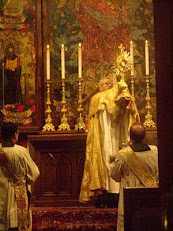
The first principle of the Ordinariate is then about Christian unity. St. Basil the Great, the Church’s greatest ecumenist, literally expended his life on the work of building bridges between orthodox brethren who shared a common faith, but who had become separated from one another in a Church badly fragmented by heresy and controversy. He taught that the work of Christian unity requires deliberate and ceaseless effort...St. Basil often talked with yearning about the archaia agape, the ancient love of the apostolic community, so rarely seen in the Church of his day. This love, he taught, is a visible sign that the Holy Spirit is indeed present and active, and it is absolutely essential for the health of the Church.

- Msgr. Jeffrey Steenson, Homily on the Occasion of his Formal Institution as Ordinary
Showing posts with label Petrine Ministry. Show all posts

Tuesday, January 11, 2011

On the Feast of St. Peter's Chair...

Thou art Peter and on this rock I will build my Church.

On 22nd February we celebrate the feast of the Chair of St. Peter. This feast day is our opportunity to thank God again for the primacy of the Pope as chief shepherd of Christ's flock. It is our opportunity to affirm our belief in the full, supreme, universal and immediate jurisdiction of His Holiness the Pope over each and every single one of the faithful. Christ Himself is the Head of the Church, and He chose St.Peter and his successors to share and mediate that headship and its primacy, as servant of the servants of God.

We are told that a number of Anglicans are in the process of considering their position in the light of the Holy Father's extraordinarily generous offer to them in his recent Apostolic Constitution Anglicanorum Coetibus, which makes canonical provision for personal ordinariates for Anglicans who leave the Church of England and enter into full communion with the Catholic Church. It has also been said that a number of them are hoping to make a decision by the feast of the Chair of St.Peter this year. We must pray for the Holy Spirit to guide them in their response to the Holy Father...

Read the rest at the web site of the Brompton Oratory.

Hat tip to David Clayton.

Wednesday, January 27, 2010

FRANCIS OF ASSISI, A GIANT OF SANCTITY

This isn't specifically "Anglican Use", but Benedict XVI's powerful teaching about Francis speaks about unity, charism, renewal...all elements that are important in the Holy Father's initiative for reuniting Anglican communities with the Catholic Church.

VATICAN CITY, 27 JAN 2010 (VIS) - Benedict XVI dedicated his catechesis during the general audience, held this morning in the Paul VI Hall, to St. Francis of Assisi (1181/82-1226), a "true 'giant' of sanctity who continues to enthral many people of all ages and religious beliefs".

Francis, the Pope explained, was born into a rich family and passed a carefree youth. At the age of twenty he took part in a military campaign and was taken prisoner. On his return to Assisi he began a process of spiritual conversion that gradually led him to abandon worldly life. In the hermitage of St. Damian, Francis had a vision of Christ, Who spoke to him from the crucifix inviting him to repair His Church.

This call "contains a profound symbolism", said the Holy Father, because the ruinous condition of the hermitage also represented "the dramatic and disquieting situation of the Church at that time, with her superficial faith that neither formed nor transformed life, her clergy little committed to its duties, ... and the interior decay of her unity due to the rise of heretical movements. Yet nonetheless, at the middle of that Church in ruins was the Crucifix, which spoke and called for renewal, which called Francis"...

Read the rest of this report at the Vatican News Service.

Saturday, October 3, 2009

Benedict's Trip to Britain: New Details Emerge

October 3, 2009
by Shawn Tribe

From the Catholic Herald today comes a story about the forthcoming visit of the Holy Father to Britain, where it is surmised he might visit London, Oxford, Birmingham and Edinburgh.

Within that story is the expected question of whether the Holy Father would himself beatify Cardinal Newman during the course of his visit:
Some Catholics are hoping the Pope will break with convention and beatify Cardinal Newman himself.
Fr Federico Lombardi, the Pope's spokesman, said such a trip would be an "obvious occasion" to beatify Cardinal Newman. A journalist in the Czech Republic noted that Benedict XVI had previously expressed a preference to allow beatifications to be carried out by the local Church rather than by the Pope. In response, Fr Lombardi said: "We have a year to figure that out."


Read the rest at The New Liturgical Movement blog.

Wednesday, May 13, 2009

Michael Nazir-Ali: Anglicans must 'look to Pope for unity'

by Ruth Gledhill
May 9, 2009

As the Covenant process seemed to sustain something of a blow in Jamaica I was enjoying a the kindly light of Oxford's Newman Society at the Catholic Chaplaincy, where Michael Nazir-Ali, Bishop of Rochester who recently announced he is to retire to work with persecuted Christians, was speaking about the future of the Anglican Communion. The bishop was interviewed before he spoke by Michael Webb. Read on for some of my notes on his speech.
Bishop Michael spoke about the equal and opposite pulls in Anglicanism, towards the 'logic of Catholicism' or the 'logic of fragmentation'.
'The question now arises, which logic will prevail. It is quite possible that the logic of fragmentation will prevail and people will go their own way. Or it may be that the Anglicans will see their way to the Catholic Church, to God's will as expressed in Christ's highly prescient prayer for the unity of Christians across the ages and throughout the world.
'Anglicans to their credit have never claimed to be the one, true Church.' He noted that successive Lambeth Conferences had accepted that Anglicanism stands ready to disappear in the cause of Catholic unity, 'that is, it [Anglicanism] is not an end to itself but a means towards the greater Catholicism which is God's will.'

Read in full on Ruth Gledhill's blog Articles of Faith.