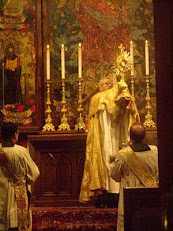
The first principle of the Ordinariate is then about Christian unity. St. Basil the Great, the Church’s greatest ecumenist, literally expended his life on the work of building bridges between orthodox brethren who shared a common faith, but who had become separated from one another in a Church badly fragmented by heresy and controversy. He taught that the work of Christian unity requires deliberate and ceaseless effort...St. Basil often talked with yearning about the archaia agape, the ancient love of the apostolic community, so rarely seen in the Church of his day. This love, he taught, is a visible sign that the Holy Spirit is indeed present and active, and it is absolutely essential for the health of the Church.

- Msgr. Jeffrey Steenson, Homily on the Occasion of his Formal Institution as Ordinary
Showing posts with label Papacy. Show all posts

Tuesday, December 16, 2014

A Living and Developing Patrimony: A Homily on Acts 10:17-33.


"At every pivotal moment in the Church’s history, Peter is there, the person of the Pope, the Vicar of Christ, who carries the mission forward, keeping the Church ever ancient and ever new, as he’s doing now, in our own day."

From the 2011 Anglican Use Conference at St. Mary the Virgin in Arlington, Texas, Fr. Christopher Phillips preached this homily, which was published in Volume 3, Number 9 (Lent 2012) issue of Anglican Embers. Preaching on the reception of Cornelius and his household into the Church, Fr. Phillips' homily is perhaps something to read and meditate on in a time when many in the Church are perturbed about current events in Rome and reports about Pope Francis. 


Tuesday, January 4, 2011

Anglican Catholics Then and Now

Last weekend, in London, three Anglican bishops and their families were received into full communion with the Catholic Church in a very public ceremony in Westminster Cathedral. Three Anglican nuns and some laypeople were also received. By Easter it is expected that the Anglican Ordinariate will have been set up, and up to 50 more Anglican priests will be received into the Catholic Church along with a significant number of laypeople.

This public reception is in marked contrast to the manner in which I, and many others were received into the Catholic Church in England in the mid 1990s. At that time "ecumenism" was still the main priority for the Catholic bishops of England and Wales as well as the Anglican establishment. There was a pact between the rulers of both churches that the defections to Rome would be low key. No one wanted to rock the ecumenical boat. Consequently, the publicity machines of both churches went into overdrive to downplay and minimize what was happening. In fact, in the mid 1990s there were not fifty Anglican priests who converted but 500. Some even reckoned the numbers to be between 750 and 1000. The reason it was difficult to establish how many of us converted to the Catholic faith at that time was because certain categories of Anglican priest didn't register in the official tally. Retired clergy, clergy in minor posts like hospital chaplains and school chaplains or priests who were only ordained for a short time all failed to appear on the official lists. This was on purpose. Both the Catholic and Anglican hierarchy had done a deal that the numbers would be deflated, those receiving converts into the Catholic Church were told specifically to make the reception low key. Those of us resigning our livings and being received were told to keep a low profile. So, for example, my wife and I received private instruction at Quarr Abbey and were received on a Tuesday evening in the crypt in a very quiet and private Mass...

read the rest of Fr. Longenecker's thoughts at his blog Standing on My Head.

Hat tip to Mary Ann Mueller

Wednesday, January 27, 2010

FRANCIS OF ASSISI, A GIANT OF SANCTITY

This isn't specifically "Anglican Use", but Benedict XVI's powerful teaching about Francis speaks about unity, charism, renewal...all elements that are important in the Holy Father's initiative for reuniting Anglican communities with the Catholic Church.

VATICAN CITY, 27 JAN 2010 (VIS) - Benedict XVI dedicated his catechesis during the general audience, held this morning in the Paul VI Hall, to St. Francis of Assisi (1181/82-1226), a "true 'giant' of sanctity who continues to enthral many people of all ages and religious beliefs".

Francis, the Pope explained, was born into a rich family and passed a carefree youth. At the age of twenty he took part in a military campaign and was taken prisoner. On his return to Assisi he began a process of spiritual conversion that gradually led him to abandon worldly life. In the hermitage of St. Damian, Francis had a vision of Christ, Who spoke to him from the crucifix inviting him to repair His Church.

This call "contains a profound symbolism", said the Holy Father, because the ruinous condition of the hermitage also represented "the dramatic and disquieting situation of the Church at that time, with her superficial faith that neither formed nor transformed life, her clergy little committed to its duties, ... and the interior decay of her unity due to the rise of heretical movements. Yet nonetheless, at the middle of that Church in ruins was the Crucifix, which spoke and called for renewal, which called Francis"...

Read the rest of this report at the Vatican News Service.

Monday, December 14, 2009

ARCIC and the Apostolic Constitution

December 14, 2009
Fr. John Hunwicke

ARCIC and the Apostolic Constitution
Archbishop Rowan didn't - despite the claims of his critics - call the ecclesiology of Anglicanorum Coetibus eccentric. He suggested that there are others who might say it. A characteristically elegant dodge; not as crude as Cicero's favourite, praeteritio ("I forebear to say that my opponent is a proved embezzler and paederast; let me simply ..."). Is there a techical name in Rhetoric for "Others may say X "? Is it the same device as "You may say that, Matty; I couldn't possibly comment"?

His Grace has a point. The ecclesiology of AC does diverge from the norms to which we are accustomed and which he himself has lucidly expounded: that a "local church" is not a denomination or a province but bishop-and-presbytery-and-diaconate-and laos. Perhaps his words indicate that he is going to make one last herculean effort to secure just such an uneccentric provision for us from General Synod. If he is, all power to his elbow. If the Westminster monsignori do succeed in sabotaging the Holy Father's initiative, we could need something to fall back on. Mind you, I devoutly hope not ...

Where Rowan fails is in not taking account of some aspects of the exercise of Primacy. This was well set out in The Gift of Authority (ARCIC 1999). "We envisage a primacy that will even now help to uphold the legitimate diversity of traditions, strengthening and safeguarding them in fidelity to the Gospel ... This sort of primacy will already assist the Church on earth to be the authentic catholic Koinonia in which unity does not curtail diversity ... Such a universal primate ... will promote the common good in ways that are not constrained by sectional interests ..."

Such an understanding of primacy implies primatial intervention to protect diversity which is under threat...

Read the rest at Liturgical Notes

Monday, November 30, 2009

Homily for the First Sunday of Advent – The Church is ONE

‘We believe in one holy catholic and apostolic Church.’

+ In the name of the Father …

Every Sunday, week by week, and on certain other feast days, we recite the Nicene Creed, and during this Advent, I shall preach on each of its four Sundays on the Church that we say in the Creed we believe to be one, holy, catholic and apostolic.

For those who are quite properly expecting the homily to be preached on the Gospel and other readings of the day – as it ordinarily should, I have printed in today’s sheet, and shall do for the next three Sundays, the Lectio Divina mediation on the readings of the day published by the United Bible Societies.

And I am preaching on the nature of the Church as one, holy, catholic and apostolic not just as an exercise suggested because Advent conveniently has four Sundays, but in the context of the prayer and discernment which are needed with regard to the Apostolic Constitution Anglicanorum coetibus that has offered the equal and honoured place in the Catholic Church that Anglicans – some Anglicans anyway – have prayed and worked for over many years...

Read the rest of this fine homily at One Timothy Four

Hat Tip to Christian Campbell of The Anglo-Catholic

Wednesday, November 4, 2009

I love the Pope: Why the Apostolic Constitution is a Good Thing

Monday, November 2, 2009 • 7:53 am
Matt Kennedy

I've frankly been surprised by the reaction to Pope Benedict's recent Apostolic Constitution offering a Personal Ordinariate to Anglicans who wish to reunite with the Roman church. Some have accused the pope of "poaching". Others have been angered at a move they anticipate will weaken the orthodox witness in the Communion by pulling Anglo-Catholics away. Still others, apparently, just don't like the pope and leap at any excuse to criticize him.

Personally speaking, as a Calvinist Anglican, I love Pope Benedict. I am thankful for the Apostolic Constitution. I will never take up his offer but I think it good, generous, and were I not committed to the five solas of the reformation, as I am, I would be Roman in a heartbeat. There are so many things I admire and respect about the Roman Catholic Church in general and this pope in particular. Let me just list several right off the top of my head...

To read the rest of Rev. Kennedy's reflections, visit his blog Stand Firm.

Tuesday, December 30, 2008

A Tendency Toward Rome

by James G. Wiles
July 11, 2008

When, after the failed assassination attempts against President Ronald Reagan and Pope John Paul II, the Soviet Union and its evil empire collapsed instead, some thought they saw a sign. Perhaps it should not go unremarked, therefore, that we are about to see a similar sign: the return of a significant portion of the Anglican Church into the fold of the Roman Catholic Church. Similar tendencies toward Rome are evident in the Orthodox Churches, the Chinese Patriotic Church in Communist China and the schismatic Pius X Society.
One thing driving this, of course, is the ecumenical dialogue which began 40 years ago under Pope Paul VI. Another is the fact that, thanks to our modern popes, the prestige of the papacy is at a level not seen in centuries. Still another is the contrast between the worldwide growth of the Catholic Church and the disintegration (not to say, disappearance) of many main-line Protestant communions, both here and in Europe. Only the evangelicals, the Catholics and the Orthodox are prospering...
Read in full at The Bulletin, Philadelphia's family newspaper.