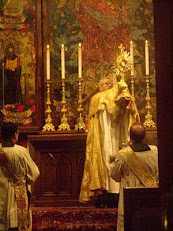
The first principle of the Ordinariate is then about Christian unity. St. Basil the Great, the Church’s greatest ecumenist, literally expended his life on the work of building bridges between orthodox brethren who shared a common faith, but who had become separated from one another in a Church badly fragmented by heresy and controversy. He taught that the work of Christian unity requires deliberate and ceaseless effort...St. Basil often talked with yearning about the archaia agape, the ancient love of the apostolic community, so rarely seen in the Church of his day. This love, he taught, is a visible sign that the Holy Spirit is indeed present and active, and it is absolutely essential for the health of the Church.

- Msgr. Jeffrey Steenson, Homily on the Occasion of his Formal Institution as Ordinary
Showing posts with label Marriage. Show all posts

Friday, May 31, 2013

The June issue of The Portal Magazine has been published online

The June issue of The Portal Magazine, the official monthly journal of the Ordinariate of Our Lady of Walsingham in the UK has been posted.

Always an interesting and enjoyable read, it contains a nice introduction to Miles Coverdale in its Anglican Luminaries column. Coverdale was a translator (from the Vulgate and the German Bible) of the Bible into English, and his version of the psalms continues to be the version used in the Book of Common Prayer (and The Customary of Our Lady of Walsingham) and in a slightly altered form, that of the Book of Divine Worship.

The final page has an interesting article on the likelihood of homosexual marriage being legislatively approved in the UK, noting that a first step to this was changing the definition of marriage from "the joining of one man with one woman, forsaking all others until death do us part”, by eliminiating the “till death do us part” (shelved with easy-to-get divorce). This legislation, like similar legislation passed by some U.S. states is now doing away with the “one man and one woman” bit as well. The article notes that "in order to facilitate this change, such concepts as adultery and consummation have, I believe, been abolished. This should give the game away, but no, the modernisers just carry on regardless."

Tuesday, July 3, 2012

Holy See Promulgates First Liturgical Texts for Ordinariates

The first liturgical texts approved for worldwide use by the Personal Ordinariates for former Anglicans have been promulgated by the Holy See.

The Order for Funerals and the Order for the Celebration of Holy Matrimony are to be used by the Personal Ordinariate of Our Lady of Walsingham in the United Kingdom; the Personal Ordinariate of the Chair of St Peter in the United States and Canada; and the Personal Ordinariate of Our Lady of the Southern Cross in Australia.

The new liturgies replace existing texts, including those from the Book of Divine Worship. Drawn from the classical Anglican prayer book tradition, the texts incorporate elements of the Anglican patrimony now in the full communion of the Catholic Church.

Monsignor Keith Newton, Ordinary of the Personal Ordinariate of Our Lady of Walsingham, noted, "This is an important moment in the development of our distinctive liturgical and ecclesial life. We saw the world stop to watch the Royal Wedding last year, now a very similar and beautiful liturgy is available for use in the Ordinariates of the Catholic Church - it is a great privilege for us to be part of that obvious working-out of practical, receptive ecumenism".

The liturgies were promulgated by the Congregation for Divine Worship on June 22, 2012, the feast day of the English saints of the Reformation, John Fisher and Thomas More. They will be implemented in accordance with local civil law requirements in the various nations, with immediate use in the United States and Canada.

"We welcome with gratitude these texts, which bring into Catholic liturgical life some of the most beloved and memorable texts in the Book of Common Prayer. These texts have blessed and comforted generations of English-speaking Christians and will be deeply appreciated in the Ordinariate communities," said Monsignor Jeffrey N. Steenson, Ordinary for the Ordinariate of the Chair of St Peter.

The new texts were developed under the guidance of Archbishop J. Augustine DiNoia OP, who served until recently as the Secretary for the Congregation of Divine Worship. Archbishop DiNoia, now the Vice President of the Ecclesia Dei Commission, has been re-appointed as chair of the Holy See's Anglicanae traditiones Commission tasked with developing the new liturgical texts for the Personal Ordinariates. The Reverend Uwe Michael Lang, CO, who also just stepped down from a post with the Congregation for Divine Worship, will also continue his role in the development of the texts.

Online:

Texts: www.usordinariate.org/ord_news_new_rites.html
Video interviews with Monsignor Andrew Burnham: www.vimeo.com/UKOrdinariate

Wednesday, January 25, 2012

New ordinariate and 1980 pastoral provision: An analysis

Jan. 23, 2012
By Jerry Filteau


WASHINGTON -- How are the new U.S. Catholic ordinariate for former Anglican groups and the 1980 U.S. pastoral provision for Episcopal (Anglican) priests who become Catholics different? What do they have in common? What does the presence of Catholics in the new ordinariate mean for other Catholics?
The pastoral, canonical, ecclesiastical and other questions posed by the new developments are numerous and challenging, but here is an attempt to sort out a few of the bigger ones.
To take the third question first, other Catholics -- Eastern or Latin rite -- who were baptized or confirmed into the church as Latin or Eastern Catholics can legitimately participate in the life and worship of an Anglican-use Catholic community, but ordinarily, they may not become a formal member of that community.
An exception is marriage, for which church laws similar to those applying to Latin-Eastern rite Catholic marriages would come into play: An Eastern or Latin Catholic marrying a Catholic in the new Anglican-use ordinariate could become a member of that ordinariate if the couple agrees on that decision.
Going back to differences and similarities between the 1980 pastoral provision and the new ordinariate, the 1980 provision was aimed chiefly at meeting requests of individual Anglican clergy. It allowed exemptions from celibacy for those who were married and sought to enter into full Communion with the Catholic Church but also wanted to continue their life commitment to ordained ministry, only now as Catholic priests...

Please read the rest of this analysis (Mr. Filteau seems to have a good grasp of the facts, although there are a couple of points that are open to interpretation and not settled) on the web site of the National Catholic Reporter.

Hat tip to Ordinariate Portal