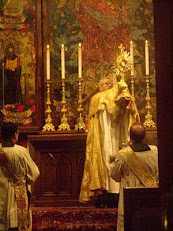
Father Scott Hurd wrote on Facebook last Sunday (September 9th):
Great meeting last night at which the future of Saint Luke's (in Bladensburg, for now) was unveiled. It was great to be with my friends and colleagues Fr. Mark Lewis and Fr. Rick Kramer, the communications directors for both the North American and UK ordinariates; Susan Gibbs and Fr. James Bradley.
The shape of that future was not mentioned in Fr. Hurd's post, and the web sites of the Ordinariate and St. Luke's are not updated yet with info. However, I have heard from a friend that the future that is contemplated is that there will be a unified parish at St. Luke's in Bladensburg for all Anglican Use Catholics in the area. While St. Luke's will sponsor regular Anglican Use masses at Our Lady of Hope Parish in Potomac Falls, VA, there is no provision for services to continue at the Benedictine Abbey of St. Anselm's, which has been hosting the Anglican Use Society of St. Thomas of Canterbury for nearly two years now.
The current plan includes moving St. Luke's from its current site in two years after the lease period is up. A search for a new site has yet to be found, possibly in the northeast quadrant of DC. At the same time, the Archdiocese apparently would like St. Luke's to consider moving to a place where Catholics are underserved by parishes now, which, for all practical purposes, could amount to the same thing. There is also talk of a capital campaign to purchase and build the new place, wherever it is to be located. However, that plan has not yet been put into place.
My correspondent assures me that some of the members of St. Luke's, of the St. Thomas Society and the St. Gregory Society (the branch in Northern Virginia) were consulted ahead of this announcement, but the correspondent was uncertain as to whether they had any real input into the actual formation of the plan. It will be the case, as announced earlier, that there will be regular Masses in Northern Virginia at Our Lady of Hope church in Potomac Falls.
Two concerns are raised by the announcements at this meeting.
First, one of the great things about the group that had been meeting at St. Anselm's was that they were regularly meeting for Evensong. It cannot be stressed enough that Evensong is one of the true jewels of the Anglican Patrimony. It should be a goal of every parish to offer it regularly. It is a service that is at once rooted in the earliest liturgies of the Church, that shows forth the beauty of holiness in liturgical worship and yet is a fully evangelical service: the perfect vehicle, as it were, to reach out to other Christians and the unchurched. Of course, as we have all been taught, the Mass is the summit of Christian prayer; but St. Paul didn't enter a town, celebrate the Divine Liturgy and invite folks in: he went to the synagogue for its regular servcie of psalms and lessons and preached the Gospel there, where anyone, Jew or Gentile, might hear (as the daily lesson from Acts in the Daily Office earlier this week reminded us).
John Wesley, in his
The Sunday Service of the Methodists in North America declared:
There is no LITURGY in the World, either in ancient or modern language, which breathes more of a solid, scriptural, rational Piety, than the COMMON PRAYER of the CHURCH of ENGLAND.
As quoted on page 5 in American Methodist Worship by Karen B. Westerfield Tucker.
This endorsement of the value of the Prayer Book liturgy, and especially the daily offices, are echoed by scholars and liturgists down to our day. Fr. Louis Bouyer, of the Oratory wrote in his great book
Liturgical Piety:
We must admit frankly that the Offices of Morning Prayer and of Evensong, as they are performed even today in St. Paul's, Westminster Abbey, York Minster, or Canterbury Cathedral, are not only one of the most impressive, but also one of the purest forms of Christian common prayer to be found anywhere in the world.
and more recently, in an article by Ed Franklin in
The Walsingham Way, (published by the principal church of the US Ordinariate, Our Lady of Walsingham in Houston), Eamon Duffy is quoted as writing:
Anglican Choral Evensong is to my mind the greatest liturgical achievement of the Reformation, a perfect blend of noble prayer in memorable language, interspersed with the reading of two extended passages of scripture, all set to glorious music.
Secondly, one of the issues that many of the Anglican Use parishes face, whether Ordinariate or Pastoral Provision, and which they share with many parishes of Eastern Catholic Churches, is the great distance that parishioners must travel in order to attend worship at the parish church. In Boston, we are well acquainted with this: I travel almost 45 minutes from the south to the church, while my fellow schola member Allen travels almost 45 minuters from the north. It means that, except for Sunday and occasional Holy Days, there is no contact with the church. Many of the parishioners cannot reasonably come even every week because of the distance. But what if there were a way to have regular worship closer to home? It would certainly be feasible to have one or two additional sites (preferably a church or oratory, but even a home or other setting) for midweek worship and fellowship.
My DC correspondent wrote that a suggestion was made during the meeting by one of the clergymen that there might be faith formation offered during the week for people in DC, i.e., the people from the St. Thomas of Canterbury Society, since St. Luke's will be offering similar catechesis on Wednesdays in Bladensburg. In theory, there could be an informal evening prayer or compline service during these sessions, but the prayer component was not discussed at that time. I hope it will be.
In the D.C. area up until this time, there was an opportunity for worship close to home at St. Anselm's, where I was fortunate enough to visit back in January of this year. And as that community grew, it recognized this need for worship opportunity close to home, and started the associated Society of St. Gregory the Great for Northern Virginia residents. It would be a shame if this attempt to meet the needs of parishioners was discontinuted, particularly for a parish as richly blessed with clergy as St. Luke's is, which counts among its clergy Fr. Lewis, Fr. Kramer, and Fr. Sly.
CUA is blessed with a number of chapels (the one in Caldwell Hall is particularly beautiful) and is surrounded by religious houses like St. Anselm's (including the wonderful Dominican Study House. located right across Michigan Ave from the center of CUA's campus). Why not regular services on campus and introduce the Ordinariate and the Anglican Use liturgy to a cadre of students who would then bring the memory and hopefully the practice of those treasures of Anglican patrimony out to the world as they graduate?


 Posts