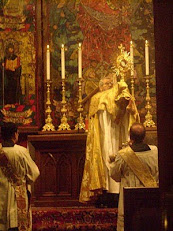
The first principle of the Ordinariate is then about Christian unity. St. Basil the Great, the Church’s greatest ecumenist, literally expended his life on the work of building bridges between orthodox brethren who shared a common faith, but who had become separated from one another in a Church badly fragmented by heresy and controversy. He taught that the work of Christian unity requires deliberate and ceaseless effort...St. Basil often talked with yearning about the archaia agape, the ancient love of the apostolic community, so rarely seen in the Church of his day. This love, he taught, is a visible sign that the Holy Spirit is indeed present and active, and it is absolutely essential for the health of the Church.

- Msgr. Jeffrey Steenson, Homily on the Occasion of his Formal Institution as Ordinary
Showing posts with label Ecclesiology. Show all posts

Saturday, February 13, 2010

Events Reminder

There are several events coming up in which readers may be interested. These are listed to the left, with more details and links.

First up, the Institute of Catholic Culture hosts "The Pope, The Anglicans and the Mass" on February 21, 2010 at 7:30 pm. Fr. Joseph Fessio, SJ, who heads Ignatius Press, will lead a discussion of Anglicanorum Coetibus at St. Ambrose Catholic Church in Annandale, Virginia. Free admission.

Next, there will be a discussion of Anglicanorum Coetibus by members of the Faculty of Theology of the University of St. Michael's College (95 St. Joseph Street, Room 207, in Toronto, Ontario, Canada) on Wednesday March 3, 2010, from 3:15 pm to 4:45 pm. Titled "The Pope's Response to Anglicans: Theological Reflections on the New Structure To Receive Anglican Groups Who Request Full Communion", this will be preceded by Midday Prayer, with Choir at 1:30 pm.

The next conference on Anglicanorum Coetibus, "Anglicanorum Coetibus Conference: An exploration of Anglican Patrimony", will be held on Saturday, April 24, 2010, from 10:30am - 6:00pm, at Pusey House in Oxford University in England.

The last event we've learned of is an Anglican Use Pilgrimage, from November 2 - 15, 2010, with the theme: "St. Paul, St. John the Divine, and the Early Church in Turkey." This pilgrimage will be led by Fr. Ernie Davis, Administrator of St. Therese Little Flower Parish where the Anglican Mass is celebrated on Sundays.

Sunday, December 27, 2009

The Legitimate Patrimony of Ethnic and Ritual Churches

The question of respecting the legitimate patrimony of distinct ritual churches has dogged the Catholic Church for many centuries; but this problem has usually been the result of local misunderstanding and not the teaching of the Church's magisterium. In the U.S. this problem's worst manifestations led to the creation of two separate schisms: the Polish National Catholic Church and the Carpatho-Russian Orthodox diocese. While the problems with ethnic diversity and between Eastern and Latin spirituality caused tension, this could have been resolved by the proper exercise of humility and patience. And while the situation of Anglicans is not exactly the same as that of either the Polish nor of the Eastern Churches, it is analagous.
The specific question of the Eastern Churches legitimate patrimony was taken up by the Second Vatican Council, in its decree Orientalium Ecclesiarum. But even before that, Pope Pius XII wrote, in his encyclical Orientalis Ecclesiae:
25. As it was in those times long past, Venerable Brethren, so will it be also today. More effective than anything else for promoting that reunion of all our separated sons with the one Church of Christ for which all good men are striving, will be a sincere and practical goodwill, with the help and inspiration of God. The fruit of such goodwill is mutual understanding, an understanding which Our Predecessors have sought so earnestly to foster and increase by various means, in particular by founding in Rome the Pontifical Institute of Higher Oriental Studies.
26. This goodwill implies also a proper respect for those traditions which are the special heritage of the peoples of the East, whether these be concerned with the sacred liturgy and the hierarchical Orders or with other observances of the Christian life, so long as they are in keeping with the true faith and with the moral law[emphasis mine-ed]. Each and every nation of Oriental rite must have its rightful freedom in all that is bound up with its own history and its own genius and character, saving always the truth and integrity of the doctrine of Jesus Christ.
27. We would have this to be known and appreciated by all, both by those who were born within the bosom of the Catholic Church, and by those who are wafted towards her, as it were, on the wings of yearning and desire. The latter especially should have full assurance that they will never be forced to abandon their legitimate rites or to exchange their own venerable and traditional customs for Latin rites and customs. All these are to be held in equal esteem and equal honor, for they adorn the common Mother Church with a royal garment of many colors. Indeed this variety of rites and customs, preserving inviolate what is most ancient and most valuable in each, presents no obstacle to a true and genuine unity. It is especially in these times of ours, when the strife and discord of war have estranged men's hearts from one another nearly all the world over, that all must be impelled by the stimulus of Christian charity to promote union in Christ and through Christ by every means in their power.
28. But the work of faith and charity would remain incomplete and powerless to establish unity firmly in Christ Jesus, unless it rested upon that unshaken rock upon which the Church is divinely founded, that is, upon the supreme authority of Peter and his Successors.

In Anglicanorum Coetibus, Pope Benedict has applied these principles to the patrimony of Anglican Christians, recognizing that there is great value in many of the liturgical and spiritual customs found in Anglicanism. That even the Complementary Norms are not specific about this patrimony allows freedom for this distinct Anglican patrimony to be defined by the ordinariates that will be erected.

Monday, November 30, 2009

Homily for the First Sunday of Advent – The Church is ONE

‘We believe in one holy catholic and apostolic Church.’

+ In the name of the Father …

Every Sunday, week by week, and on certain other feast days, we recite the Nicene Creed, and during this Advent, I shall preach on each of its four Sundays on the Church that we say in the Creed we believe to be one, holy, catholic and apostolic.

For those who are quite properly expecting the homily to be preached on the Gospel and other readings of the day – as it ordinarily should, I have printed in today’s sheet, and shall do for the next three Sundays, the Lectio Divina mediation on the readings of the day published by the United Bible Societies.

And I am preaching on the nature of the Church as one, holy, catholic and apostolic not just as an exercise suggested because Advent conveniently has four Sundays, but in the context of the prayer and discernment which are needed with regard to the Apostolic Constitution Anglicanorum coetibus that has offered the equal and honoured place in the Catholic Church that Anglicans – some Anglicans anyway – have prayed and worked for over many years...

Read the rest of this fine homily at One Timothy Four

Hat Tip to Christian Campbell of The Anglo-Catholic

Saturday, November 28, 2009

Communion as sign of unity in faith

Fr. Phillips details some correspondence he's had with an Anglican pastor, and the question of intercommunion that came up.

"...that they all may be one..."

I had a brief exchange of emails with an Anglican clergyman. His parish is, I think, part of the American group that's in a pastoral relationship with some of the Anglicans in Africa. I don't really understand all the connections, and I don't know who's in communion with whom, but he's a very nice man and a cleric who plainly loves Christ.

He had expressed some interest in attending the information day on Anglicanorum coetibus that we're having here on December 12th, and he mentioned that he'd like to stop in and meet me sometime soon. I let him know I'd be delighted to see him, and we exchanged some possible dates and times. One of my suggestions was a time right after a weekday Mass which is attended by the students in our parish school. "In fact," I said, "maybe you'd like to come to the Mass, and we can meet right afterwards." That sounded like a great idea to him, and I thought we were set.

Then I got another email. "Am I ok for Holy Communion?"

I knew what he was asking, and I wondered why he would even ask. "Sadly, no," I wrote back, "I'm a man under orders, as I know you understand."

His response? Here's what he wrote: "This is one of the things that stands in the way of real unity—the RCC treats other Christians as though they aren’t really Christians—denying them the Body and the Blood...

Read Fr. Phillips' response, another good exposition of Catholic ecclesiology reflected in the Church's practice of Holy Communion, at his blog Atonement Online.

Ecclesiology: The True Stumbling Block for non-Catholics

Fr. Hunwicke has a great post that very succinctly deals with ordination and ecclesiology in such a way as to make clear that the tradition of male priests is a necessary reflection of the Trinity.

One Father
Rowan Williams asks whether, "when so much agreement has been firmly established in first order matters about the identity and mission of the Church, it is really justifiable to treat other issues as equally vital for its health and integity". And: "In what way does the prohibition against ordaining women so enhance the life of communion, reinforcing the essential character of filial and communal holiness as set out in Scripture and tradition and ecumenical agreement, that its breach would compromise the purposes of the Church as so defined?" Behind this surely lurks a question which, if we are honest, many of us sometimes have worried about: " How do we present to the world a gloomy prohibition against Women Clergy as being positive Good News?"

The answer is in Rowan's own summary of the new consensual ecclesiology: "God is eternally a life of three-fold communion; and if human persons are to be reconciled to God and restored to the capacity for which they were made, they must be included in that life of communion. The incarnation of God the Son recreates in human persons the possibility of filial relation with the Father ... etc". The Church images and embodies that divine life of communion in which the Father stands as as the principal of unity because he is the pege theotetos or its arche, the Source of Godhead...

Read the rest at Fr. Hunwicke's blog Liturgical Notes.

Friday, November 27, 2009

Fr. Hunwicke examines Archbishop William's Rome lecture

Fr. Hunwicke has been doing a series of posts on the speech given by Archbishop of Canterbury Rowan Williams last week in Rome. His posts are always worth reading, but I point you to this particular post:
More Rowan
Rowan's Rome lecture articulates an ecclesiology which is profoundly orthodox. Hoi polloi talk about "churches" when they mean denominations or 'national' churches: the "Methodist Church"; the "Church of Scotland". But Rowan knows that "the retheologising of ecclesiology, especially in dialogue with the Christian East, has meant that we are now better able to see the local community gathered round the bishop or his representative for eucharistic worship not as a portion of some greater whole but as itself the whole, the qualitative presence of the Catholic reality of filial holiness and Trinitarian mutuality here and now". This is profoundly in line with the ecclesiology set out by Joseph Ratzinger in two CDF documents Communionis notio and Dominus Iesus. Church means bishop, presbyterate, diaconate, laos. In this particular church, the Katholike is fully present. In practical terms, Rowan has spelt this out in his assurances that individual American dioceses which are "Windsor-compliant" would not be severed from full communion with the See of Canterbury because of their entanglement with the rest of PECUSA.

Unlike his dim colleagues on the English bench of bishops, Rowan knows that this is why "A code of practice will not do"; pastoral arrangements designed with the discriminatory intent of ensuring that Mrs Bloggs never actually has to see a woman priest in her own church are worse than useless. Whether he has the clout to cajole his colleagues into consenting, even at this late stage, to a Third Province for us seems more than doubtful.

It is on the basis of this ecclesiology that Rowan makes a deft criticism of the 'Ordinariates' which has eluded the journalists but is uncomfortably closer to home than we might care to admit. "It remains to be seen whether the flexibility suggested in the Constitution might ever lead to something less like a 'chaplaincy' and more like a church gathered around a bishop"...

To read the rest, and the comments, many of which are also insightful, visit the blog Liturgical Notes.