The first principle of the Ordinariate is then about Christian unity. St. Basil the Great, the Church’s greatest ecumenist, literally expended his life on the work of building bridges between orthodox brethren who shared a common faith, but who had become separated from one another in a Church badly fragmented by heresy and controversy. He taught that the work of Christian unity requires deliberate and ceaseless effort...St. Basil often talked with yearning about the archaia agape, the ancient love of the apostolic community, so rarely seen in the Church of his day. This love, he taught, is a visible sign that the Holy Spirit is indeed present and active, and it is absolutely essential for the health of the Church.

- Msgr. Jeffrey Steenson, Homily on the Occasion of his Formal Institution as Ordinary
Showing posts with label Chair of St. Peter. Show all posts

Saturday, March 21, 2015

Spring Issue of Ordinariate Observer Available.

The Spring 2015 issue (a double issue) is now available for download. Included are articles on the meeting of all 3 ordinaries in London in February, the dedication of the US Chancery, Dr. Clint Brand's  papal knighthood, and updates from several of the parishes throughout North America.

http://ordinariate.net/documents/2015/3/Spring%202015%20Ordinariate%20Observer.pdf

Friday, August 22, 2014

US Ordinariate begins publishing "Ordinariate Observer"


The Ordinariate of the Chair of St. Peter has completed an important item on its to do checklist with the publication of the initial issue of The Ordinariate Observer.

This initial publication has articles on the move of the congregations of St. Luke's from Bladensburg, MD to Washington, DC and St. Gregory the Great's from Beverly to Stoneham, MA. Monsignor Steenson writes on "The Joys and the Challenges of Growing our Congregations".

Other articles include "News from our Principal Parish: Our Lady of Walsingham"' "Target Date for our New Chancery: Early 2015"; "And there I was in Afghanistant: Special Report by Fr. Jerry Sherbourne"; "Reports from Our Clergy"; "Presbyteral Assembly in October Needs the Help of All of Our Congregations"; "Clergy Retirement Plan Approved"; "A Beautiful Church Plus Beautiful Country: A Perfect Place to Live?" about Holy Nativity in Payson, AZ; "Father Paul Manning to Lead Fall Retreat in Belleville, IL"; "First Combined Ordinariate Mass Celebrated in California"; "From Philadelphia: New Ordinariate Community Begins From Former Anglican Fellowship"; and "St. Gregory's Journey From the Winter of 2012 to Today: A Journey of Joy." 


Wednesday, February 19, 2014

Mass for the US Ordinariate's Feast of Title

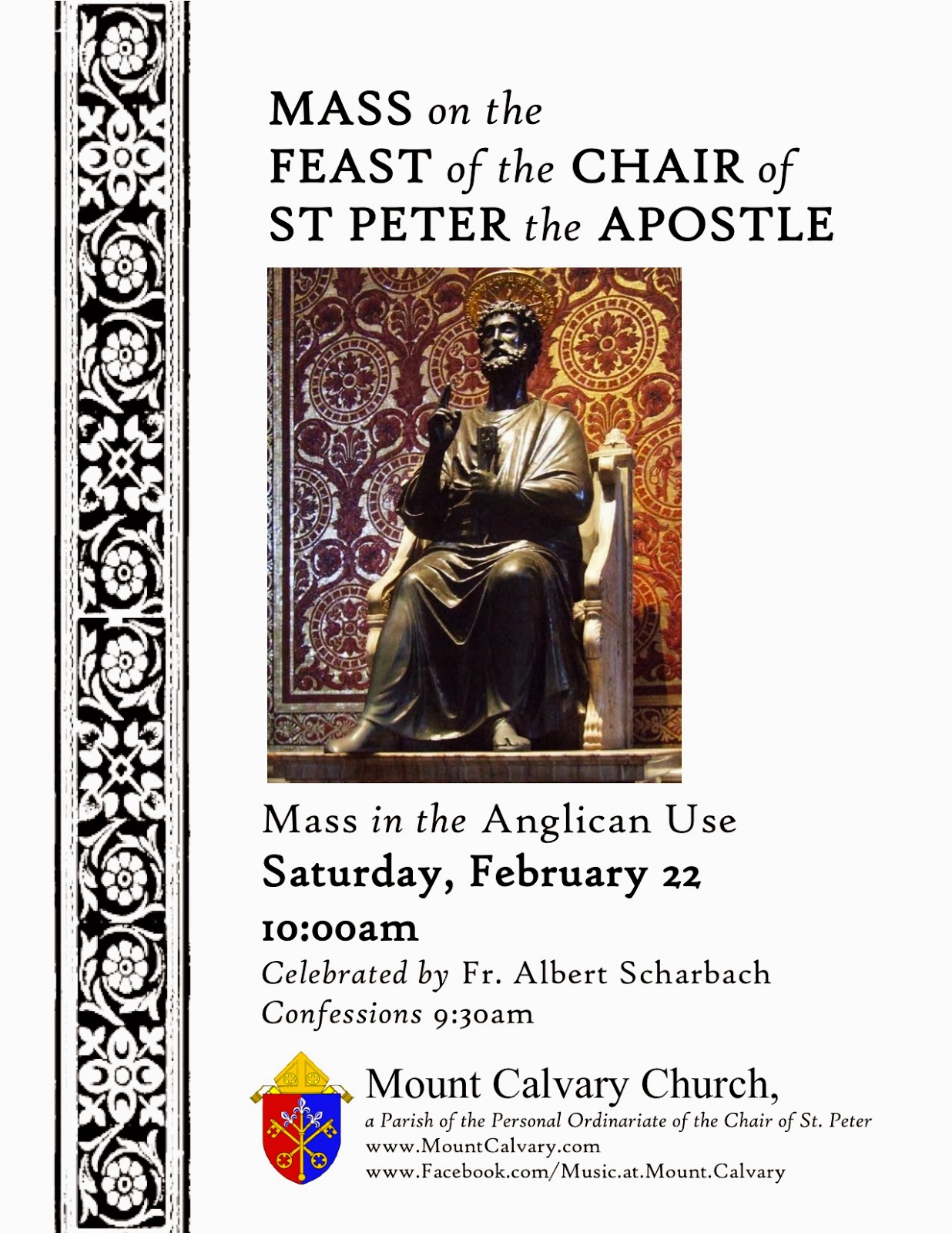
Mount Calvary Church is pleased to announce that Fr. Albert Scharbach will be celebrating a special Mass in the Anglican Use on the Feast of the Chair of St. Peter, the Solemnity of Title of the Personal Ordinariate of the Chair of St. Peter, at 10:00am this Saturday, February 22 in the main church at Mount Calvary. There will be an opportunity for confessions at 9:30.

Fr. Scharbach, a new priest of the Ordinariate, celebrated his First Mass as a priest here at Mount Calvary after his ordination in November, and has been a frequent celebrant for daily Mass since then. Fr. Scharbach currently serves as Pastoral Associate to Bishop Denis J. Madden, Auxiliary Bishop of the Archdiocese of Baltimore.

We very much hope that you can all join us here at Mount Calvary for this special feast day for the Ordinariate, which takes place at the same  time as the Ordinariate's pilgrimage to Rome. For more information, please see our website at www.mountcalvary.com.

Monday, February 18, 2013

Note on the Solemnity of the Chair of St. Peter


In his statement on February 11, 2013, the Ordinary of the Ordinariate of the Chair of St. Peter, Msgr. Steenson, reminded us that “members of the Ordinariate are in a particular way the spiritual children of His Holiness Pope Benedict XVI,” and Msgr. Steenson exhorts us, despite some feelings of sadness and a sense of shock, to deeper joy and special gratitude to the Holy Father “for giving us this beautiful gift of communion.”


On Friday, February 22, the Ordinariate of the Chair of St Peter will celebrate its Solemnity of Title, and the Ordinary commends all Ordinariate communities in North America to express their gratitude to Pope Benedict with the singing of a Solemn Te Deum of Thanksgiving (at the conclusion of Mass or Evensong, or as a separate service). After the Te Deum and its versicles, this special rite of thanksgiving may conclude with the following prayer:

Let us pray.
O God, whose mercies are without number, and the treasure of whose goodness is infinite: we render thanks unto thy most gracious majesty for the gifts which thou hast bestowed upon us (and especially for the pontificate of our Holy Father Benedict XVI, and for the gift of communion with the Chair of Peter); evermore beseeching thy mercy that, as thou dost grant the prayers of them that call upon thee, so thou wouldst not forsake them, but rather dispose their way towards the attainment of thy heavenly reward. Through Jesus Christ our Lord, who liveth and reigneth with thee in the unity of the Holy Ghost, one God world without end. Amen.


The Ordinary and the Ordinariate community is aware that the Te Deum is not usually heard during Lent. However, February 22 is the Ordinariate’s Titular Solemnity and should be kept as such according to the Particular Calendar approved by the Holy See. The Te Deum is rightly proclaimed; Friday abstinence may be dispensed; the liturgical color is white; and the Gloria and Creed are said or sung at Mass (the Alleluia is omitted, as throughout the season).

With thankful joy, let us then pray and work that Pope Benedict’s “labors in the vineyard might continue to bring forth a fruitful harvest.”

Monday, June 18, 2012

A Question of Collaboration


Vincent Uher wonders:

Why did the USA not benefit from the kind of name accorded to the UK in the establishment of the Personal Ordinariate of Our Lady of Walsingham?

Clearly, the English, Anglican, and Catholic convergence in the UK was recognised around its most central apparition of Our Lady at Walsingham as the most appropriate name for the Ordinariate under the patronage of that most famous convert Blessed John Henry Newman. Deo gratias!

Was there nothing similar in the USA? Does the Personal Ordinariate of the Chair of St. Peter resonate with anyone as uniquely expressive of the American Anglican experience being welcomed into the Church? I entered the Church on the feast of the Chair of St. Peter so that has meaning to me. And communion with the Chair of St. Peter has been a most important aspiration over the years.

The name is majestic and wonderful, but does it speak to the American Anglican experience and the long held desire for corporate reunion with Rome? Of course, it does, and in that respect it is successful. But it could be just as true in Australia or South Africa or elsewhere. Unfortunately, there is no explanation of how this name was chosen, but it is said that it came to be chosen without any consulation of the Anglican Use parishes, clergy, and people. How very sad if true.

I am long on record that I had hoped the Ordinariates around the world would all be called Ordinariates of Our Lady of Walsingham. We would have been able to set down the difficult appellation "Anglican", and we could have been called "Walsingham Catholics" as a kind of short-hand the world over.

I also held a second opinion that if each were to be different bearing something of national character then Father Paul Wattson and Mother Lurana had clearly pointed the way for us. I have no doubt that the 'Personal Ordinariate of Our Lady of the Atonement' would have been the best choice. For those who do not know, Fr. Paul and Mother Lurana were Episcopalians and their communities came into the Catholic Church with a devotion to Our Lady of the Atonement for the sake of Christian Unity. This devotion was embraced by the Catholic Church and the Pope himself embraced the devotion and honoured it.

Does it make a difference? I think so. How much more appropriate would the Personal Ordinariate of Our Lady of the Atonement under the patronage of St. Elizabeth Ann Seton be in comparison to what was chosen. St. Elizabeth Ann Seton was of course a convert from the Episcopal Church, and it is her major relic that is in the High Altar of the gorgeous Our Lady of Walsingham Church in Houston, Texas which over many years was my home parish.

Of course, no one asked. So how could I or any others have made representation to authorities of our hopes or aspirations regarding a name or anything else? No the generosity and openness of Pope Benedict XVI in Anglicanorum coetibus was met with a brotherhood of absolute secrecy worthy of Freemasons in the establishment of the U.S. Ordinariate.

If the way the U.S. Ordinariate began shrouded in secrecy is to be the norm, then a key element of the Anglican patrimony is to be left behind. Collaboration cannot be reduced to a few folks gathered together in an unnecessarily secretive liturgical committee or particular Working Group. None of this is the Manhattan Project.

This post is actually meant to undergird this simple plea: that those to be affected by decisions be invited to collaborate prior to the final judgements being rendered. Our Anglican background has taught us well how to do this, and it does not mean that we are putting anything to a vote. But now without the sort of vote that Anglicans once held in synod and on council, surely collaboration and investigation of the laity's aspirations and ideas prior to delivering decisions is the wisest course of action to ensure that there are no unnecessary troubles along the way.

Do visit his blog Tonus Peregrinus. Mr Uher is well worth the read, and I am very happy to see him writing more often these days.

I won't disagree with his conclusion that there should be widespread consultation with the faithful by the pastors of the Church. I believe Blessed JH Newman thought the same, and that should be enough to recommend the idea.

But regarding the name for the North American Ordinariate, I have to say that I am surprised that Mr. Uher doesn't see the rationale for the name of the Ordinariate. While the feast of Our Lady of the Atonement was indeed ratified by Rome (in 1946), and I am very happy to see it on the Ordinariate Calendar, there was another liturgical celebration begun by Fr. Paul of Greymoor that won ratification by Rome even earlier than OLA...the Chair of Unity Octave, now usually known as the Week of Prayer for Christian Unity.

It was Fr. Paul's and Mother Lurana's insight that there could be no unity among Christians without communion with Peter, and thus the Octave in January from the feast of the Chair of St. Peter in Rome to the feast of the Conversion of St. Paul. (Of course, the modern Roman calendar combined the January 18th feast of the Chair of St. Peter in Rome with the February 22nd feast of the Chair of St. Peter in Antioch into one feast, but the Octave remains in January. Letting the editors at Reader's Digest revise the calendar is another reason to be glad that the Anglican Missal tradition and the promoters of the 1962 Roman Missal kept the old Calendar in play; else how would we know why we start that Octave of Prayer when we do?) Couldn't the origin of the Unity Octave be the rationale for the selection of this name for the Ordinariate in the US?

On a related, if tangential note, in the most recent issue of the Anglican Use Society's publication Anglican Embers, the propers for the feast of Our Lady of the Atonement have been published, set to psalm tones after the manner of the Anglican Use Gradual. You may download the propers for the feast at the Embers page.


Monday, March 26, 2012

HOUSTON, TX: The Ordinariate of the Chair of St. Peter takes shape

Boundaries stretch from the Mexican border to the Arctic Ocean and from sea to shining sea

A VOL EXCLUSIVE

By Mary Ann Mueller in Houston
Special Correspondent
March 26, 2012

The Rt. Rev. Monsignor Jeffrey Steenson has an incredibly difficult task ahead of him. On December 31, 2011, he was simply a Roman Catholic priest quietly teaching Patristics - his academic forte - at the University of St. Thomas in Houston. The Anglican Ordinariate was a gleam in Pope Benedict XVI's eye. On January 1, 2012, the Personal Ordinariate of the Chair of St. Peter was born, at least on paper, with Fr. Steenson, the former Episcopal bishop of the Diocese of the Rio Grande, was tapped as its leader.

As New Year's Day dawned, within the space of hours, the Pope, through the hands of William Cardinal Levada, challenged the new Ordinary, to do something that had never been done before. He was to create a nationwide diocese on the North American continent using the words of the Apostolic Constitution -- Anglicanorum Coetibus, the Complementary Norms for Anglicanorum Coetibus, and the Decree from the Congregation for the Doctrine of the Faith establishing the Personal Ordinariate of the Chair of St. Peter, coupled with the current Canons of the Catholic Church and the Catechism of the Catholic Church to guide him as the scuffling framework needed to complete his job and fully enflesh the Pope's prophetic vision.

"I'm basically starting a new diocese from nothing ... from scratch," the world's newest Anglican Ordinariate Ordinary explained. "The basic administrative work isn't finished yet. We wouldn't create an Ordinariate with people until we have a good corporate basis in which to do it."

On Jan. 1, there were no paid employees of the Personal Ordinariate of the Chair of Saint Peter. Msgr. Steenson and the Ordinariate's other officers: Fr. Scott Hurd, Canon to the Ordinary - or the Vicar General in Catholic parlance; Margaret Chalmer, Chancellor; Margaret Pichon, Assistant to the Ordinary; and Susan Gibbs in Media Relations are all highly qualified unpaid "volunteers". Only Barbara Jonte, the Ordinariate's new Executive Assistant, is a paid staff member. However, she did not join the team until after the Ordinariate was erected on Jan. 1. The other four "volunteers" had worked many long hours leading up to New Year's Day so when the Ordinariate was formally announced from the Vatican, there was a functioning rudimentary skeleton in place to implement immediate Ordinariate needs such as unveiling the design of the Ordinariate's crest, activating the Ordinariate's website, organizing the Jan. 2 Houston news conference, the planning of the Feb. 12 investiture of Fr. Steenson as the founding Ordinary, and preparing for his elevation as a protonotary apostolic monsignor.

This rank gives Msgr. Steenson a seat in the United States Conference of Catholic Bishops (USCCB) - the Catholic version of the House of Bishops - and entitles him to clutch a crozier, don the mitre, have a heavy-chained pectoral cross draped across his chest, and a wear bishop's fuchsia-colored cassock with oversized red cuffs. His new Catholic coat of arms boasts a fuchsia galero - the large, broad-brimmed tasseled hat associated with upper ranking clergy - and twin triple layers of red tassels in keeping with his new ecclesial hierarchical rank.

"There's no policy manuals ... we don't have the particular norms that, like what we used to call in The Episcopal Church, the Diocesan Constitution ... we don't have that," he said referencing his previous experience as an Episcopal bishop.

The closest equivalent he has to a diocesan constitution would be the Complementary Norms for Anglicanorum Coetibus that is still not detailed and is very sketchy. He has to figure things out as issues present themselves and needs are identified.

As the VIII Bishop of the Rio Grande, Msgr. Steenson inherited an established Episcopal diocese, albeit small. His Episcopal diocese encompassed the entire state of New Mexico, save the Four Corners region of the Navajoland, and spilled into Texas as far as the Pecos River.

As the Ordinariate's founding "bishop", Msgr. Steenson's new "diocese" temporarily encompasses the entire United States and all of Canada - until a separate Canadian Ordinariate can eventually be established. The Monsignor's new jurisdiction slices through 197 American Catholic dioceses and 71 dioceses north of the 49th Parallel. His spiritual authority stretches from the Arctic Archipelago in Canada to Ka Lae, South Point, Hawaii and Key West, Florida in the United States and from the Alaskan Aleutian Islands in the West to Newfoundland in the East and all points in between. His people pray for Queen Elizabeth II in Canada and Barack Obama in America. To the North, they look with joy to the Queen's Diamond Jubilee celebrating her 60 years on the throne, while farther South all eyes turn to the battle for the White House...

Read the rest of this report on Virtue Online.

Saturday, March 10, 2012

Calendar and Sanctorale for Ordinariate of the Chair of St. Peter published


The web site of the Personal Ordinariate of the Chair of St. Peter has published its particular calendar and sanctorale. Like the Personal Ordinariate of Our Lady of Walsingham in England and Wales, this calendar has the following differences from the Roman Calendar:

  • The term "Ordinary Time" is not used of the Sundays. Sundays following the Christmas season are named "Sundays After Epiphany", while the three Sundays before Ash Wednesday regaining their historic names of Septuagesima, Sexagesima and Quinquagesima.
  • The Sundays following the Easter season and the feast of the Most Holy Trinity are named "Sundays After Trinity", according the practice of northern Catholicism in general and the Church of England in particular.
  • The Rogation Days before the feast of the Ascension are restored.
  • Observance of the Octave of Pentecost is restored (in vestments and propers, but using the weekday readings from the Roman Lectionary).
  • The Ember Days, at their traditional times, are restored.
  • The first Sunday of October is permitted to be used for a parish's dedication festival, if the date of the dedication is unknown

The Calendar specifies that the Sundays After Epiphany will use the Roman Lectionary, and so Second Sunday after Epiphany would use the readings for the Second Sunday in Ordinary Time; and the Sundays After Trinity will use the Lectionary readings from the weeks of Ordinary Time.

In the Sanctorale, several feast days are added to the US calendar, and some feasts of the US calendar are raised in rank: The Chair of St. Peter on February 22 becomes a Solemnity. Our Lady of Walsingham on September 24th is added to the calendar as a Feast, and Our Lady of the Atonement is added to the calendar on its traditional day of July 9th as an optional memorial.

Download the Calendar and Sanctorale at this link.

Sunday, January 1, 2012

ERECTION OF THE PERSONAL ORDINARIATE OF THE CHAIR OF SAINT PETER AND NAMING OF THE FIRST ORDINARY

Fr. Jeffrey Steenson preaching at Newark Basilica in June 2010
Fr. Jeffrey Steenson preaching at the Solemn Mass
during the 2010 Anglican Use Conference
at the Cathedral Basilica of the Sacred Heart
in Newark, New Jersey, June 2010.

EREZIONE DELL’ORDINARIATO PERSONALE DI THE CHAIR OF SAINT PETER E NOMINA DEL PRIMO ORDINARIO
La Congregazione per la Dottrina della Fede, a norma della Costituzione Apostolica Anglicanorum coetibus, ha eretto l’Ordinariato Personale di The Chair of Saint Peter nel territorio della Conferenza Episcopale degli Stati Uniti d'America.

Nel contempo il Santo Padre Benedetto XVI ha nominato primo Ordinario il Reverendo Jeffrey Neil Steenson.

Rev. Jeffrey Neil Steenson, D.Phil. (Oxon)

[Ed. Note: My Translation in Brackets]

[• ERECTION OF THE PERSONAL ORDINARIATE OF THE CHAIR OF SAINT PETER AND NAMING OF THE FIRST ORDINARY

The Congregation for the Doctrine of the Faith, according to the norms of the Apostolic Constitution Anglicanorum coetibus, has erected the Personal Ordinariate of The Chair of St. Peter within the territory of the Episcopal Conference of the United States of America.

At the same time, the Holy Father Benedict XVI has named as the first Ordinary the Reverend Jeffrey Neil Steenson.]

Experience
Carl and Lois Davis Visiting Professor in Patristic Studies, University of St. Thomas/St Mary's Seminary, Houston, TX (2009-). Licensed in the Archdiocese of Galveston-Houston.

Undergraduate course: THEO 3382 — God, One and Triune (autumn, 2009).
Graduate courses: YHS5304 - Patristics; CG5312 - Patrology (spring, 2010).
Received into the Roman Catholic Church (Advent 2007); ordained deacon (Dec. 13, 2008) and priest (Feb. 21, 2009) under the Pastoral Provision for married Anglican clergy; incardinated in the Archdiocese of Santa Fe.

Recipient of Louisville Institute Sabbatical Grant for Pastoral Leaders (2008).
Sabbatical study at the Instituto Patristico Augustinianum; in residence at the Pontifical Irish College (2008-2009).
Taught core curriculum course (THE2311 – Western Theological Tradition), in the University of Dallas Rome Program (Spring 2009).
Bishop, Episcopal Diocese of the Rio Grande, Albuquerque, NM (2004-2007); Canon to the Ordinary (2000-2004).

Served on the Theology Committee of the House of Bishops.
Member of the Board of Trustees, Nashotah House Seminary.
Member and Officer of the Board of Directors, The Living Church Foundation.
Member of the Board of Directors, The Anglican Digest.
Rector, St. Andrew's Episcopal Church, Fort Worth, TX (1989-2000).

Member of the Board of Directors, The Living Church Foundation.
Officer of the Episcopal Synod of America.
Member of the Board of Trustees, Episcopal Theological Seminary of the Southwest.
Member of the Board of Trustees, The University of the South.
Rector, Church of the Good Shepherd, Rosemont, PA (1985-1989).

Lecturer in Anglican Theology, The Lutheran Theological Seminary, Philadelphia.
Member of the Steering Committee of the Evangelical and Catholic Mission.
Assistant, All Saints' Church, Wynnewood, PA (1983-1985).

Tutor and Adjunct in Theology, The General Theological Seminary, New York.
Doctoral Studies, University of Oxford (Christ Church) (1979-1983).

Assistant, All Saints' Church, Highfield, Oxford, England.
Episcopal Church Foundation Fellow (1979-1983).
Ordained Anglican Priest by the Bishop of Oxford in Christ Church Cathedral (June 29, 1980).
Sportswriter, The News-Sun, Waukegan, Illinois (1972-1979).

Education

D. Phil. (Theology), University of Oxford, (1979-1983). Thesis: "Basil of Ancyra and the Reception of the Nicene Creed."

M.Div., cum laude, Harvard Divinity School (1976-1978) (New Testament/ patristics).

MA., summa cum laude, Trinity Evangelical Divinity School (1974-1976) (church history).

B.A., cum laude (history), Trinity College (1970-1974) (history).

Personal

Birthdate: April 1, 1952.

Family: married to Debra J. Arnold in 1974; children: Kristina (33), Eric (30), John Mark (24).

Interests: Flying (private, commercial, instrument-rated, ASEL & ASES).


Publications

"The Unopened Gift," Anglican Theological Review 87 (Fall 2005): 645-651.

"The New Donatists: Why the Fight for Orthodoxy within Anglicanism Must Avoid Ancient Errors" [T.W. Smith Lecture at St. John's, Elora, Ontario, 2005] (publication anticipated).

"Intimacy and Friendship: Some Boundary Issues," Anglican Theological Review 85 (Winter 2003): 97-102.

"Scripture and Tradition: A Famous Irenaean Text Revisited" Proceedings of the Atlantic Theological Conference (Charlottetown, P.E.I., 1993).

"Episcopal Jurisdiction in Athanasius: A Line in the Sand?" [International Patristics Conference, Oxford, England, August, 1991].

"Koinonia and Reception: A Response to the Report of the Archbishop of Canterbury's Commission on Communion and Women in the Episcopate" (Episcopal Synod of America, 1989).

"The Teaching Tradition: Scripture and Doctrine" in The Scriptures and Modern Christian Teaching [Proceedings of the Theological Conference 1988] (Charlottetown, 1988), pp. 59-71.

"Patterns of Orthodox Witness: Some Principles from the Nicene Fathers" in Rebuilding the House of God [Proceedings of the Theological Conference 1987] (Charlottetown, P.E.I., 1988), pp. 101-109.

"Basil of Ancyra on the Meaning of Homoousios" in Arianism: Historical and Theological Reassessments, ed. Robert C. Gregg [Patristic Monograph Series, 11] (Cambridge, MA., 1985), pp. 267-279.

Basil of Ancyra and the Course of Nicene Orthodoxy (D.Phil. thesis, University of Oxford, 1983).

"The Date of the Philocalia" in Origeniana Tertia, ed. R. Hanson and H. Crouzel (Rome, 1985), pp. 245-252.

Various reviews, conference papers, and addresses.

from The Vatican News Service.