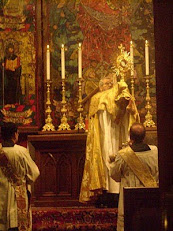
The first principle of the Ordinariate is then about Christian unity. St. Basil the Great, the Church’s greatest ecumenist, literally expended his life on the work of building bridges between orthodox brethren who shared a common faith, but who had become separated from one another in a Church badly fragmented by heresy and controversy. He taught that the work of Christian unity requires deliberate and ceaseless effort...St. Basil often talked with yearning about the archaia agape, the ancient love of the apostolic community, so rarely seen in the Church of his day. This love, he taught, is a visible sign that the Holy Spirit is indeed present and active, and it is absolutely essential for the health of the Church.

- Msgr. Jeffrey Steenson, Homily on the Occasion of his Formal Institution as Ordinary
Showing posts with label Catechism. Show all posts

Saturday, February 2, 2013

ALPHA course to be offered by new Ordinariate community

Saint Mary Star of the Sea Parish and Saint Gregory the Great Church [new Ordinariate community being formed in Beverly--ed] will be offering Alpha For Catholics as a Lenten program onThursdays, February 14th through April 18th from 7 to 9pm, at Saint Mary, Star of the Sea convent, 15 Chapman Street, Beverly, MA. To register please call 978-948-2356 leaving your name & number; or register online at www.northshorecm.org/Beverly-Alpha.html. All registrations will be acknowledged.


Tuesday, June 19, 2012

On an Ordinariate Catechism...

While it is understood that the Catechism of the Catholic Church is the standard for the Ordinariates, the Catechism itself is designed as a source for producing particular catechisms. With that in mind I point you to two considerations of this.

From Vincent Uher's Tonus Peregrinus, writing about a text of Percy Dearmer:
I hope in due course the Ordinariates together with the Anglican Use parishes will produce a new particular Catechism with Services of Instruction like those with which we were once familiar. Of course, they would need to be adapted properly to our Catholic life. It would be an excellent way to bring quotes from the Anglican worthies to bear upon questions of the faith by way of footnote or direct quotation in the text...
see "Percy Dearmer Speaks".

In the September 2011 Holy Cross embertide issue of Anglican Embers, we published an article about devising an Ordinariate-specific Catechism. You can read author Hugo Mendez's thoughts at "An Ordinariate Catechism: Prospects and Possibilities" on the Anglican Embers page of the Anglican Use Society's web site.

Saturday, February 18, 2012

Pastoral Letter to the TAC from Abp. Hepworth


PASTORAL LETTER

Archbishop Hepworth
In recent months, a deep division has been created in the Traditional Anglican Communion. Bishops and Vicars General have threatened others with expulsion. Clergy and laity have been bullied and threatened. A minority of the bishops plan to meet shortly in South Africa with the openly published agenda of expelling all those who are at the various stages of discernment of the offer of the “fullness of Catholic Communion” contained in the Apostolic Constitution of Pope Benedict XVI.
This bullying reached new levels with the publication of letters from Canon Gray in England and Bishop Marsh in the United States, cancelling arrangements into which they entered that created a tolerant environment during this process. In the past few days, these events among others have greatly concerned me:
  • A priest of many years standing in the United States who is licensed to the Patrimony (created to protect those discerning their future in the light of the Ordinariate) has been refused permission to conduct the funeral of a long-standing friend because “he has applied to become a Roman Catholic”.
  • Father Brian Gill, a founding member of the TAC and our leader for many sacrificial years in England, who has been on holiday, wrote “On arrival back I found the disgusting circular letter from Fr. Ian Gray in which he wrote: Those of you who have submitted personal dossiers and may now wish to reconsider your position to return to the TTAC/TAC should do so by contacting me directly in writing by February 3rd 2012.
  • Bishop Marsh of the United States has circulated a letter to clergy who have been transferred to Bishops Moyer and Campese assuming that neither they nor their bishops still belong to the TAC.
  • Bishop Garcia of Puerto Rico has been told by Bishop Marsh that he is no longer considered a member of the TAC because of his positive attitude to the Ordinariates.
  • Meanwhile, it has emerged that Bishop Marsh is a high-ranking member of a virulently anti-catholic Lodge of Freemasons, and claims to have successfully influenced Roman Catholic authorities to reject the TAC and its bishops as a credible ecclesial communion.
  • Obviously in collusion, several Bishops and Vicars General are moving to attempt the illegal and uncanonical expulsion of their fellow bishops and clergy who are considering the Ordinariates on the grounds that they are “seeking to become Roman Catholic”. In so doing, they effectively remove themselves from our Communion
Neither I nor those under attack can any longer allow this conduct to continue unchallenged.
Anglicanism has always aspired to tolerance. Even the persecution of Catholics in England was balanced by tolerance and respect in missionary regions. Anglo-Catholics and Evangelical Anglicans sustained a mutual respect and restraint in spite of vigorously asserting their positions. Opponents found this a weakness. Those of us who experienced it found it a strength.
Whether the destructive forces of the past fifty years have ended the possibility of tolerance in the wider Anglican world is a matter for prayer now and the judgement of history in the future. We seek the truth that is in Christ Jesus, knowing that we must live in the moment of time in which we have been created. For us that is a fractured church, a turmoil of conflicting theology, and the power of resurgent hostile creeds. Science has created new boundaries of sinfulness that test us – power over life, the abundant access to information and entertainment, the global competition for the necessities of life, and the battles between scientific leaders and the idea of God. It is not an easy time to be a good Christian.
I make clear the basis of conflicts within our own Communion:
  • Continuing Churches have a long history. Some have been glorious, others are better forgotten. They can never be permanent. They must continue to relate to the Church from which they withdrew, to influence it for good, to make clear the reasons for their withdrawal “into the desert”. To permanently split from the Church is schism. To go into the desert to heal the Church is heroic.
  • There is only one Church, one Body of Christ, one Vine. Every ecclesial group must be able to show evidence of its oneness with the Body of Christ, the Church. As soon as a group becomes permanently and comfortably alone, unacknowledged by any other part of the Church, believing itself to be the only perfect form of Christianity, and accepts and even welcomes that isolation, it has slipped into the schism of the sect.
  • There is only one truth given once and for all by Christ. The Church seeks to expound that truth in every age and to apply it to problems that are new, and to those things that have been challenges in every age. It is not what the individual thinks; it is what the Church teaches. The great ecumenical conversations of the past century acknowledged this fact and sought to define both the teaching authority of the Church and the truth that is taught.
  • The past century has been a time of massive expansion of human conflict and of the instruments that undergird human conflict. The permanent expansion of the instruments of conflict has created a world that is tolerant of conflict and human destruction. Anglican Churches have adopted too readily the destruction of human dignity in all its manifestations – family, livelihood, vocation, community – to achieve ideological victory. The far more difficult pathway of tolerance and love has been lost.
  • The Apostolic Letter of the Pope to Anglicans has reignited dormant bigotry and anti-Catholicism, has forced people (even bishops) to examine the true nature of their faith and to assess the importance of the Catholic teachings that they cannot accept.
The present attempts to expel those who are working (often with exquisite difficulties) to test a vocation to fuse Anglican heritage with Catholic Communion, newly available and still in infancy, is not to be tolerated.
The minority of our leaders (Bishops and Vicars General) who intend to meet in South Africa have announced their intention to expel and depose others in our Communion, actions we have not experienced for many years, but which have been a tragic hallmark of Continuing Anglicanism. They intend to change the Concordat that has ordered our common life from the beginning, abandoning the requirement to submit changes to the clergy and laity in the Synods of our Provinces. And they propose to interfere in the affairs of member Provinces, creating spiritual, canonical and legal havoc that will only have one result – the diminution of our apostolate and the betrayal of those who have trusted us.
Even more significantly, they propose for the first time in our common life to expound doctrine according to their personal beliefs, abandoning the tests of common faith whether Anglican or Catholic. I note that the two leaders of this minority in the United States have never attended a meeting of the College of Bishops and have never experienced our corporate life.
The majority remain loyal to the ideals that have sustained us to this point. They remain true to their oaths and promises on doctrine and discipline. They are determined to protect their people and minister to them as they make decisions and undergo processes that cannot be hurried any more than outcomes can be foreseen.
These bishops and senior clergy, in the United States, Canada, the Caribbean, Latin America, the Torres Strait, Australia, Africa and India are determined to continue their ministry, to respect the ecclesial bonds that exist between them, to sustain their Christian friendship even as some of them succeed (with their clergy and people) in being pioneers of Ordinariates that will grow, if they are of God. They intend to deepen their bonds that are already solid with the mutual support of decades of working together. They reject in advance any attempts to interfere with their jurisdiction, their ministries and the people committed to their care. They too will shortly meet to celebrate their bonds of Christian commitment, and will take steps to protect their ecclesial identity.
The basis of that collegial identity will be:
  • The Concordat of the Traditional Anglican Communion which, with its disciplined commitment to good order, has served us well.
  • New structures to enable close bonds of friendship, scholarship and spiritual support between those who have joined an Ordinariate and those who aspire to join.
  • A commitment to foster and develop the Anglican tradition within the doctrinal framework of Catholic teaching, as set forth in the Catechism of the Catholic Church, the doctrinal standard of the Ordinariates.
  • A commitment to each of the processes that have been established to heal the schism between Canterbury and Rome.
  • A commitment to the theological education of laity and clergy as a primary preparation for reconciliation between the churches.
Each of us has had moments of deep frustration and disappointment with the implementation of the Apostolic Constitution. There are very valuable lessons to be learned for the ecumenical future of the Church. It faces a world that will only become more hostile.

In the meantime, the loyal majority of TAC bishops wish to assure the Roman Catholic authorities with whom they are working of our collegial respect for the Holy Father, our belief in the teachings contained within the Catechism of the Catholic Church, that is one of the foundations of Anglicanorum Coetibus, and therefore our reaffirmation of the Portsmouth Petition to the Holy Father.
+John Hepworth
Primate


Hat tip to The Cavalier's Commonplace Book for pointing out this Pastoral Letter.

Sunday, September 11, 2011

Inquirer's Class to begin September 17th in D.C.

The St. Thomas of Canterbury Society of Washington, DC announces that it will begin an Inquirer's Class on September 17th at its location at St. Anselm's Abbey in Washington.

There will be four sessions on the following dates:

Saturday, September 17, 2011, 2:30 – 4:30 p.m., followed by Evening Prayer in the Abbey Church;
Saturday, October 15, 2011, 2:30 – 4:30 p.m., followed by Evening Prayer in the Abbey Church;
Saturday, November 12, 2011, 2:30 – 4:30 p.m., followed by Evening Prayer in the Abbey Church;
Saturday, December 10, 2011, 2:30 – 4:30 p.m., followed by Advent Lessons and Carols in the Abbey Church.

All of the Evening Prayer services, and the service of Advent Lessons and Carols, will be followed by coffee hour.

The course will consist of five major sections: Creed, Sacraments, Morals, Prayer and the Anglican Patrimony. Sacraments and Prayer will be covered in one session.

Although there will be an overview in each section, we will concentrate our efforts on those areas that our members have indicated are of the greatest interest to them as Anglicans considering reception into the Catholic Church through the ordinariate.

For example, there will be a discussion on authority in the Church, infallibility, human sexuality, the Precepts of the Catholic Church, and Mary and the Saints in the appropriate sections of the course.

The monks of St. Anselm's Abbey are assisting in preparing the materials and will lead the class.

Pre-registration is not required, and all members and non-members of the Society are welcome to attend. Please feel free to contact James Farr via e-mail (codeblueiii@yahoo.com) with any questions you may have.

Tuesday, December 21, 2010

Anglican Nuns Joining The Battle. Will You?

Wednesday, December 15, 2010
BY PAT ARCHBOLD
We have all seen the war movies and heard the stories of those too young to serve lying about their age so as to join the service in defense of liberty, justice, or freedom. Some said they were young and naive, but they wanted to be in the battle. They wanted to make a difference.

When I hear these stories, I usually think of the kid from Brooklyn or the farm boy out of Iowa. They knew where the real battle of their day was occurring and they wanted to be part of it.

The kid from Brooklyn, the farm boy from Iowa, the nuns at Walsingham?...

Read the rest at The National Catholic Register.

Update to the story on the Walsingham Nuns
Get thee out of a nunnery, bishop tells sisters
Three nuns have been forced to leave their convent and hand over their habits as the row over defections from The Church of England to Rome becomes increasingly divisive.

By Jonathan Wynne-Jones, Religious Affairs Correspondent
19 Dec 2010

The nuns were asked to leave the Priory of Our Lady of Walsingham after revealing they planned to join the Roman Catholic Church.
The Rt Rev Peter Wheatley, the Bishop of Edmonton and Visitor to the house, told the nuns to leave the house they were sharing with four other, older, sisters.
Relations had become strained in the convent following the decision by the younger sisters to join the Ordinariate – the structure set up by Pope Benedict XVI to welcome disillusioned Anglicans into the Catholic fold.
The older nuns were upset by their announcement, which they felt divided the house and left them facing the task of running the community on their own.
Sisters Wendy Renate, Jane Louise and Carolyne Joseph, wanted to stay at the priory until they were able to be received as Catholics, but were told to leave as soon as possible...

Read the rest in The Telegraph

Monday, November 1, 2010

The Ordinariate Process Begins

Bishop Peter Elliott in Australia gave an important address to Forward in Faith there a bit over a week ago. An excerpt:
The steps towards establishing Ordinariates in the United Kingdom, the US, Canada and Australia are well under way. The Congregation for the Doctrine of the Faith has recently approved programs of preparation for the laity and formation for the clergy who intend to be reconciled through the Ordinariate. Here the key resource is the Catechism of the Catholic Church. Clergy will also need to familiarise themselves with the magisterial sources for systematic and moral theology and the Code of Canon Law. The “magisterium at your finger tips” may be found in an excellent series of paperback volumes, Precis of Official Catholic Teaching obtainable from the United States. These handy books take us into the living teaching voice of the Popes and Councils. I also recommend the new United States Catholic Catechism for Adults.

To establish the Ordinariates, two stages are envisaged next year: 1. the reconciliation and ordination of clergy who have applied for Orders in the Ordinariate and been accepted, then 2. at a later date, the first reconciliations of the lay faithful. The clergy will therefore be in place to welcome and minister to former Anglicans in a community that maintains the familiar Anglican patrimony of worship, spirituality, scholarship and pastoral care. We saw how that patrimony has enriched English Catholicism during the magnificent papal visit to Scotland and England, particularly during the beatification of Blessed John Henry Newman...


Read the rest of Bishop Elliott's address at the Traditional Anglican Communion's Messenger Journal.
Hat tip to Fr. Hunwicke.

Saturday, October 2, 2010

New Anglican Use group forming in Lehigh Valley

by Fr. Eric Bergman

Just last evening I received a telephone call from Msgr. Francis Nave, Pastor of Sacred Heart of Jesus Church in Bath, Northampton County, in the Diocese of Allentown. Msgr. Nave was appointed by Bishop John Barres, Bishop of Allentown, as his liaison to the group of Anglicans from the Lehigh Valley that the St. Thomas More Society has been aiding in their desire to be reconciled to Holy Mother Church. Msgr. Nave informed me that the bishop has granted permission for the group to be catechized together, with the intention that they would be reconciled to the Church at the Easter Vigil next year, April 23, 2011. Thus, catechism classes will begin as soon as possible, and for this reason an organizational meeting will be held at Sacred Heart of Jesus Church, 210 E. Northampton St., Bath, this Sunday afternoon at 4PM.

from "More News", the monthly newsletter of the Thomas More Society in Scranton, PA

Friday, July 30, 2010

The Catechism of the Catholic Church

Fr. Hunwicke, at his blog Liturgical Notes has begun a series to explore the significance of the Catechism of the Catholic Church for the Anglican Ordinariates to be established under Anglicanorum Coetibus. He begins the series:

The Apostolic Constitution Anglicanorum coetibus says the the CCC will be the doctrinal standard of the Ordinariates. Nicholas Lash has drawn attention to the unusual nature of this provision; whatever one may think of the gentleman concerned, he has raised a significant question.

I know of no other grouping within the Roman Unity which, apparently, has its own doctrinal standard; not even the 'uniate' Churches with their sense of a distinct theological - as well as liturgical - inheritance. Everybody else is expected to adhere to the doctrine of the Magisterium, in accordance with the the degree of solemnity with which a particular matter has been proposed. For example, decrees of doctrinal Ecumenical Councils and ex cathedra pronouncements of the Roman Pontiff are to accepted as a matter of divine faith; pronouncements of 'pastoral' Councils, and of the Roman Pontiff when not speaking ex cathedra, are to be given lesser degrees of assent or 'religious respect', according to their respective status. I venture to point out that discussions about the authority of documents from Vatican II are happening at the moment between the Holy See and SSPX, and that respectable theologians, not excluding Joseph Ratzinger writing as a private theologian, have detected nuances within this question.

I contend that the status given to CCC in Anglicanorum coetibus is not in fact different from the status it has been declared to have in all the other particular churches in full communion with the See of Peter...

Read the rest of his first posting in The Catechism of the Catholic Church (1) and his followup today in The Catechism of the Catholic Church (2)

Friday, January 15, 2010

The Catechism of the Catholic Church, Papal Infallibility, and the TAC

Christian Campbell has posted a long and varied post on the acceptance of Catholic teaching by members of the Traditional Anglican Communion (TAC). He also alerts us to forthcoming postings of an official nature by leaders in the TAC. A few excerpts below:
While many individual Anglicans — even within the Traditional Anglican Communion — may have “hang-ups” over papal infallibility or the acceptance of the Catechism of the Catholic Church as a doctrinal standard, a couple of points ought to be firmly established with respect to the doctrine of the TAC bishops themselves.

In the next several days, the Primate of the TAC will release via The Anglo-Catholic several important documents. For the first time, the entire text of the October 2007 “Portsmouth Letter” (in which the TAC appealed to the Holy See for a means to achieve corporate reunion) will be available to the general public. As this document was part of an ongoing dialogue between the TAC episcopate and the Congregation for the Doctrine of the Faith, to this point, only brief excerpts have been publicized. The release of the entire letter will make very clear the unambiguous position of the TAC...

For those communicants of the TAC who are yet reluctant to accept unfamiliar or difficult doctrines on the authority of the Roman Pontiff, what of your own bishops? You believe them to be the successors to the Apostles and you have a duty to heed the call of your shepherds...

Please read the full post at The Anglo-Catholic blog.

Sunday, January 3, 2010

Ecumenism and the Catechism of the Catholic Church

Fr Aidan Nichols, in an address to Forward in Faith in 2002, spoke of the Anglican Establishment ("The ecumenical conversations between this Anglicanism and the Catholic Church will inevitably be long and arduous") and added:
" There is another Anglicanism, more restricted in size but at the same time more compact and coherent in doctrinal outlook and sacramental practice. ... This is an Anglicanism which looks to pre-Reformation Christendom, to the apostolic See of the West and, further afield, to those of the East. It is an Anglicanism that has already received much from the Latin Catholic inheritance, liturgically and otherwise. It is an Anglicanism too that has often nurtured the hope of restoring union with the patriarchal church of the West from which it was sundered.

"This, I might add, should be on the understanding that the church of Peter and Paul does not wish the West to breathe without the East, without that 'other lung' in the metaphor of the Dominican ecclesiologist Yves Congar. 'The other lung' is a phrase which [Pope John Paul II] often repeated, and indeed turned into action, not least in the promulgation of the Catechism of the Catholic Church, much of which, as has been said, reads as if written in Constantinople. With this other Anglicanism the ecumenical journey is, by any reasonable assessment, shorter and more secure"...

Read the rest at Fr. Hunwicke's blog Liturgical Notes.