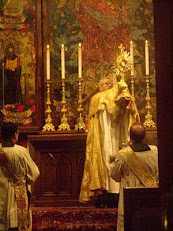
The first principle of the Ordinariate is then about Christian unity. St. Basil the Great, the Church’s greatest ecumenist, literally expended his life on the work of building bridges between orthodox brethren who shared a common faith, but who had become separated from one another in a Church badly fragmented by heresy and controversy. He taught that the work of Christian unity requires deliberate and ceaseless effort...St. Basil often talked with yearning about the archaia agape, the ancient love of the apostolic community, so rarely seen in the Church of his day. This love, he taught, is a visible sign that the Holy Spirit is indeed present and active, and it is absolutely essential for the health of the Church.

- Msgr. Jeffrey Steenson, Homily on the Occasion of his Formal Institution as Ordinary

Wednesday, June 3, 2015

On the memorial of Sts. Charles Lwanga and companions


At the Anglican Use Society's annual conference in Houston in 2009, Dr. Mary Moorman Armstrong delivered this talk about the grassroots ecumenism of Catholics and Anglicans as exemplified in the Ugandan Martyrs, whose feast day is observed today, June 3rd. In the second reading in the Office of Readings in the Roman rite Liturgy of the Hours, we read the following from Pope Paul VI's homily on the occasion of the canonization of these martyrs.

Who could have predicted to the famous African confessors and martyrs such as Cyprian, Felicity, Perpetua and -- the greatest of all -- Augustine, that we would one day add names so dear to us as Charles Lwanga and Matthias Mulumba Kalemba and their twenty companions? Nor must we forget those members of the Anglican Church who also died for the name of Christ.

On this memorial feast, read Dr. Moorman's talk and keep in mind these African martyrs who refused to compromise their virtue or faith; whose failure to comply with their earthly king's immoral demands earned them a place in the court of the one true King, our Lord Jesus Christ.


http://www.anglicanuse.org/AngEmb-3-01_Moorman.pdf

Wednesday, May 6, 2015

Professor Hans-Jürgen Feulner receives papal knighthood

Professor Hans-Jürgen Feulner, long-time friend of the Ordinariates, member of the Anglicanae Traditiones commission, and professor of liturgics at the University of Austria, has been awarded a papal knighthood.

The knighthood was officially bestowed in the Nuntiature in Vienna by parchment certificate of appointment at which time Prof. Feulner received the Papal Order of St. Gregory the Great. It was an impressive ceremony, with nice words from the Nuncio, and Mgr. Lopes, from the Congregation of Doctrine and Faith, reading a letter from Cardinal-Prefect Mueller; Msgr. Lopes pinned the Order on Prof. Feulner's jacket.


The little group of guests comprised representatives from the university, city of Vienna, the German embassy and others.


This is the second layman, to my knowledge, to receive a papal knighthood for work involved with the Ordinariates (Dr. Clinton A. Brand of St. Thomas University in Houston, Texas being the other...see a story on that here).

I am pleased to publicize this happy, and well-deserved, award.

Called to Be Holy Novena Booklet

As promised, here is the link to the booklet of readings and prayers for the nine days of the Called to be Holy Novena from 15th to 23rd May.
The spiritual writers/writings included are as follows:
  • Day 1 – The Dream of the Rood (8th C)
  • Day 2 – St. Bede on Hilda and Cædmon of Whitby (7th C)
  • Day 3 – The Cloud of Unknowing (14th C)
  • Day 4 – Julian of Norwich (14th-15th C)
  • Day 5 – Lancelot Andrewes (16th-17th C)
  • Day 6 – Thomas Ken (17th-18th C)
  • Day 7 – Blessed John Henry Newman (19th C)
  • Day 8 – Evelyn Underhill (19th-20th C)
  • Day 9 – Michael Ramsey (20th C)
Regarding the use of the Novena materials please refer to the Introduction of the booklet, written by former Anglican Deacon Antonia Lyn and our own Ordinariate Expats spiritual director, Fr. Scott Anderson.
We encourage you all to join the Personal Ordinariate of Our Lady of Walsingham in this spiritual exercise and in praying for the success of the events which each Ordinariate group will hold for all comers during or at some time after the Novena.

Thursday, April 9, 2015

What Does the Anglican Patrimony Have to Offer the Church?

Interesting article from "New Oxford Review". My take away is that the essence of Anglicanism (in Mr. Smith's view) is the forming of a liturgical people via the Prayerbook tradition of Eucharist and Daily Office. This is not unlike the idea that Anglicanism (despite Henry VIII's dissolution of the monasteries) is essentially Benedictine. Read the whole article for yourself. The beginning is below.

===============================
RE-APPROPRIATING THE SUBJECTIVE WITH THE OBJECTIVE
What Does the Anglican Patrimony Have to Offer the Church?
April 2015
By Richard Upsher Smith Jr.
November 2014 marked the fifth anniversary of the promulgation of Pope Benedict XVI’s apostolic constitution Anglicanorum Coetibus, which established personal ordinariates for Anglican converts to Roman Catholicism “so as to maintain the liturgical, spiritual and pastoral traditions of the Anglican Communion within the Catholic Church, as a precious gift…and as a treasure to be shared.” Anglicanorum Coetibus was not greeted with universal applause among former Anglicans already in communion with Rome, at least not among those of my acquaintance. These converts, who had left Anglicanism for what they had come to believe was the true Church, and who had been attending ordinary Novus Ordo parishes, sometimes for decades, wondered what substantial patrimony Anglicans could bring into the Church. To be sure, Anglicans have (or used to have) splendid liturgies, and their church music was incomparable, at least into the middle decades of the past century. But what do Anglicans have to give to the Church that is not of common inheritance from the pre-Reformation centuries or simply Protestant heresy?
A number of writers has tried to answer this question by taking an inventory of the strong and attractive characteristics of the Anglican heritage — for example, the Book of Common Prayer, the King James Bible, theologians like Richard Hooker and Jeremy Taylor, poets like John Donne and George Herbert, not to mention moderns like C.S. Lewis and T.S. Eliot. This method is useful, if only because it sets us thinking about what Anglicanism really is; but it does not arrive at the essence of Anglicanism.
The answer lies instead in the origins of Anglicanism at the beginning of modernity...
Read the rest at: http://www.newoxfordreview.org/article.jsp?did=0415-smith

Hat tip to Bill Tighe.

Saturday, March 21, 2015

Spring Issue of Ordinariate Observer Available.

The Spring 2015 issue (a double issue) is now available for download. Included are articles on the meeting of all 3 ordinaries in London in February, the dedication of the US Chancery, Dr. Clint Brand's  papal knighthood, and updates from several of the parishes throughout North America.

http://ordinariate.net/documents/2015/3/Spring%202015%20Ordinariate%20Observer.pdf

Saturday, March 7, 2015

The Anglican Use: Some Historical Reflections (Anglican Embers 2006;1(11):297-305)

From our Holy Cross 2006 issue (volume 1, number 11), this reflection on the meaning of the Pastoral Provision (the harbinger of the Ordinariates) by Fr. James Moore takes the long view, beginning with the survival of Catholic faith within members of the Church of England from the earliest days in the 16th century. Read it online at: http://www.anglicanuse.org/Moore_AnglicanUseHistoricalReflections_AngEmb0I11.pdf

Monday, March 2, 2015

‘Keep the Flame of the Christian Faith Burning’: Ordinariate Catholics Acquire Old Methodist Church

by Joanna Bogle, Register Correspondent 
Sunday, Mar 01, 2015

Welcome to the west of England. The railway line from Exeter St. David’s in Devon runs along the Exe Estuary — dozens of little sailing boats scurrying about on the water, with a green sweep of hills on the opposite bank — and then, somewhere around Dawlish Warren, it’s suddenly alongside the open sea, the waves occasionally  splashing against the side of the train.
Father David Lashbrooke is a priest in the nearby town of Torquay, and he is making history. He is a priest of the Personal Ordinariate of Our Lady of Walsingham (overseeing the flock of Anglicans who have come into full communion with the Catholic Church, thanks to Pope Emeritus Benedict XVI). He and his flock — with the goodwill of the local Methodists — have taken over a local Methodist church and are turning it into the home of their flourishing Catholic community and a center for mission outreach.
“Keep the flame of the Christian faith burning in this place,” said the Methodist minister, as he handed a lighted candle to Father Lashbrooke at the Methodists’ last service in the church.
And the flame is indeed burning brightly. The former Chelston Methodist Church is about to be renamed as the Church of Our Lady of Walsingham and St. Cuthbert Mayne (a local man and one of the 40 English martyrs who died for their Catholic faith between 1535 and 1679), and it is already home to a good-sized congregation at a sung Mass each Sunday...


Read the rest at the web site of the National Catholic Register.

Hat tip to Shane Schaetzel via Facebook.

Thursday, February 5, 2015

New US Ordinariate Chancery Dedicated and Blessed

February 4, 2015

Cardinal Levada with Msgr. Steenson
Houston – The Chancery of the Personal Ordinariate of the Chair of St. Peter was blessed and dedicated on Sunday, February 1st, with all the majesty and magnificence of the best of our Anglican patrimony and Catholic heritage.
With the prayers and presence of two Cardinals, an archbishop, two dozen priests and deacons, a festive choir, musicians, a contingent from the Knights of Columbus and a crowd of several hundred, the Chancery was liturgically and officially prepared for use as the headquarters for our growing mission within the Catholic Church in the United States and Canada.
Read the rest of the story and see more photos at the web site of the Personal Ordinariate of the Chair of St. Peter.

Japanese congregation of the Australian Ordinariate


Is this Raphael Kajiwara?
We have been made aware of an amendment to the website of the Personal Ordinariate of Our Lady of the Southern Cross indicating that it now includes a Japanese congregation in Tokyo under the leadership of “Father” Raphael Kajiwara.
It has long been mooted that members of the Traditional Anglican Church of Japan (TAC) – the Nippon Kirisuto Sei Ko Kai – around their former suffragan bishop, the Right Revd. Raphael Kajiwara, retired bishop of Yokohama, would be or have been received into the Catholic Church and that they would in fact join the Australian Ordinariate...
Read the rest of David Murphy's report at Ordinariate Expats

Sunday, January 25, 2015

The Causes for My Becoming Catholic


To close out the Week of Prayer for Christian Unity, we present this article from Anglican Embers by the leader of the Personal Ordinariate of the Chair of St. Peter, Msgr. Jeffrey Steenson. Writing about his motivation for becoming Catholic, he follows in the footsteps of Fr. Paul Wattson, creator of the Chair of Unity Octave, in finding his own personal communion with the Apostolic See to be the basis for furthering the cause of Christian unity.
Read the article at the Anglican Embers page of the Anglican Use Society site: http://www.anglicanuse.org/AE_2_08_Steenson-Becoming-Catholic.pdf


Thursday, January 22, 2015

In celebration of the Holy See's vision for Christian Unity

On February 1st, Septuagesima, the chancery building for the Personal Ordinariate of the Chair of St. Peter will be dedicated. The new ordinariate missal Divine Worship is also due to be presented at that time.

And a mere week later, on Sexegesima, all three ordinaries of the Personal Ordinariates will gather in London to celebrate a solemn Evensong & Benediction in celebration of the Holy See's vision for Christian Unity, of which the Ordinariates are a key part.

Please pray for the Ordinaries and all the people of the Ordinariate and the unity of all Christians.


Sunday, January 18, 2015

On the primacy of the Pope


St. Paul tells us in 1 Corinthians that "To each is given the manifestation of the Spirit for the common good. " And so the same is of course true for the apostles. In John's Gospel, Jesus bestows the name Peter on Simon during their first meeting. This name is representative of the gift that Peter will be given as leader of the apostolic college, which is further explained later in John's Gospel when Peter is commanded to "feed my sheep" and in Luke's Gospel where Jesus assures Peter that he has prayed for him so that he will be able to strengthen his brethren.

In his article on the Joint International Catholic-Orthodox Theological Commission, meeting in Ravenna, Italy, Msgr. Daniel Hamilton looks at the primacy of Peter and of his successors in the Apostolic See, that same seat of unity which Father Paul of Greymoor felt so key to the unity of the Church.

Read it at the Anglican Embers web site on the Anglican Use Society site: http://www.anglicanuse.org/AE_2_07_Hamilton-Ravenna-Primacy.pdf

Thursday, January 8, 2015

Dedication services for new Chancery of US Ordinariate set for February 1-2


We are pleased to share with you the dates and times for the Chancery dedication for the Ordinariate. Please mark your calendars for February 1-2, 2015.The formalities officially begin with Evensong at 4:00pm on Sunday; however, Mass will be celebrated that morning at 11:15 in the presence of His Eminence William Cardinal Levada, who will be the homilist. Please let us know if you plan to be at the Mass and (for clergy) if you plan to concelebrate. We will send out more information in early January with the particulars for Mass and for Evensong.
We hope many of you can attend. Please do not hesitate to let us now in the Ordinariate office me know if you have questions.

from the Ordinariate Observer, Winter 2014-15 edition.

Choral Evensong to celebrate the 3rd Anniversary of the US Ordinariate

The congregation of St. Gregory the Great in Stoneham, Mass. will be celebrating the 3rd anniversary of the founding of the US Ordinariate on January 28th, with Boston Archbishop Sean Patrick Cardinal O'Malley as officiant.


Tuesday, December 23, 2014

Keep the Mass in Christmas


 "Whereas we not only use it as a nourishment spiritual, as that it is too, but as a mean also to renew as ‘covenant’ with God by virtue of that ‘sacrifice’ as the Psalmist speaketh."

Lancelot Andrews, a bishop in the regin of James I and VI, and the head of the team charged with the translation of the Scriptures into English now known as the Authorized Version or King James Version, was insistent that in the Lord's Supper we are not only nourished by a spiritual meal, but renew the covenant with God through the one Sacrifice of Christ.

And this is only fitting. In the seventh chapter of Leviticus we read "For the wave breast and the heave shoulder have I taken of the children of Israel from off the sacrifices of their peace offerings, and have given them unto Aaron the priest and unto his sons by a statute for ever from among the children of Israel;" and in many other places of the Old Testament it is clear that only the priests could eat of the sacrifices of the Tabernacle and Temple. Jesus confirms this in his dispute with the Pharisees when, in chapter 6 of Luke he asks them "Have you not read what David did when he was hungry, he and those who were with him: how he entered the house of God, and took and ate the bread of the Presence, which it is not lawful for any but the priests to eat, and also gave it to those with him?"

But we are assured in the first epistle of St. Peter that all of us who are baptized are "living stones...built into a spiritual house, to be a holy priesthood, to offer spiritual sacrifices acceptable to God through Jesus Christ." And our priesthood is seen, not in that we each offer the sacrifice, for even in the time of the Temple every priest did not offer the sacrifice, as only one at a time could do so, (and hence Zechariah was chosen by lot from among his section of the priesthood to offer the incense on the day he encounted the Archangel), but in that we eat of the Sacrifice.

The best way to keep Christ in Christmas, as others have noted, is to keep the Mass in Christmas. May all of our readers be blessed in the days to come when we remember the tender love of our Savior who came to dwell in humble surroundings that we might share in his glory.

Read, mark, learn and inwardly digest the wise words from the Anglican Patrimony in Bishop Andrewes' text from our Pentecost 2010 (Vol III, No. 2) issue: http://www.anglicanuse.org/AE_3_02_AngPatr-Andrewes_Sacrifice.pdf