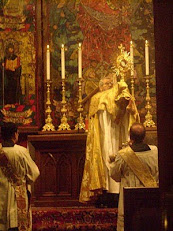
The first principle of the Ordinariate is then about Christian unity. St. Basil the Great, the Church’s greatest ecumenist, literally expended his life on the work of building bridges between orthodox brethren who shared a common faith, but who had become separated from one another in a Church badly fragmented by heresy and controversy. He taught that the work of Christian unity requires deliberate and ceaseless effort...St. Basil often talked with yearning about the archaia agape, the ancient love of the apostolic community, so rarely seen in the Church of his day. This love, he taught, is a visible sign that the Holy Spirit is indeed present and active, and it is absolutely essential for the health of the Church.

- Msgr. Jeffrey Steenson, Homily on the Occasion of his Formal Institution as Ordinary
Showing posts with label Vespers. Show all posts

Wednesday, October 9, 2013

Choral Vespers for the Feast of Blessed John Henry Newman

BY CHARLES COLE

Choral Vespers for the Feast of Blessed John Henry Newman will be broadcast live from Westminster Cathedral on BBC Radio 3 this Wednesday at 3.30pm. Appropriately much of the music is English, including Stanford's virtuosic double-choir setting of the Magnificat and also his beautiful Iustorum animae. The plainsong melody for the hymn Iste confessor is also English and is taken from the Bosworth Psalter. This year we mark the 50th anniversary of Poulenc's death, and the two choral pieces which frame the Vespers, the Introit and the Salve Regina, are both by the French composer.

Introit: Tout puissant (Poulenc)
Hymn: Iste confessor (Plainsong)
Psalms 14, 111 (Plainsong)
Canticle: Magna et mirabilia (Plainsong)
Responsory: Iustus Dominus (Plainsong)
Magnificat for Double Chorus, Op.164 (Stanford)
Motet: Iustorum animæ (Stanford)
Antiphon: Salve Regina (Poulenc)
Organ Voluntary: Præludium in E minor (Bruhns)

The Cathedral Choir is directed by the Master of Music, Martin Baker and the organ is played by the Assistant Master of Music, Peter Stevens.

from the New Liturgical Movement blog.

Monday, November 26, 2012

The Daily Offices as a Healing Balm

David Clayton is the Artist-in-Residence at Thomas More College in Merrimack, NH. An Oxford graduate, David has spoken about the way that even in contemporary Oxford, the Daily Office is the framework around which the life of the College is built. In a new post on the New Liturgical Movement blog he writes about a novel way of praying the office that his students and colleagues have taken up:
Recently when I went home to England we had a reunion of old college friends of mine. Most were not believers of any sort - I had known them since I was eighteen and so the friendships pre-date, by a long way, my conversion (I was 31 when was received into the Church and have just turned 50 FYI). It was great to catch up with everyone and see how they were getting on. I was interested by a recent decision of one. She had given up teaching genetics at Imperial College, London and was now working for a company that would go into investment banks in the City and teach executives how to meditate to help them deal with the stress of the job. She been introduced to meditation when she took up yoga for the physical benefits and then was attracted to the 'spirituality' that is attached to it.

In order to convince the executives that there is something to this Eastern meditation, they would be armed with statistics from scientific research. She said that there had been observable improvements in the condition of heart patients in hospitals when people meditated. The research shows, she said, that even if the patients did not meditate with the visitors or even if they were unaware it was happening, just have meditation going on in the building seemed to have a positive effect.

I was happy to believe that she was right and that the research backed her up. However, my reaction was that if anything good was coming out of this, then it was because it was participating in some way in Christian prayer, whether they knew it or not. I would contest that the fullness of what they are doing is in the traditional prayer of the Church and there is every chance that this would be even more powerful if done.

When I got back to the USA, I contacted local hospitals and asked if they would like a small group of people to come and sing Vespers on a regular basis. What is surprising and some ways dismaying, is that I couldn't find anyone who had ever heard of this being done before. There are Christian prayer groups who visit hospitals, but I don't hear of people making regular commitment (beyond the occasional concert) to pray the liturgy. Shouldn't the liturgy of the hours be one of our most powerful weapons as part of the New Evangelisation?

...

I was delighted when the Catholic chaplain at the VA Hospital, the American armed services veterans hospital in Manchester, New Hampshire invited us to come in every other Monday evening. Fr Boucher is an old friend of mine and the college. Since September, myself and Dr Tom Larson from Thomas More College have been leading a group of male students in Vespers and Compline on Monday evenings. Because we were singing the psalms, we have presented it as ecumenical and administratively this enabled us to fill an available slot in the chapel and it has attracted a few non-Catholics

The veterans at the hospital know that we are there but very few have been able to come each time. Most are too ill or injured even to be able to get up one floor from the ward without someone dressing them and bringing them up and those helpers aren't always available. Even then, I am not fooling myself that large numbers want to come but can't make it. This is an unusual thing. But we are undaunted. A regular group of up to a dozen guys has been going in and singing the psalms. We keep the door open and sing loud enough so that it floats down the corridor for the wards to hear. They are always surprised at the effort we make to sing well on their behalf and in order to praise God. It has been gratifying to hear how readily those who come, many who have never been to any Office before, can sing with us, and want to. We are singing in the vernacular so that any visitor can understand and join in. Nevertheless the tones are modal and have the feel of the plainchant tradition and this I think draws them in. (They were developed for the liturgy at the college)...

Read his full reflection at the NLM post "Send Out the L-Team - Making a Sacrifice of Praise for American Veterans"

Sunday, March 11, 2012

Convert priest thrilled to host Pope and Archbishop of Canterbury

Rome, Italy, Mar 9, 2012

(CNA/EWTN News).- Catholic convert Father Peter Hughes prefers to describe himself as “an Anglican who is now in full communion with Peter.”

“In a personal sense I have made this journey, and it has been both a fascinating and a demanding one,” said Fr. Hughes, the prior of San Gregorio al Celio monastery in Rome, in an interview with CNA.

Fr. Hughes was received into the Catholic Church in 2000, after many years as an Anglican vicar in his native Australia and in England.

This weekend he will experience his life come full circle as he hosts both Pope Benedict XVI and the Anglican Archbishop of Canterbury Rowan Williams. The two religious leaders will pray Vespers together to mark the 1,000th anniversary of the monastic Camaldolese Order, which has overseen San Gregorio since the mid 1500s.

“The thought of living one’s own ecclesial tradition in a different context and celebrating what is rich in both …is reflected in this whole celebration,” said Fr. Hughes...

Read the rest on the web site of the Catholic News Agency.

Hat tip to Fr. Z.

Wednesday, March 7, 2012

Anglican Patrimony in the Heart of the Church: WESTMINSTER ABBEY CHOIR TO SING IN ST. PETER'S

Vatican City, 6 March 2012 (VIS) - The Choir of Westminster Abbey in London, England, is due to sing alongside the "Cappella Musicale Pontificia", or Sistine Choir, on 29 June, in an event which will be broadcast across the world. The Westminster Choir has been invited to the Holy See through Msgr. Massimo Palombella, director of the Sistine Choir.
A joint communique made public today notes that "this momentous ecumenical occasion is the first time in its over-500 year history that the Sistine Chapel Choir has joined forces with another choir. The invitation to Rome came after Pope Benedict XVI visited the Abbey in September 2010 when he attended Evening Prayer and prayed at the tomb of St. Edward the Confessor with Archbishop Rowan Williams of Canterbury, as part of his State visit to England and Scotland".
Speaking about the forthcoming visit, the primate of the Anglican Church has highlighted how St. Peter is patron of both the Vatican Basilica and of Westminster Abbey, therefore "celebrating together his apostolic witness and example is a powerful reminder of the call that our Churches share to be faithful to the apostolic fullness of the Gospel today".
The two choirs will together sing at First Vespers in the Basilica of St. Paul's Outside-the-Walls on 28 June, and at Mass in the Vatican Basilica on the morning of 29 June. The Westminster Abbey Choir will also travel to the Benedictine monastery at Montecassino to sing Vespers and Mass with the monastic community at the burial place of St Benedict. It was Benedictine monks who established a tradition of daily worship which continues to this day in Westminster Abbey, founded in the year 960.

From the Vatican Daily News Service.