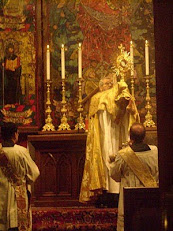
The first principle of the Ordinariate is then about Christian unity. St. Basil the Great, the Church’s greatest ecumenist, literally expended his life on the work of building bridges between orthodox brethren who shared a common faith, but who had become separated from one another in a Church badly fragmented by heresy and controversy. He taught that the work of Christian unity requires deliberate and ceaseless effort...St. Basil often talked with yearning about the archaia agape, the ancient love of the apostolic community, so rarely seen in the Church of his day. This love, he taught, is a visible sign that the Holy Spirit is indeed present and active, and it is absolutely essential for the health of the Church.

- Msgr. Jeffrey Steenson, Homily on the Occasion of his Formal Institution as Ordinary
Showing posts with label Chant. Show all posts

Tuesday, November 25, 2014

Melismatic Propers for Midnight Mass at Christmas

Many people who attend Anglican Use liturgies are aware of The Anglican Use Gradual, edited by C. David Burt, a fellow congregant of mine at St. Athanasius Parish in Boston. The AUG sets the minor propers of the liturgy (introit, gradual, alleluia, tract, offertory and communion) to simple psalm tones so that even a small schola or choir can chant them. I have heard the chants of the AUG sung not only in Pastoral Provision and Ordinariate parishes, but even in regular Roman Rite parishes.

Mr. Burt's gradual was the first English language gradual to appear for Catholic use, although there are now many others available, thanks to the work of folks like the hard working people at Corpus Christi Watershed.

But The Anglican Use Gradual remains the best suited for the Divine Worship liturgy, as it has congruent language, the texts being taken from the Coverdale psalter and the King James and Revised Standard translations of the Scriptures.

Over the years, we have published additions to the gradual in Anglican Embers, adapting the melismatic tones found in the Solemnes books and chants from the Sarum tradition. These are available on the Anglican Embers page at the Anglican Use Society web site, but here's a link to an appropriate one, the Midnight Mass propers for Christmas, published in our Advent 2010 issue: http://www.anglicanuse.org/Christmas-Midnight-Propers.pdf

Thursday, April 25, 2013

Feast of St. Mark

Today was a Red Letter Day, the feast of St. Mark. The Book of Divine Worship collect for today is:

Almighty God, who by the hand of Mark the evangelist hast
given to thy Church the Gospel of Jesus Christ the Son of
God: We thank thee for this witness, and pray that we may
be firmly grounded in its truth; through the same Jesus
Christ our Lord, who liveth and reigneth with thee and the
Holy Spirit, one God, for ever and ever. Amen.
There being no Mass at St. Athanasius today, I went to St. Paul's in Cambridge, Mass, home to the only Catholic boys choir school in the United States. The choir, together with the Men's Schola, sang for a Solemn High Mass in the Extradordinary form, with Fr. John Zuhlsdorf, who blogs at What Does the Prayer Really Say?, serving as celebrant. The Mass, and following talk (which I couldn't stay for) were sponsored by Juventutem Boston. Here are some photos and video of tonight's Mass.
Servers and clergy entering the Sanctuary.

The conclusion of the Introit.

During the Introit, Prayers at the Foot of the Altar.

The deacon chants the Gospel for the feast.


Clergy in choro.

Boys choir and Men's schola sing Palestrina's motet Sicut Cervus at the Offertory.

Sanctus, Consecration and Benedictus. The Ordinary was the
Missa Quarti Toni by Tomás Luis de Victoria.
Ecce Agnus Dei.
Holy Communion.

Fr. Z leaving the sanctuary after the chanting of the Regina Coeli.

Monday, November 26, 2012

The Daily Offices as a Healing Balm

David Clayton is the Artist-in-Residence at Thomas More College in Merrimack, NH. An Oxford graduate, David has spoken about the way that even in contemporary Oxford, the Daily Office is the framework around which the life of the College is built. In a new post on the New Liturgical Movement blog he writes about a novel way of praying the office that his students and colleagues have taken up:
Recently when I went home to England we had a reunion of old college friends of mine. Most were not believers of any sort - I had known them since I was eighteen and so the friendships pre-date, by a long way, my conversion (I was 31 when was received into the Church and have just turned 50 FYI). It was great to catch up with everyone and see how they were getting on. I was interested by a recent decision of one. She had given up teaching genetics at Imperial College, London and was now working for a company that would go into investment banks in the City and teach executives how to meditate to help them deal with the stress of the job. She been introduced to meditation when she took up yoga for the physical benefits and then was attracted to the 'spirituality' that is attached to it.

In order to convince the executives that there is something to this Eastern meditation, they would be armed with statistics from scientific research. She said that there had been observable improvements in the condition of heart patients in hospitals when people meditated. The research shows, she said, that even if the patients did not meditate with the visitors or even if they were unaware it was happening, just have meditation going on in the building seemed to have a positive effect.

I was happy to believe that she was right and that the research backed her up. However, my reaction was that if anything good was coming out of this, then it was because it was participating in some way in Christian prayer, whether they knew it or not. I would contest that the fullness of what they are doing is in the traditional prayer of the Church and there is every chance that this would be even more powerful if done.

When I got back to the USA, I contacted local hospitals and asked if they would like a small group of people to come and sing Vespers on a regular basis. What is surprising and some ways dismaying, is that I couldn't find anyone who had ever heard of this being done before. There are Christian prayer groups who visit hospitals, but I don't hear of people making regular commitment (beyond the occasional concert) to pray the liturgy. Shouldn't the liturgy of the hours be one of our most powerful weapons as part of the New Evangelisation?

...

I was delighted when the Catholic chaplain at the VA Hospital, the American armed services veterans hospital in Manchester, New Hampshire invited us to come in every other Monday evening. Fr Boucher is an old friend of mine and the college. Since September, myself and Dr Tom Larson from Thomas More College have been leading a group of male students in Vespers and Compline on Monday evenings. Because we were singing the psalms, we have presented it as ecumenical and administratively this enabled us to fill an available slot in the chapel and it has attracted a few non-Catholics

The veterans at the hospital know that we are there but very few have been able to come each time. Most are too ill or injured even to be able to get up one floor from the ward without someone dressing them and bringing them up and those helpers aren't always available. Even then, I am not fooling myself that large numbers want to come but can't make it. This is an unusual thing. But we are undaunted. A regular group of up to a dozen guys has been going in and singing the psalms. We keep the door open and sing loud enough so that it floats down the corridor for the wards to hear. They are always surprised at the effort we make to sing well on their behalf and in order to praise God. It has been gratifying to hear how readily those who come, many who have never been to any Office before, can sing with us, and want to. We are singing in the vernacular so that any visitor can understand and join in. Nevertheless the tones are modal and have the feel of the plainchant tradition and this I think draws them in. (They were developed for the liturgy at the college)...

Read his full reflection at the NLM post "Send Out the L-Team - Making a Sacrifice of Praise for American Veterans"

Tuesday, July 10, 2012

Blog vacation

Dear Readers,

I will not be blogging any news articles for the next 6 weeks or so, as I have a few items to take care of that will consume a great deal of time. At the beginning of May I was laid off from my job of 13 years, which I was fortunate enough to know about well ahead of time. I took some classes for the six months prior to my termination, and have a certification exam coming up in August that will require study.

Also, I am revising the book of Communion chants I assembled last year for use in our parish. These are in the same format as the music of David Burt's Anglican Use Gradual, with the addition of verses to sing during the communion. Along with fixing errors and typos, I want to add the chants for ritual Masses such as Marriage and Confirmation, and a table to help users coordinate between the "Ordinary Time" designation of Sundays upon which the Lectionary is based and the "of Epiphany" and "after Trinity" designations now assigned to those Sundays per annum in the Ordinariate Calendars. Once this is completed, I will alert you to their availability.

Our little Latin schola is singing this week for two Masses for Our Lady of the Atonement, and then I need to attend to preparing the music for the "high Mass" season of October through April.

And finally, I need to attend to getting the web site for the annual Anglican Use Society Conference finished and work on advertising for that.

And in addition to studying, editing and searching for work, there are the usual summer chores: the gardens, painting the house, erecting a new porch...

I am sure that you will not lack for news however, and recommend the following sites if you are not already visiting them regularly.

For thought-provoking commentary, I recommend the following blogs.

Vincent Uher's Tonus Peregrinus .

Fr. Stephen Smuts in South Africa.

Be on the watch for new posts from Fr. Hunwicke, whose blog has recently had a name change, from Liturgical Posts to Fr. Hunwicke's Mutual Enrichment. The title, I'm sure, hints at treasures worth seeking.

For news and analysis, from several viewpoints, visit the Anglo-Catholic blog, and the blogs of three of the bloggers there: Fr. Christopher Phillips, Fr. Edwin Barnes and Deborah Gyapong.

Additionally, you might wish to visit:

For Thine Own Service by Fr. James Bradley, and

Catholics in the Ozarks by Shane Schaetzel.

I wish you all well. Please keep the work of Msgr. Steenson, Msgr. Newton and Fr. Entwistle, and all of the new Ordinariate communities and the Anglican Use parishes in your daily prayer.

Thursday, October 14, 2010

New set of Communion Propers for Anglican Use Mass

Since the Congregation of St. Athanasius in Boston moved to large quarters last December at St. Lawrence Church, we've found it advisable to make use of the option provided in both the Graduale Romanum and the Anglican Use Gradual to sing additional verses with the communion chant that we've employed for years. It has fallen to your blog host to compile these verses each week, and recently I decided to try to get ahead of the process and compile the chants for several weeks in advance; my goal is to eventually have all of the chants set with the appropriate verses and then publish them via Lulu.

Here you have the fruits of my labor so far: Communion chants with verses for the Sundays and principal feast days from the 29th Sunday in Ordinary Time (i.e., October 17th) through Ash Wednesday. The chants are mostly taken from the Anglican Use Gradual compiled by C. David Burt; with a few additions such as St. John and Holy Innocents which I made using the Graduale Romanum as a guide and the Douay-Reims version for the text of the chant. Please feel free to contact me with any corrections. I will hopefully have the project finished by the time we reach the beginning of Lent.

Tuesday, December 30, 2008

Anglican Use Gradual vs. By Flowing Waters

December 10, 2007

Let's say your parish either has a music program in complete moribund disarray or has no program at all. You have been invited to start from scratch and move the parish gradually toward the ideal, as stated by Vatican II, of giving Gregorian chant "pride of place in liturgical services" (SC 116) along with sacred polyphony.
Parishioners speak English. Of them, 20% are eager to hear more chant, 20% are implacably hostile to it, and 40% don't care as long as you sing reasonably well and mostly in English. There are two resources (online and free) to consider: an English rendering of the Graduale Simplex called By Flowing Waters, and a book (approved for use by former Anglicans now fully in communion with Rome) called the Anglican Use Gradual.
Read in full (there are at least 50 comments) at the Musica Sacra forum of the Church Music Association of America.