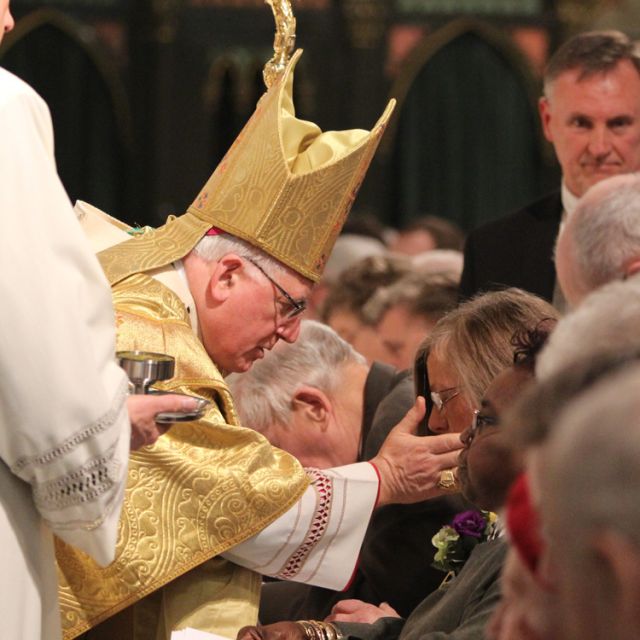
The first principle of the Ordinariate is then about Christian unity. St. Basil the Great, the Church’s greatest ecumenist, literally expended his life on the work of building bridges between orthodox brethren who shared a common faith, but who had become separated from one another in a Church badly fragmented by heresy and controversy. He taught that the work of Christian unity requires deliberate and ceaseless effort...St. Basil often talked with yearning about the archaia agape, the ancient love of the apostolic community, so rarely seen in the Church of his day. This love, he taught, is a visible sign that the Holy Spirit is indeed present and active, and it is absolutely essential for the health of the Church.

- Msgr. Jeffrey Steenson, Homily on the Occasion of his Formal Institution as Ordinary
Showing posts with label Unity. Show all posts

Thursday, January 22, 2015

In celebration of the Holy See's vision for Christian Unity

On February 1st, Septuagesima, the chancery building for the Personal Ordinariate of the Chair of St. Peter will be dedicated. The new ordinariate missal Divine Worship is also due to be presented at that time.

And a mere week later, on Sexegesima, all three ordinaries of the Personal Ordinariates will gather in London to celebrate a solemn Evensong & Benediction in celebration of the Holy See's vision for Christian Unity, of which the Ordinariates are a key part.

Please pray for the Ordinaries and all the people of the Ordinariate and the unity of all Christians.


Friday, December 12, 2014

Our Lady and Christian Unity


On the feast of La Virgencita we bring you an article from our Lenten 2010 issue (volume 3 no 1) comes this sermon by the very reverend Peter Stravinskas on Our Lady and Christian Unity. This was preached during Evensong for Our Lady of Walsingham, and tells the story of Our Lady of Siluva and Our Lady of Walsingham, but alludes to the feast of the Nativity of Our Lady. And in it Fr. Stravinskas preaches about the scandal of Christian disunity and the need for all Christians to take seriously Dante's short but powerful statement in the Commedia "In His will is our peace." Both that we find peace in doing his will and that we will have no peace until we do his will.

Ven con nosotros a caminar, Santa Maria, ven!


Monday, June 16, 2014

THE POPE RECEIVES THE PRIMATE OF THE ANGLICAN CHURCH: GREAT SAINTS, TEACHERS AND COMMUNITIES DEMONSTRATE OUR COMMON ROOTS

Vatican City, 16 June 2014 (VIS) – The awareness that the objective of unity may seem distant, but is always the aim of the path of ecumenism and common concern for the ills of humanity, especially human trafficking, were some of the key themes in the Holy Father's encounter with His Grace Justin Welby, archbishop of Canterbury, in the Vatican this morning.

“The Lord’s question – 'What were you arguing about on the way?' – might also apply to us. When Jesus put this question to his disciples they were silent; they were ashamed, for they had been arguing about who was the greatest among them. We too feel ashamed when we ponder the distance between the Lord’s call and our meagre response. Beneath his merciful gaze, we cannot claim that our division is anything less than a scandal and an obstacle to our proclaiming the Gospel of salvation to the world. Our vision is often blurred by the cumulative burden of our divisions and our will is not always free of that human ambition which can accompany even our desire to preach the Gospel as the Lord commanded”.

Despite these difficulties, “The Holy Spirit gives us the strength not to grow disheartened and invites us to trust fully in the power of His works. As disciples who strive to follow the Lord, we realise that the faith has come to us through many witnesses. We are indebted to great saints, teachers and communities; they have handed down the faith over the ages and they bear witness to our common roots”.

The bishop of Rome went on to remark that yesterday, on the Solemnity of the Most Holy Trinity, the archbishop of Canterbury celebrated Vespers in the Church of San Gregorio al Celio, “from which Pope Gregory the Great sent forth Augustine and his monastic companions to evangelise the peoples of England, thus inaugurating a history of faith and holiness which in turn enriched many other European peoples. This glorious history has profoundly shaped institutions and ecclesial traditions which we share and which serve as a solid basis for our fraternal relations”.

“On this basis, then, let us look with confidence to the future. The Anglican-Roman Catholic International Commission and the International Anglican-Roman Catholic Commission for Unity and Mission represent especially significant forums for examining, in a constructive spirit, older and newer challenges to our ecumenical engagement. He also emphasised their shared “horror in the face of the scourge of human trafficking and forms of modern-day slavery” and thanked Archbishop Welby “for the leadership you have shown in opposing these intolerable crimes against human dignity”.

“In attempting to respond to this urgent need, notable collaborative efforts have been initiated on the ecumenical level and in cooperation with civil authorities and international organisations. Many charitable initiatives have been undertaken by our communities, and they are operating with generosity and courage in various parts of the world. I think in particular of the action network against the trafficking in women set up by a number of women’s religious institutes”. He concluded, “Let us persevere in our commitment to combat new forms of enslavement, in the hope that we can help provide relief to victims and oppose this deplorable trade. I thank God that, as disciples sent to heal a wounded world, we stand together, with perseverance and determination, in opposing this grave evil”.

From the Vatican Information Service's Daily Bulletin.

See also the address by Pope Francis to His Grace Justin Welby earlier today.

Saturday, September 21, 2013

Msgr Keith Newton on the state of the Ordinariate in the UK


Dear brothers and sisters in Christ,

Next Tuesday, 24 September, the Feast of Our Lady of Walsingham, is an opportune moment to be invited to write to you about the Personal Ordinariate of Our Lady of Walsingham, established two and a half years ago. I am grateful to your bishop for giving me this opportunity to tell you about the contribution the Ordinariate makes to the life and mission of the Catholic Church in our country.

Pope Benedict XVI established this new structure in 2011. He wanted to help groups of Anglicans, who wished to bring with them some of the traditions and beauty of the Anglican heritage in which they were nurtu-red, the ability to enter into full communion of the Catholic Church.

Since then more than 80 former Anglican clergy have been ordained as Catholic priests of the Ordinariate in England and Wales. They lead about 40 groups of former Anglican lay people, as well as serving the wider Catholic Church as chaplains in hospitals, prisons or schools or as diocesan priests. In London two churches have been entrusted to us. Elsewhere, our groups celebrate Ordinariate Masses in diocesan Catholic churches. We now have our own Ordinariate rite, which draws on those elements of the Anglican tradition which are consistent with Catholic teaching. As it is gradually introduced, it will add to the distinctive character of our worship. Already, one of the jewels of the Anglican tradition, choral Evensong, is beingregularly celebrated by the Ordinariate in some Catholic churches.
The Ordinariate adds to the rich diversity of the Catholic Church. Any Catholic is free to take part in the life and liturgy of the Ordinariate and receive the Sacraments from its clergy. Our priests are just like any other Catholic priests. By attending an Ordinariate Mass, you are fulfilling your obligation, just as you would by going to any Catholic church in the world. Members of the Ordinariate are likewise free to attend Mass in any Catholic church, being truly and fully members of the Catholic Church.

People coming to our Masses have spoken positively about the conviction of our preaching, our strong musical tradition and hymn singing, our pastoral outreach and the welcoming nature of our gatherings afterwards. This puts us in a strong position to play a full part, with the whole Church, in the urgent task of the New Evangelisation.

Like many members of the Church of England, in which I was ordained for over 35 years, I longed and prayed for union with the Catholic Church and the Ordinariate was a personal fulfilment of those prayers. It has been an incredible and uplifting journey for us all, full of grace, joy and blessings. Of course, we have experienced hardship and sacrifice as well. For many, especially those of our priests who are married with families, there has been great financial uncertainty; for us all it has meant leaving friends and familiar places of worship in the Church of England. We ask for your encouragement, your support and your prayers.
You may ask why we did not become Catholics in the usual way. It is a reasonable question but misses the most important point about the Ordinariate, that it is 'a prophetic gesture that can contribute positively to the developing relations between Anglicans and Catholics' and 'It helps us to set our sights on the ultimate goal of all ecumenical activity: the restoration of full ecclesial communion in the context of which the mutual exchange of gifts from our respective spiritual patrimonies serves as an enrichment to us all' (Benedict XVI, Address to the Bishops, Oscott College, September 2010).

The Personal Ordinariate of Our Lady of Walsingham has begun in a small way but it is a concrete expression of the Church's desire to fulfil our Lord's command that 'they may all be one'. It is a small step towards healing one of the most damaging wounds of our history: the dividing of Christ's Body, the Church in this land.

With the assurance of my prayers for the whole Church as we all seek to be faithful to Our Lord Jesus Christ.

Monsignor Keith Newton, Ordinary

from The Tablet, September 20, 2013
hat tip to Mary Ann Mueller

Wednesday, August 28, 2013

News from the Sodality of St. Edmund, King & Martyr

The Update, from St. Edmund's in Cambridge, Ontario, is always a good read, and I commend this monthly newsletter to all of you who stop by here. In this month's issue, there's a reflection by Msgr. Andrew Burnham on the birth of the Ordinariates, and he concludes on this hopeful note:

We are few, like Gideon's men (Judges 6), but the bravery of 80 priests, most of whom have lost stipend and some future pension benefits, and the 30 or 40 groups of laity, who have lost their habitual time and place of worship and nowadays go to church at a less convenient time and to a less convenient place, is, we believe, the beginning of something new and magnificent. It is not just Choral Evensong and all that, though the Customary of Our Lady of Walsingham provides that for us, it is a step towards the healing of one of the most damaging wounds of history, the dividing of Christ's Body the Church, here in England.
The update is available from St. Edmund's web site.


Thursday, February 28, 2013

Pope Benedict prompted ecumenical friendships even as dialogue slowed

VATICAN CITY (CNS) -- Pope Benedict XVI's pontificate was marked by strong ties of friendship and esteem with the leaders of the world's Orthodox and Anglican Christians, but his papacy also coincided with a difficult time in the search for full Christian unity.

In the face of new obstacles to ecumenism -- particularly regarding the ministry of women, attitudes toward homosexuality and differences on ethical issues -- Pope Benedict often emphasized the role of prayer in seeking Christian unity, as well as the need for divided Christians to work together to protect religious freedom and defend traditional Christian values.

For Catholics coming from the Anglican tradition, the ecumenical highlight of Pope Benedict's pontificate was his decision in 2009 to establish personal ordinariates, jurisdictions similar to dioceses, which recognize their full communion with Rome while preserving some of their Anglican heritage.

Msgr. Jeffrey N. Steenson, head of the Ordinariate of the Chair of St. Peter for former Anglicans in the United States and Canada, said, "Unambiguously, it is his ecumenical legacy."

Canadian Bishop Donald Bolen of Saskatoon, Saskatchewan, Catholic co-chairman of the International Anglican-Roman Catholic Commission on Unity and Mission, had a slightly different view.

"The ordinariates for Catholics coming from an Anglican background are not a new form of ecumenism or the new hope for Christian unity," he said. "They are pastoral provisions for individuals and groups who, in conscience and after long prayer, have sought full communion with Rome while not wanting to leave behind their spiritual, theological and liturgical heritage.

"Welcoming them into the church and encouraging them to hold on to that heritage is a recognition on the part of Pope Benedict and the Roman Catholic Church -- arising from decades of dialogue -- that the diverse gifts given to different Christian communities should enrich the entire body of Christ," Bishop Bolen said in an email response to questions.

Msgr. Steenson said Pope Benedict's care for former Anglicans entering the Catholic Church "was and has been a project close to his heart for many years, even as Cardinal (Joseph) Ratzinger," head of the Congregation for the Doctrine of the Faith...

Read the entire story at Catholic News Service.

Sunday, February 3, 2013

Speech by Archbishop Müller at Ordinariate Symposium

Ordinariate Expats has the link to the Prefect of the Congregation for the Doctrine of the Faith Archbishop Mueller's speech yesterday at the US Ordinariate's Anniversary Sympoisum, as well as the full text of the talk.

An excerpt from the talk:

At the very heart of the Christian faith is the revelation of the Blessed Trinity: God is Father, Son, and Holy Spirit, three Persons united in the one Godhead. The revelation of the Trinity is not one doctrine among others, but it is God’s very self-manifestation in which God does not just impart some abstract knowledge about himself, but rather draws us in to the depths of the mystery of his life and love so that we might be saved, healed, and restored to relationship with him. The revelation of the Trinity encompasses the whole of the Christian faith, and therefore will be a helpful context for our reflection on unity. The communion of the Church flows from the communion of the Blessed Trinity, which is a model of unity not based on uniformity, nor is it a unity without substance.
The Father is the source and author of all life. He reveals himself, that is to say, he gives himself to the World in giving his Incarnate Son and he pours forth the Holy Spirit with the Son so that every aspect of this revealing self-gift might be illuminated and life-giving. The Church, receiving the gift of the Son and being vivified by the Spirit, responds in Eucharistic praise, offering back to the Father for the sake of the world the very gift she has received. This the Church does in the power of the Holy Spirit who effects the transformation of the Church’s gifts into the Body and Blood of Christ, the only acceptable sacrifice which brings salvation to the whole world.
The encounter with Divine Revelation and the dynamic of inter-Personal love in God characterizes the most basic shape of the Church which stands before the Father, in the Son, through the Holy Spirit. Through our Eucharistic sharing in the death and resurrection of Christ, we, the many, are made one in Christ Jesus. This communion with Christ fashioned by the Spirit allows us access to the Father. Indeed, the greatest prayer of the Church is the oneour Lord gave us in which we call God not only his Father, but “Our Father”.
From the perspective of the world, this is indeed a new kind of unity different from all other human attempts at oneness. The history of the world demonstrates again and again that human beings often go about trying to construct unity by enforcing uniformity. When we think of how this has played out in governments and societies, particularly in the totalitarian regimes of the last century, we see that there is an inherent danger in this conception. Uniformity tends toward the elimination of those who do not conform or comply. Conversely, another way the world tries to achieve oneness is by simply overlooking or ignoring the differences that do exist, even to the point of allowing contradictory claims to truth. But this kind of liberal expansiveness, which is rather a hallmark of “latitudinarian” Anglicanism, brings about a unity that is naïve and ephemeral and is, in fact, unity in name only. It is relativism in the absolute and erodes the very foundation of truth upon which true ecclesial communion is built.
True communion is rooted in the unity of the Father, Son, and Holy Spirit, a communion in which the diversity of the Persons is constituted and sustained by their essential relations. The Father is not the Son and the Spirit is neither the Father nor the Son, and yet each divine Person is who he is in relation to and in perfect communion with the other. This communion in difference is the key insight as we consider our participation as Church in the Trinitarian mystery. We are all called to discipleship and grafted onto the ecclesial Body of Christ through Baptism. Our unity with one another as members of the one Body does not destroy our distinctiveness. Clergy and lay, religious and secular, married and single, male and female, we all share an equal dignity and are formed into one Church through the profession of “one Lord, one faith and one Baptism”. Our distinctiveness and interdependence is a blessing for the Church and a source of its vitality.
The unity of the one and the many is a key insight of Anglicanorum coetibus. The unity of the Church is an image of the eternal unity of God, and according to that heavenly pattern, unity is not achieved by an elimination of distinctiveness. The unity of faith, therefore, permits a diversity of expression of that one faith. This is what is meant in the Apostolic Constitution when it says that groups of Anglicans can enter into communion with the Catholic Church while preserving elements of the distinctive Anglican spiritual and liturgical patrimony. The diversity in liturgical expressions, in some governance structures and in parochial culture does not threaten ecclesial communion. The overarching structure which holds together these expressions is the faith of the Church, ever ancient and ever new, and expressed eloquently in the Catechism of the Catholic Church.

Thursday, December 6, 2012

The Pallium

Fr. Robert Mercer, CR, writes in St. Edmund's latest Update:
Anglicans tend to know little about Anglicanism. How many are aware that the Archbishop of Canterbury's coat of arms displays the pallium? How many know what a pallium is? It is a Y shaped vestment, woven from lamb's wool, marked with crosses, worn by the archbishops of ancient, important or primatial dioceses. It hangs down back and front from the shoulders like a yoke over the chasuble. It is conferred on archbishops by the Pope and indicates the strong bond between himself and them. But the Archbishop of Canterbury is not in communion with the Bishop of Rome. Quite so. The arms of Canterbury therefore lie!

But as I say, the majority of Anglicans are ignorant of this lie. I myself am not offended. The lie is a reminder of what once was. The first Archbishop of Canterbury was sent to England by Pope Gregory the Great in 597 (when he brought with him the consecration prayer which we of the Ordinariate use at the eucharist). The lie I see as an expression of hope, or if not of hope, as an expression of what ought to be. The Archbishop of Canterbury ought to be in communion with the Bishop of Rome. The church should be one: bishops should express such unity by being in communion with all other bishops. They are, after all, supposed to be the ministers of unity. And a universal church needs a universal primate, president, presiding servant. Who can this possibly be if not the Bishop of Rome? The Eastern Orthodox recognize this and one Russian has added, "What use is primacy without jurisdiction?" What does the Archbishop of Canterbury do to foster unity? He advocates policies which drive the two churches further and further apart, the ordination of women, gay marriages, and he is evasive about the human right to life.

Then again, how many Anglicans know that off and on for some four hundred years there have been some modest attempts at Anglican Roman Catholic rapprochement? Admittedly such attempts have been more off than on. But Canon Bernard Pawley of St Paul's cathedral in London and his wife Margaret have published a history of these attempts, Canterbury and Rome Through Four Centuries...
Read the full article in this month's Update.

HT to Gary Freeman.

Wednesday, October 10, 2012

Pope Paul VI on St. Elizabeth Ann Seton

May you always be able to cultivate the genuine fruitfulness of evangelical holiness, and ever experience how-far from stunting the flourishing development of your economic, cultural and civic vitality -it will be in its own way the unfailing safeguard of that vitality. Saint Elizabeth Ann Seton was born, brought up and educated in New York in the Episcopalian Communion. To this Church goes the merit of having awakened and fostered the religious sense and Christian sentiment which in the young Elizabeth were naturally predisposed to the most spontaneous and lively manifestations. We willingly recognize this merit, and, knowing well how much it cost Elizabeth to pass over to the Catholic Church, we admire her courage for adhering to the religious truth and divine reality which were manifested to her therein. And we are likewise pleased to see that from this same adherence to the Catholic Church she experienced great peace and security, and found it natural to preserve all the good things which her membership in the fervent Episcopalian community had taught her, in so many beautiful expressions, especially of religious piety, and that she was always faithful in her esteem and affection for those from whom her Catholic profession had sadly separated her.

from the homily by Pope Paul VI at the canonization of Elizabeth Ann Seton, September 14, 1975.

Almighty Father, whose blessed Son before his passion prayed for his disciples that they might be one, even as thou and he are one: Grant that thy Church, being bound together in love and obedience to thee, may be united in one body by the one Spirit, that the world may believe in him whom thou didst send, the same thy Son Jesus Christ our Lord; who liveth and reigneth with thee, in the unity of the same Spirit, one God, now and for ever. Amen.
from the Book of Divine Worship, For the Unity of Church, p. 496

Tuesday, April 17, 2012

Another (in-depth) post on the reception of ACCC groups this past weekend

Canadian Anglican groups welcomed into Catholic Church


Tuesday, 17 April 2012 09:01
Ottawa Archbishop Terrence Prendergast at the Rite of Reception of Anglican Catholic Church of Canada members.Ottawa Archbishop Terrence Prendergast at the Rite of Reception of Anglican Catholic Church of Canada members.- Photo by Robert Du Broy, courtesy of the Archdiocese of Ottawa

OTTAWA - Bishops in Ottawa and Victoria received two groups from the Anglican Catholic Church of Canada (ACCC) into the Roman Catholic Church April 15, including two former ACCC bishops and about a half dozen clergy.

"Today, the Body of Christ is a little more healed, a little more unified," Ottawa Archbishop Terrence Prendergast told more than 700 people who packed St. Patrick's Basilica. "Today, after half a millennium, separated brethren are separated no more. We are brethren, rejoicing at the same banquet table. Hallelujah."

In Victoria, an estimated 600 people packed St. Andrew's Cathedral, where Bishop Richard Gagnon welcomed the former metropolitan bishop of the ACCC, Peter Wilkinson.

The two groups received on Divine Mercy Sunday will soon become part of the Canadian Deanery of St. John the Baptist of the Personal Ordinariate of the Chair of St. Peter under Msgr. Jeffrey Steenson, who was named the Ordinary when the American Ordinariate was erected Jan. 1. Steenson, a former Episcopal (Anglican) bishop, is a married Catholic priest who teaches theology at the University of St. Thomas and St. Mary's Seminary in Houston...


Read the rest at The Catholic Register.

Friday, April 6, 2012

A Spiritual Autobiography

by the Rev. Jurgen Liias

This has been written as part of an Application Process seeking Ordination in the Catholic Church through the Anglican Ordinariate..

This last year I gathered together at 8a.m. on Saturday morning- (the time was intended to find only motivated folk) -a group of parishioners of CTR to explore the meaning of the invitation of Pope Benedict in Anglicanorum Coetibus.  We began our study under the brilliant tutelage of Dr. Thomas Howard addressing the question for ten weeks: “What does the Catholic church really teach?” A convert from Fundamentalism and Anglicanism, Dr. Howard was able to instruct us both biblically and cogently about those subjects most troublesome to evangelical protestants: Marian dogma and devotion, the primacy of Peter, the infallibility of the Pope, the veneration and intercession of Saints, the doctrine of purgatory, prayer for the dead etc.   A second ten week study program was focused on Anglican- Catholic Ecumenical Conversations and initiatives: ARCIC, the Pastoral provision, Anglican-use Catholic churches, and finally the idea  of an Anglican Ordinariate proposed by the Pope’s decree.    I concluded that series with an invitation: If twelve individuals feel called personally to respond to the Pope’s invitation to Anglicans to come into full communion with the See of Rome through the Ordinariate, I would lead them forward.  I initially received nine commitments; a tenth joined us in November; on December 31 I received 11 and 12! On January 1, the US Ordinariate was established. God could not have been clearer.

I am as well convinced that this was the Kairos for me precisely because of the Ordinariate. Though I might have journeyed earlier to Rome in my own personal history, this was a collective historic moment  for the beginning of the fulfillment of the vision of the reunion of Rome and Canterbury. That was the dream of our tractarian fathers, that was the explicit goal of Pope Paul VI and Archbishop Ramsey at the launching of the ARCIC dialogues, this was an implicit hope in the bold ecumenical theology of Pope John Paul II in Ut Unum Sint and his revisioning of a Papacy for the whole church. I am humbled to be invited by God to be a small part of this historic work.

Read the whole of Fr. Liias' spiritual autobiography at his eponymous blog.

Sunday, April 1, 2012

Queen Elizabeth announces appointment of Catholic as next Archbishop of Canterbury


In a daring move that has completely surprised news watchers and experts, Buckingham Palace revealed today the Her Majesty, Queen Elizabeth II, in consultation with His Holiness, Pope Benedict XVI, has appointed as the next Archbishop of Canterbury, the Catholic bishop of Foligno, Italy, Gualtiero Sigismondi.


Her Majesty, Queen Elizabeth II


The Foligno diocese, in the Umbria region of Italy, is home to the restored Benedictine abbey of Norcia, where St. Benedict, founder of the world-wide Benedictine order of monks had his abbey.
In the released statement, Her Majesty writes, "In a dark time almost 1400 years ago, the sons of St. Benedict came to this island and helped restore the light of Christ that had been nearly extinguished after invasions and wars. It is my hope that His Grace, Bishop Sigismondi, with his intimate experience of Benedictine life and his dedication to Christian tradition will similarly renew the light of Christ in our land."


His Grace, Bishop Gualtiero Sigismondi


The incumbent Archbishop of Canterbury, His Grace Rowan Williams, who announced his retirement at the end of this year so that he may take up an academic appointment at Cambridge University, is said to be delighted with the choice. "As is well known, I have always felt that the Anglo-Catholic view is the purest strain of churchmanship in the Church of England, and this bodes well for the unity of the whole Christian Church. I have full confidence in Her Majesty's selection, and look forward to greeting Bishop Sigismondi when he visits during the special June bank holiday when we will celebrate Her Majesty's diamond jubilee.


His Grace, Archbishop Rowan Williams


Fr. Federico Lombardi, the Vatican Press Secretary, released a statement that said that His Holiness was pleased that this appointment would go forward, adding that this would serve to draw the two churches closer, accelerating the process begun since the 2009 publication of Anglicanorum Coetibus.


His Holiness, Benedict XVI with
press secretary Fr. Federico Lombardi, S.J.

Sunday, February 12, 2012

Homily of Msgr. Jeffrey Steenson at Mass of Institution


Fr. Jeffrey Steenson Processing into the Co-Cathedral of the Sacred Heart in Houston

at the Beginning of the Mass for his Institution as Ordinary of the Personal Ordinariate

of the Chair of St. Peter


The Chair of St. Peter and Christian Unity

“Behold how good and joyful a thing it is, for brethren to dwell together in unity!” (Ps. 133:1). With all our hearts, let us thank Pope Benedict XVI for this beautiful gift, the Personal Ordinariate of the Chair of St. Peter, and let us pray that it may further the goal of Catholic unity. When Cardinal Wuerl told me that the Holy Father would establish the Ordinariate under this name, I truly rejoiced, for it goes to the heart of what our mission should be. And it helps us to understand why our Lord entrusted His Church to St. Peter in the first place.


So much ink has been spilled over the interpretation of these words of our Gospel, which Jesus spoke to Peter in Caesarea Philippi – “You are Peter, and on this rock I will build my Church” (Mt. 16:18). Of course, for Catholics, the authoritative interpretation was provided at the First Vatican Council. But we must honestly acknowledge that Christians have read this text in different ways. Even amongst the church fathers there was not unanimity over what “On this Rock” means precisely. The great Augustine himself said that the reader must choose – Does this Rock signify Christ or Peter? (Retract. 1.20). But Augustine quite properly would not have thought this a matter of either/or. For Peter brings everything to Christ. The trajectory is clear. We are Christ’s and Christ is God’s (I Cor. 3:23). I am grateful that, over the course of my ministry, the teachings of Pope John Paul II and Pope Benedict XVI have been so clear on this point – the Church exists to bring souls to Christ. But, as our text plainly affirms, Jesus has invested Peter with a ministry of fundamental importance. And he does so by employing three verbs in the future tense – I will build my church … the gates of hell will not prevail against it … I will give you the keys of the kingdom of heaven. When Jesus speaks in the future tense, he draws all things to himself; we know then that this commission does not end with the historical Peter. The whole life of the Church on earth until the end of time is anticipated in this moment.


In this context, listen to St. Anselm, the 37th Archbishop of Canterbury, perhaps the greatest theologian ever to grace England’s green and pleasant land: “This power was committed specially to Peter, that we might therefore be invited to unity. Christ therefore appointed him the head of the Apostles, that the Church might have one principal Vicar of Christ, to whom the different members of the Church should have recourse, if ever they should have dissentions among them. But if there were many heads in the Church, the bond of unity would be broken” (Cat. Aur. Mt. 16:19).


The first time we find Matthew 16:18 specifically applied to Peter’s successors, the Bishops of Rome, came amidst a controversy between Pope Stephen and Cyprian of Carthage in the middle of the third century. At the risk of sounding pedantic, I hope that you will permit me to speak briefly to this, because it is very relevant to the Ordinariate. In the Anglican tradition, the church fathers are held in high esteem; here is where we were taught to find our bearings on theological questions.


The third century popes are heroes to me, because they were courageous pastors who sought to restore those brethren who had broken or fallen away to the full communion of the Catholic Church. At a time when many bishops were very severe and uncompromising about the purity of the Church, God gave us popes who understood that welcoming back the wandering and the fallen is of the very essence of the ministry that Jesus gave to the Apostles. In the letters of St. Cyprian there is a remarkable and revealing correspondence from St. Firmilian of Caesarea about Pope Stephen (Ep. 75, ca. 255) – Can you believe it, Cyprian? Stephen actually thinks that he sits on the chair of Peter as he orders us to accept the baptism of these separated groups! He actually wants us to regard these people as Christians!


I think this is the important context in which to understand what Pope Benedict is saying to us in Anglicanorum coetibus. Some will argue that the Catholic Church makes Christian unity a difficult thing to achieve. Look at what is being asked of those who are considering the Ordinariate! – Anglicans have not only to be received but even confirmed, and their clergy ordained in the absolute form. Is this not asking them to begin all over again? Certainly not! From Zephyrinus to Callistus to Cornelius to Stephen – these third century popes, most of whom laid down their lives as martyrs, who governed the Church at a time when it seemed as though the gates of hell really might prevail, threatening to destroy her essential unity – the Catholic Church simply asked that the bonds of charity be restored sacramentally by invoking the presence of the Holy Spirit. These are brothers and sisters, returning home.


The first principle of the Ordinariate is then about Christian unity. St. Basil the Great, the Church’s greatest ecumenist, literally expended his life on the work of building bridges between orthodox brethren who shared a common faith, but who had become separated from one another in a Church badly fragmented by heresy and controversy. He taught that the work of Christian unity requires deliberate and ceaseless effort. Like an old coat which is always being torn and is difficult to mend, the unity of the Church must never be taken for granted but requires great diligence and courage from her leaders (Bas. Ep.113). St. Basil often talked with yearning about the archaia agape, the ancient love of the apostolic community, so rarely seen in the Church of his day. This love, he taught, is a visible sign that the Holy Spirit is indeed present and active, and it is absolutely essential for the health of the Church. I can’t think of a better illustration for this homily than Bernini’s great sculpture of the Chair of St. Peter in the apse of St. Peter’s Basilica: Peter’s chair is upheld by the great fathers of the Church; and, hovering over it all, the luminous alabaster dove, the Holy Spirit, bathing everything in the radiance of God’s love.


There is so much to be celebrated about the patrimony of Anglicanism, its liturgical, spiritual, and pastoral traditions, which the Catholic Church welcomes as a treasure to be shared. But let us be clear about our first principles. So many people during the 477 years that Anglicans have been separated from Rome have prayed fervently and made great sacrifices for this day to come. In obedience and trust they embraced whole-heartedly all that Jesus’ prayer for the unity of his disciples requires (Jn. 17:21). It is surely no coincidence that this reconciliation should come at the very time Pope Benedict has put the new evangelization at the top of the Church’s agenda. To be converted and conformed to the image of Christ means that his Church will be transformed and renewed through and through. I so much appreciate how our Chancellor, Dr. Margaret Chalmers, puts it: “Our patrimony is people.” We thus open our hearts, in humility and love, to all Christians divided by culture and circumstance and misunderstanding. We extend our hand in friendship to all who seek the Truth. These are our companions along the way. We begin with a strong faith that God has given us Peter, his hand firmly on the tiller, returning us to Jesus, “the Shepherd and Bishop of our souls” (I Pet. 2:25).


Fr. Jeffrey Steenson


Fr. Jeffrey Steenson greets lay and clerical representatives of the

Anglican Use parishes and Ordinariate after the decree of his

nomination by the Holy Father was read out by Donald Cardinal Wuerl

of Washington, D.C.

Friday, January 27, 2012

The Catholic Diocese of Fort Worth experiences Christian Unity with the the Pastoral Provision and the Anglican Ordinariate


Our Shepherd Speaks
Dear Brothers and Sisters in Christ,
One of the blessings about the life of Faith here in the Diocese of Fort Worth, especially with an eye to the Week of Prayer for Christian Unity, has been the lived experience of the Pastoral Provision and the recent announcement of the establishment of the "Ordinariate of the Chair of St. Peter" on January 2, 2012 at Our Lady of Walsingham in Houston,Texas.AsIsaidatthenewsconference, both are, I believe complementary, yet distinct expressions of the Lord's will that "all may be one." They are first ecclesial movements toward something — full communion with the See of Peter — and not away from something...

Read the rest of Bishop Vann's column in the February issue of North Texas Catholic, beginning on page 2.

Thursday, January 19, 2012

Baltimore Episcopal parish, priests to be received into Catholic Church

By Catholic Review Staff

Cardinal-designate Edwin F. O’Brien, apostolic administrator of the Archdiocese of Baltimore, announced Jan. 19 that Mount Calvary Church, a Baltimore parish of the Episcopal Diocese of Maryland, will be received into full communion with the Roman Catholic Church through the newly created Anglican Ordinariate for the United States.

Father Jason Catania, Mount Calvary’s pastor, informed the archdiocese that it has reached an agreement with the Episcopal Diocese of Maryland, effectively ending the parish’s 169-year history with the Anglican Church. In October 2010, the parish’s vestry unanimously voted to leave the Episcopal Church and to become an Anglican-use Catholic parish.

Mount Calvary’s reception into the Catholic Church marks the second such Anglican community in Baltimore to do so. In 2009, Cardinal-designate O’Brien welcomed 10 Episcopal nuns and their chaplain to the Archdiocese. In 2011, the nuns, members of the All Saints Sisters of the Poor in Catonsville, were welcomed into a newly erected Roman Catholic diocesan priory of the same name. Their chaplain, Father Warren Tanghe, was ordained a Catholic priest in June.

“The steady flow of Mount Calvary alumni to Rome, combined with the decision by the All Saints Sisters and the publication of Anglicanorum coeitbus, made it clear to the people of the parish that our future lies with the Catholic Church,” Father Catania said.

Mount Calvary will continue to worship at its Eutaw Street church. A settlement was recently reached between Mount Calvary and the Episcopal Diocese of Maryland that will enable the parish to retain the property...

Read the rest of this story at The Catholic Review

Hat tip to Mary Ann Mueller

The parish and priests will be received into the full communion of the Catholic Church on Sunday, January 22nd by Fr. Jeffrey Steenson, Ordinary of the Ordinariate of The Chair of St. Peter. That afternoon, evensong will be celebrated at Mount Calvary with Fr. Dwight Longenecker preaching; many parishioners of the Anglican Use Society of St. Thomas More from Scranton, PA are expected at the evening service, in Vigil for the March for Life the following day in Washington, D.C.

Saturday, September 17, 2011

Ft Worth, Texas Ordinariate Group to be received

Dear friends in Christ,

On Sunday, September 25, at 2 in the afternoon, the first of our group of people (The Community of St. Peter the Rock) who will be members of the Anglican Ordinariate within the Catholic Church will be received and Confirmed by Bishop Kevin Vann at St. Patrick’s Cathedral in Fort Worth. I know not all of you can be with us for this joyous occasion. Of your charity, I ask that you remember us in your prayers at Mass on that day and that you give thanks with us to God for this wonderful blessing.

“I thank my God in all my remembrance of you…”

Fr. Timothy Perkins
The Community of St. Peter the Rock
A Fort Worth-area Ordinariate Fellowship
817/583-3675

----


We are entering as a group of the faithful within the Diocese of Fort Worth. We will receive sacramental ministrations in local parishes of the diocese but will continue to gather as a community as we await the establishment of an American Ordinariate. Presently we have three regional fellowships that gather together for worship and catechesis each Sunday in the Chapel of the Catholic Center of the diocese. On Wednesday evenings, each fellowship meets locally. One group has use of an Oratory that was prepared for them by a local Catholic family within their office building, another uses a local parish Church or a Campus Ministry Chapel, and another meets in homes.

Bishop Vann has been entirely supportive of the formation of our community, and those who are being received at this time received instruction from a team of catechists provided by the diocese, which began in July of 2010 and was completed this past Lent . In August, we began a second offering of RCIA, again with the assistance of those with whom we have previously networked and under the direction of the Director of Catechesis of the Diocese of Fort Worth.

I hope this comment is helpful. Like all of you, we wait with prayerful longing for the Ordinariate to be established. Please rejoice with us in this next important step on the journey.

From The Anglo-Catholic blog.

St Luke's Bladensburg, MD

St. Luke's will be received into the Roman Catholic Church at 9:30 am on October 9, 2011 in the Crypt Church at the Basilica of the Shrine of the Immaculate Conception in Washington, DC; His Eminence Donald Cardinal Wuerl celebrating."

St. Luke's Episcopal Church Bladensburg, MD has its own property and sanctuary.

from The Anglo-Catholic.

We are honored to announce Monsignor Keith Newton, the ordinary of the Personal Ordinariate of Our Lady of Walsingham in the UK, will be the celebrant and preacher at St. Luke's on October 16, 10:00am. This will be the first ever Catholic Mass celebrated at St. Luke's.

Msgr. Newton was formerly a bishop of the Church of England and served as the Bishop of Richborough in the Province of Canterbury from 2002 to 2010. On January 15, 2011, he and two other former Church of England bishops were ordained to the priesthood in Westminster Cathedral by Vincent Nichols, Archbishop of Westminster. On this date Pope Benedict XVI appointed him the first ordinary of the Ordinariate in England and Wales.

The Personal Ordinariate of Our Lady of Walsingham is the very first Ordinariate established by His Holiness, Pope Benedict XVI. Ordinariates in other parts of the world are to be established in the near future.

from the web site of St Luke's parish, Bladensburg.

See these earlier posts:

"Big News in Washington"
"Anglicans on the Move"

Saturday, July 30, 2011

RIP: Fr. Conrad Kimbrough

During those three decades in Wisconsin, Father Kimbrough mastered the art of drawing back the veil between God and man through the celebration of the sacred liturgy, the preaching of the Gospel, and the guidance of the lost. Father Kimbrough was heir to the renovation of Anglicanism initiated by the 19th century Oxford Movement, led by the brilliant English scholar and Anglican priest Blessed John Henry Newman, but like Newman, who later left the Church of England and became a Catholic priest, Conrad Kimbrough was increasingly beset by doubts about the reality of the ancient Church, of Catholic faith and order, in a Christian community formed by schism during the 16th century Protestant Reformation...

Father Kimbrough’s Catholic friends introduced him to the foreign cardinal, with whom he had a conversation about Anglicanism and his doubts, and Father Kimbrough was delighted that this Catholic bishop from a far country knew so much about Anglicanism and was so sympathetic to his situation. Although he could not receive Holy Communion at the cardinal’s Mass, Father Kimbrough stayed until the end, and to avoid being in anyone’s way, he sat high up on the last bleacher of the gymnasium. As the procession passed by far beneath on the gym floor, the visiting cardinal stopped and gestured for Father Kimbrough to come down. He was deeply moved and ever after said that he felt like sinful Zacchaeus being called down from the sycamore tree. He knelt down to receive the cardinal’s blessing, and that very night Conrad Kimbrough decided to be received into the Catholic Church. Less than one year later, the entire world was introduced to that same cardinal from a far country as Pope John Paul II...

Bishop Michael Begley of Charlotte received Father Kimbrough with great generosity and respect for his twenty-five years of service as an Anglican minister, and on 11 February 1978, the Feast of Our Lady of Lourdes, Conrad Kimbrough was ordained to the priesthood of Jesus Christ. He was 50 years old and just beginning the work of his life in the Catholic Church...

Read the entire post on the blog of Fr. Scott Newman Ecclesia Semper Reformanda.

Sunday, May 8, 2011

Organizational meeting of The Anglican Use Society of Savannah, GA


The organizational meeting of The Anglican Use Society of Savannah, GA will be held on Saturday, May 21, 2011 at 2:00 p.m. at the Southwest Chatham Library, 14097 Abercorn St., Room 209B, Savannah, GA, 31419. The library is located behind Savannah Mall. The meeting is open to all current and former Anglicans and other Christians who may be interested in assisting in the formation of an Anglican Use parish in the Savannah area, as well as others who may be considering reception into the Catholic Church. For more information, contact James via e-mail at codeblueiii@yahoo.com.