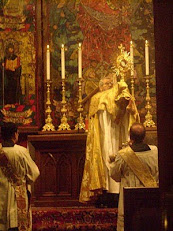
The first principle of the Ordinariate is then about Christian unity. St. Basil the Great, the Church’s greatest ecumenist, literally expended his life on the work of building bridges between orthodox brethren who shared a common faith, but who had become separated from one another in a Church badly fragmented by heresy and controversy. He taught that the work of Christian unity requires deliberate and ceaseless effort...St. Basil often talked with yearning about the archaia agape, the ancient love of the apostolic community, so rarely seen in the Church of his day. This love, he taught, is a visible sign that the Holy Spirit is indeed present and active, and it is absolutely essential for the health of the Church.

- Msgr. Jeffrey Steenson, Homily on the Occasion of his Formal Institution as Ordinary
Showing posts with label Holy Communion. Show all posts

Tuesday, December 23, 2014

Keep the Mass in Christmas


 "Whereas we not only use it as a nourishment spiritual, as that it is too, but as a mean also to renew as ‘covenant’ with God by virtue of that ‘sacrifice’ as the Psalmist speaketh."

Lancelot Andrews, a bishop in the regin of James I and VI, and the head of the team charged with the translation of the Scriptures into English now known as the Authorized Version or King James Version, was insistent that in the Lord's Supper we are not only nourished by a spiritual meal, but renew the covenant with God through the one Sacrifice of Christ.

And this is only fitting. In the seventh chapter of Leviticus we read "For the wave breast and the heave shoulder have I taken of the children of Israel from off the sacrifices of their peace offerings, and have given them unto Aaron the priest and unto his sons by a statute for ever from among the children of Israel;" and in many other places of the Old Testament it is clear that only the priests could eat of the sacrifices of the Tabernacle and Temple. Jesus confirms this in his dispute with the Pharisees when, in chapter 6 of Luke he asks them "Have you not read what David did when he was hungry, he and those who were with him: how he entered the house of God, and took and ate the bread of the Presence, which it is not lawful for any but the priests to eat, and also gave it to those with him?"

But we are assured in the first epistle of St. Peter that all of us who are baptized are "living stones...built into a spiritual house, to be a holy priesthood, to offer spiritual sacrifices acceptable to God through Jesus Christ." And our priesthood is seen, not in that we each offer the sacrifice, for even in the time of the Temple every priest did not offer the sacrifice, as only one at a time could do so, (and hence Zechariah was chosen by lot from among his section of the priesthood to offer the incense on the day he encounted the Archangel), but in that we eat of the Sacrifice.

The best way to keep Christ in Christmas, as others have noted, is to keep the Mass in Christmas. May all of our readers be blessed in the days to come when we remember the tender love of our Savior who came to dwell in humble surroundings that we might share in his glory.

Read, mark, learn and inwardly digest the wise words from the Anglican Patrimony in Bishop Andrewes' text from our Pentecost 2010 (Vol III, No. 2) issue: http://www.anglicanuse.org/AE_3_02_AngPatr-Andrewes_Sacrifice.pdf 


Thursday, June 17, 2010

Sr. Elaine, ASSP at the Anglican Use Conference

Sr. Elaine discussed the reception of her order into the Catholic Church last year, their ministries and current challenges. Her talk has been uploaded in 5 segments, the last of which has responses to questions.


Saturday, November 28, 2009

Communion as sign of unity in faith

Fr. Phillips details some correspondence he's had with an Anglican pastor, and the question of intercommunion that came up.

"...that they all may be one..."

I had a brief exchange of emails with an Anglican clergyman. His parish is, I think, part of the American group that's in a pastoral relationship with some of the Anglicans in Africa. I don't really understand all the connections, and I don't know who's in communion with whom, but he's a very nice man and a cleric who plainly loves Christ.

He had expressed some interest in attending the information day on Anglicanorum coetibus that we're having here on December 12th, and he mentioned that he'd like to stop in and meet me sometime soon. I let him know I'd be delighted to see him, and we exchanged some possible dates and times. One of my suggestions was a time right after a weekday Mass which is attended by the students in our parish school. "In fact," I said, "maybe you'd like to come to the Mass, and we can meet right afterwards." That sounded like a great idea to him, and I thought we were set.

Then I got another email. "Am I ok for Holy Communion?"

I knew what he was asking, and I wondered why he would even ask. "Sadly, no," I wrote back, "I'm a man under orders, as I know you understand."

His response? Here's what he wrote: "This is one of the things that stands in the way of real unity—the RCC treats other Christians as though they aren’t really Christians—denying them the Body and the Blood...

Read Fr. Phillips' response, another good exposition of Catholic ecclesiology reflected in the Church's practice of Holy Communion, at his blog Atonement Online.