The first principle of the Ordinariate is then about Christian unity. St. Basil the Great, the Church’s greatest ecumenist, literally expended his life on the work of building bridges between orthodox brethren who shared a common faith, but who had become separated from one another in a Church badly fragmented by heresy and controversy. He taught that the work of Christian unity requires deliberate and ceaseless effort...St. Basil often talked with yearning about the archaia agape, the ancient love of the apostolic community, so rarely seen in the Church of his day. This love, he taught, is a visible sign that the Holy Spirit is indeed present and active, and it is absolutely essential for the health of the Church.

- Msgr. Jeffrey Steenson, Homily on the Occasion of his Formal Institution as Ordinary
Showing posts with label Coverdale. Show all posts

Friday, May 31, 2013

The June issue of The Portal Magazine has been published online

The June issue of The Portal Magazine, the official monthly journal of the Ordinariate of Our Lady of Walsingham in the UK has been posted.

Always an interesting and enjoyable read, it contains a nice introduction to Miles Coverdale in its Anglican Luminaries column. Coverdale was a translator (from the Vulgate and the German Bible) of the Bible into English, and his version of the psalms continues to be the version used in the Book of Common Prayer (and The Customary of Our Lady of Walsingham) and in a slightly altered form, that of the Book of Divine Worship.

The final page has an interesting article on the likelihood of homosexual marriage being legislatively approved in the UK, noting that a first step to this was changing the definition of marriage from "the joining of one man with one woman, forsaking all others until death do us part”, by eliminiating the “till death do us part” (shelved with easy-to-get divorce). This legislation, like similar legislation passed by some U.S. states is now doing away with the “one man and one woman” bit as well. The article notes that "in order to facilitate this change, such concepts as adultery and consummation have, I believe, been abolished. This should give the game away, but no, the modernisers just carry on regardless."

Sunday, June 17, 2012

Oh, the Coverdale Psalter...

Another entry from Mr. Uher, and my commentary.
Everyone says they love the Coverdale Psalter, the grace of its language, its majestic tone. Most people have never used Coverdale's Psalter exactly as he wrote it, but rather we have worshipped with it via various recensions and twigglings over the years.

The American recension of 1928 is to my mind one of the very best. It does have single problems with the elimination of the word "Satan". A closer reading of the Vulgate and Septuaginta also has suggested worthy corrections.

Currently, the best version I have encountered is in The St. Dunstan's Plainsong Psalter published by Lancelot Andrewes Press -- a press of the Western Rite Orthodox who are also of the Anglican Patrimony, my friends. Frankly, I recommend the adoption of this Plainsong Psalter as it is. It is a wise revised edition of Canon Douglas' great Plainsong Psalter. It includes Sarum tones and other ancient British tones. Its version of the Coverdale Psalter restores some things got wrong in the American 1928 recension, and it makes other slight alterations that make the text sing doubly in the mouth of a worshipper.

This press, Lancelot Andrewes Press, is one of the reasons to cheer among the Anglican diaspora. They have brought Dr. Neale's commentary on the psalter back into print. Deo gratias! They have published a gorgeous Western Orthodox edition of The Book of Common Prayer. They have made Lancelot Andrewes great prayers available in a beautiful edition. And the version of the Rule of St. Benedict in Latin and English sold by them is the one I use...

Read the rest of Mr. Uher's post at Tonus Peregrinus

I want to second Mr. Uher's recommendation of the St. Dunstan Plainsong Psalter. I have been using this for my personal singing of the office for about 2 years now, and included it for illustration in my lectures on Gregorian and Anglican chant at the summer sessions at Thomas More College in 2010 and 2011. I have a hard cover version, but there is also a soft cover version (not a paperback) now available as well. The notes are also quite valuable.

In a future Office Book for the Ordinariates, it would be good if this noted psalter could be included.

In addition to the Coverdale Psalter, the SDPP also has several settings of the Benedictus, Te Deum, Magnificat, Nunc Dimmittis and other canticles appointed in the Prayer Book that can be used to good effect in a sung Office. See below for an example.


Friday, June 1, 2012

Mgr Andrew Burnham: The Customary of Our Lady of Walsingham

Friday, June 01, 2012


Mgr Andrew Burnham, Assistant to the Ordinary, writes in this month's Portal:
The Customary of Our Lady of Walsingham is to be published very soon now by Canterbury Press. In a month or two we shall have access to this very handsome publication. It will contain the Ordinariate’s own form of Morning and Evening Prayer, drawn from the Book of Common Prayer, together with the Litany, minor offices for use during the day, and a traditional order for Compline.
The Coverdale Psalter will be included, as will lectionary tables which closely follow the not as yet well-known, but superb, two-year sequence of Scripture readings devised for the daily Office of the Roman Breviary. There will also be the Ordinariate Calendar and, most notably, a rich anthology of post-biblical readings drawn from the riches of the British spiritual tradition. This anthology complements the Roman Divine Office as well as the Ordinariate Office, for it will be possible to use many of the post-biblical readings for the Office of Readings.

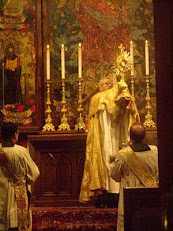
Evensong and Benediction
Some will find themselves using the different Office books for different purposes – one for individual prayer and devotion, the other for public worship. Those who want to use the Roman Office books in the morning and the Customary in the evening – or the other way round – will be able to do so without too much difficulty. The particular value of the Customary is that it makes available one of the acknowledged treasures of the Anglican tradition – the public celebration of the Office, and in particular of Evensong. The reform of the Roman Office following the Second Vatican Council sought the development of the public celebration of the Office and, truth to tell, that is a reform yet to be realised. In these early days of the Ordinariates, there have been already many celebrations of Evensong and Benediction and it is intriguing to know not only that this has been in accordance with the Holy Father, Pope Benedict’s wish, but also that it has been his great pleasure, that this should have been so.

Traditional language
It is hoped that the Customary will be ecumenically helpful too. There has been a deliberate decision by the Holy See that the Ordinariate’s distinct Use should be predominantly in traditional language. This is not to criticise in any way the modern language translations and compositions of recent Anglican revisions. Rather it is a recognition of the value of the sacral language of the Prayer Book. Members of the Ordinariates in North America and Australia are great devotees of Prayer Book English. Moreover, the 400th anniversary of the 1611 Authorised Version of the Bible (AV) – and the immense popularity still of cathedral Evensong – shows that the British public too are aware of the beauty and importance of a traditional sacred dialect. It is that dialect which the Customary and the Revised Standard Version (RSV) of the Bible preserve and make available.

‘Common Bible’
Why the RSV and not the King James Bible? The answer lies in the subtle development of the English Bible tradition. For accuracy’s sake, twentieth century students began to rely on the Revised Version of 1881-1894. Meanwhile the Revised Standard Version of 1946-1957 was becoming established and, in 1966, was accepted by Catholics and Protestants as a ‘Common Bible’. It was the first truly ecumenical Bible and brought together the two traditions – the Catholic Douay-Rheims Bible and the Protestant Authorised Version. Thus, whenever the Customary quotes extensively from the Bible, it is the RSV that it uses. The Catholic Church in the 1970s in Britain opted (mistakenly as it now seems) for the ‘dynamic equivalent’ Jerusalem Bible translation. That version greatly helped public understanding of the Scriptures, but, like the Mass translation of the same period, was based on a theory of translation that is of great value in paraphrasing and communicating the meaning of, for example, modern literature written in other languages, but no longer thought appropriate for representing sacred texts written in ancient languages.
Our prayer is that the Customary will be a treasury not only for the Ordinariates but for the whole English-speaking world.
__
The Customary of Our Lady of Walsingham is available to 'pre-order' from Amazon.co.uk here.

Friday, May 11, 2012

How the Ordinariate is healing England’s cultural wounds

Four hundred years after the bitter conflicts of religion, the Church is posthumously reCatholicising Archbishop Cranmer and reclaiming him for our tradition
By FR ALEXANDER LUCIE-SMITH on Friday, 11 May 2012


Yesterday I was in a cathedral city in the south of England, and having time to spare, and because it was raining, I decided to visit the cathedral and stay for Evensong. I am, like so many in this country, familiar with Evensong; I find it both beautiful and alien at the same time. I both love it and hate it. I only go to Evensong to listen to it, never to take part.
...

Thus the experience of Cranmerian English leaves me feeling conflicted. I love it and I hate it, and I feel I ought to love it, as it is so beautiful, and because it has inspired so many of our great poets, not least among whom is T.S. Eliot.

That’s why I am profoundly pleased by something that happened earlier that day in London. I attended a meeting about the Ordinariate of Our Lady of Walsingham, at which Mgr Burnham, the assistant to the Ordinary, told the assembled guests that a Customary is in preparation.  This is essentially what we might call an office book, with various readings drawn from the English spiritual tradition, such as Newman’s writings from his Anglican days; but it also draws on those fine psalms and prayers used by Cranmer, with some doctrinal alterations. Mgr Burnham also spoke of the growing popularity of Evensong and Benediction amidst Ordinariate congregations.

What this Customary will do, it seems to me, is posthumously reCatholicise Cranmer and reclaim him for our tradition; it will make the Cranmerian liturgy, which I find a cause of division and conflict, into something that will bring about unity. It will mean that from now on, I need not find Evensong alien. Perhaps Dr Cranmer himself would approve. I hope so! It certainly promotes the healing of a cultural and religious wound.
The Ordinariate, which I greatly welcome, is already enriching us in many ways. Long may it continue to grow and flourish.

Read the whole article in the Catholic Herald.